Your 50-Megapixel Camera Doesn't Make You a Photographer
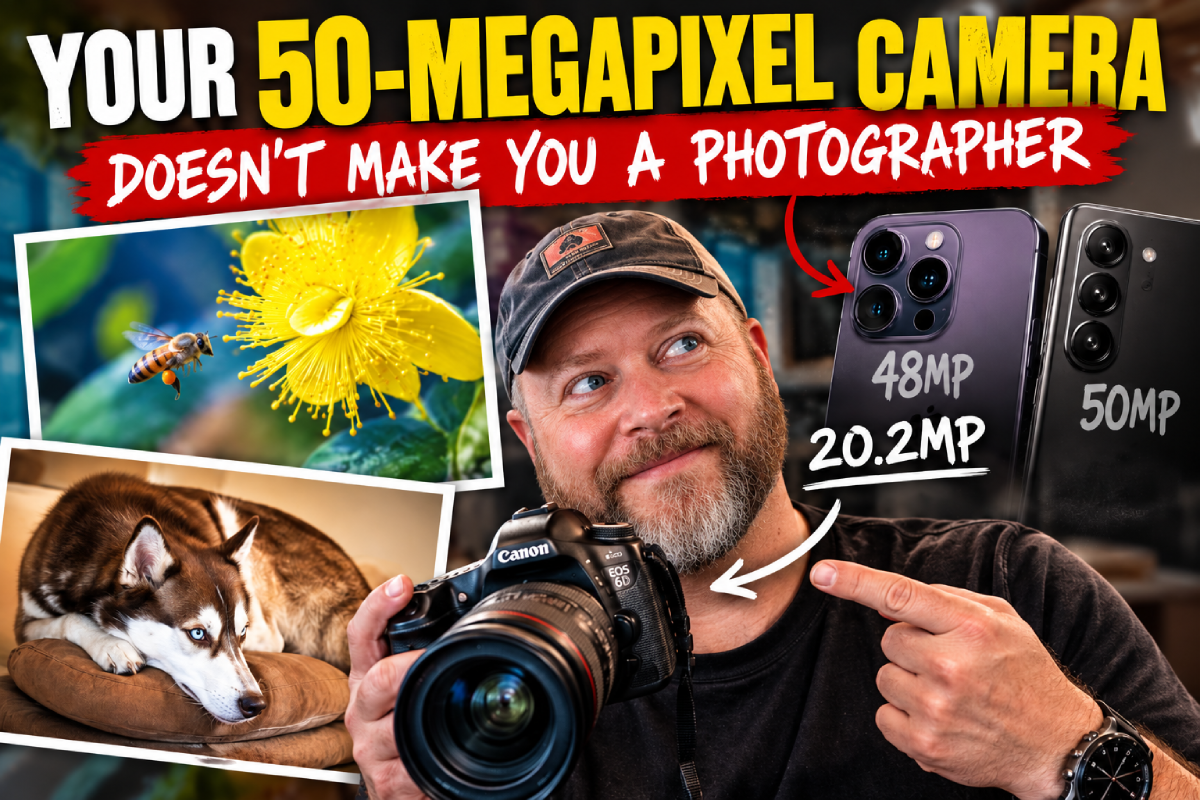
Every time a new phone comes out, somebody inevitably starts waving the megapixel count around like they just pulled a ruler out in the middle of a locker room.
“Mine has 50 megapixels.”
Oh. Well. La-di-fucking-da.
I’m an iPhone guy, and I’m looking at the iPhone Duo, which has a 48-megapixel camera. One of my Android buddies, who regards Apple products with roughly the same affection normally reserved for untreated hemorrhoids, immediately pointed out that his Galaxy Z Fold has a 50-megapixel camera.
Congratulations, I guess. You have two more megapixels. Maybe now we can finally capture the individual pores on your forehead while you take a selfie sitting in your truck.
This whole megapixel arms race has always amused me because megapixels are not meaningless, exactly, but the way we talk about them damn near is. Megapixels tell you how many pixels are in the image, which is useful information if you’re cropping the hell out of something, printing a photograph the size of a garage door, or doing something else where resolution genuinely matters. What they absolutely do not tell you is whether the photograph is going to be any damned good.
I have an old Canon EOS 6D that came out in 2012. By modern phone-marketing standards, this thing should apparently be carved from stone and powered by a little man turning a crank inside it, because it has a whopping 20.2 megapixels.
Twenty.
Not 48. Not 50. Not 100 or 200 or whatever absurd number we’re eventually going to reach before somebody realizes nobody needs a photograph of their cheeseburger with enough resolution to identify the cow from which it came.
And here’s the problem: that old 20-megapixel Canon takes fucking beautiful photographs.
I’m not even particularly good at photography. I enjoy it, I understand some of the basics, and occasionally I manage to point the camera in approximately the correct direction while pressing the correct button. Nobody is calling National Geographic asking where I’ve been hiding. Yet even with my extremely average photographic abilities, that old Canon has produced pictures that I still look at years later and think, damn, that came out nice.
For example, I took this:

That’s a bee in flight approaching a flower. I managed to catch the little bastard in midair, the flower is beautifully detailed, the bee is reasonably sharp, and everything behind them melts away into this gorgeous soft background. There isn’t some AI algorithm trying to figure out which parts of the photograph should be blurry after the fact. That’s a full-frame sensor, a proper lens, depth of field, light, focus, and probably a healthy dose of dumb luck on the part of the idiot holding the camera.
Then there’s this one:

That’s Meeko, my short-haired Alaskan Klee Kai, doing what earned him the nickname “cat dog” by curling himself up on top of the back of our couch like apparently furniture seats were beneath him. His eye is sharp, his face has wonderful detail, the background drops away naturally, and there is a warmth and depth to that photograph that I have always loved.
And yes, I’m using more than one picture of Meeko here. He was a good boy and he deserves the extra screen time.
Here’s another:

Same dog. Same ancient 20.2-megapixel camera. Completely different setting, completely different photograph, and again there is absolutely nothing about that image sitting there begging for another 30 million pixels. His eyes are sharp, the snow gives the shot texture, the background falls away nicely, and the entire thing works because the camera, lens, subject, light, focus, and timing all came together.
Again: 20.2 megapixels.
This is why I roll my eyes when somebody tells me their phone camera is better because it has more megapixels. That’s like telling me your car is better because the speedometer goes to 180. Okay, but what engine is in it? What suspension? What tires? Can the damn thing actually do 180, and more importantly, do you have any idea what you’re doing once it gets there?
A camera is a system. Sensor size matters. The quality of the sensor matters. The lens matters enormously. Aperture matters. Focal length matters. Stabilization matters. Autofocus matters. Light matters. Image processing matters. And, inconveniently for those of us who would prefer to solve everything by buying more expensive equipment, the person taking the photograph matters too.
Phones have become astonishingly good at compensating for that last part. Modern phones are basically little photography robots. You press the button and the phone immediately starts performing computational witchcraft, combining exposures, correcting colors, balancing shadows, sharpening details, reducing noise, recognizing faces, and occasionally creating the depth-of-field effect that a real camera achieved because physics actually made the background blurry.
That’s fantastic. I love it. I carry my phone everywhere and take vastly more photographs with it than I ever take with my Canon because the best camera is still the camera you actually have with you.
But convenience isn’t the same thing as photographic superiority, and a bigger number printed on the spec sheet sure as hell isn’t either.
There are reasons I might want 48 or 50 megapixels. Having extra resolution gives me more freedom to crop. It can preserve additional detail under the right conditions. There are legitimate engineering reasons manufacturers use these enormous sensors and then combine pixels together for normal photographs. I’m not claiming megapixels are some giant fraud invented by Big Camera in a smoke-filled room somewhere.
I’m saying that once you’ve got enough resolution for what you’re doing, piling on more megapixels rapidly becomes a dick-measuring contest for spec sheets.
You do not need 50 megapixels to take a selfie.
You certainly don’t need 50 megapixels to take a picture of your dinner, your dog sleeping upside down, the sunset you’re going to completely fail to capture the majesty of, or the concert you’re watching through a six-inch screen instead of with your actual eyeballs.
And if my mediocre ass can take those photographs above with a 20.2-megapixel camera from 2012, maybe we can finally stop pretending that the person with the largest megapixel number automatically has the best camera.
Because if you suck at photography, 50 megapixels doesn’t fix that.
It just gives you a much larger file of your shitty photograph.