Be a Man. Just Don't Act Human.
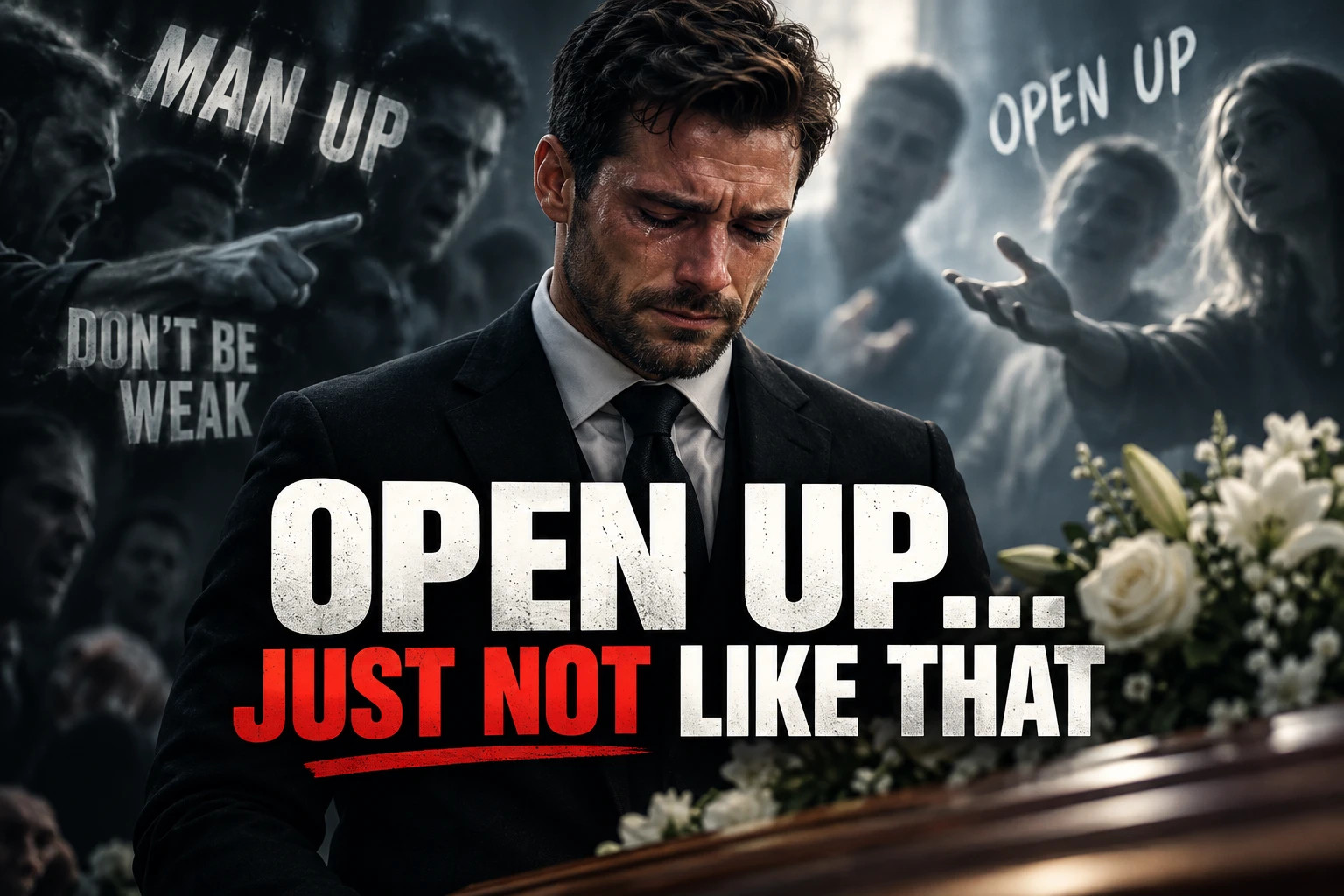
Society tells men to open up, then shames them the moment they do. A man crying at his grandmother's funeral isn't weak. He's a human being.
Men and women are different, that’s for damn sure, and that’s perfectly fine, because we were never supposed to be identical. But somewhere along the way society seems to have decided that equality means spending an enormous amount of time discussing women’s needs while men’s needs get treated as something we’re supposed to quietly deal with on our own.
I recently saw a post from a woman who said she got “the ick” when her boyfriend started crying at his grandmother’s funeral. Let that sink in for a moment. The man had lost his grandmother, someone he loved, and he was standing at her funeral grieving. Instead of seeing a human being in genuine sadness, his girlfriend apparently found him less attractive. What the actual fuck?
I’m not going to name her. I don’t believe in publicly humiliating somebody just because they said something stupid. But notice what I’m doing there: even while I’m talking about how casually a man’s grief got dismissed, I’m making a conscious effort to protect the feelings of the woman who dismissed it. That brings me to something I’ve been thinking about for a long time, which is that society demands men be emotionally available while simultaneously punishing them for showing emotional vulnerability.
Before anyone gets defensive, this isn’t just something women do. Other men are every bit as guilty, and we’ve all heard it: man up, grow a pair, stop being a pussy, nobody wants to hear you whining.
Between us we’ve created this bizarre, razor-thin line men are expected to walk. Be strong, but not intimidating; sensitive, but not weak; confident without being arrogant, protective without being controlling, emotionally available but never emotionally needy. Provide, but don’t expect appreciation for it. Be masculine, just not toxic, and for God’s sake don’t turn into one of those pathetic “beta males.” Being a man apparently means balancing on a tightrope strung between toxic masculinity and pathetic weakness while everyone standing below complains that you’re doing it wrong.
Nobody taught us the other half
Something else bothers me. For generations boys have been taught how to treat women: respect them, protect them, provide for your family, open doors, buy flowers, be a gentleman, never hit a woman, put her needs ahead of your own. And honestly, most of that is perfectly good advice.
But how much time have we spent teaching women how to treat men? I don’t mean how to attract a man, or how to get one to commit, or what standards he has to meet before he counts as husband material. I mean how to actually treat him: how to support him when he’s struggling, how to recognize when he’s overwhelmed, how to make him feel appreciated, desired, respected, and loved for something other than what he provides.
Women are certainly taught to nurture others, and plenty of women are wonderful partners, so that’s not the argument. The question is whether we’ve built a culture where a man’s emotional needs count as equally important, because in far too many relationships one person is doing all the giving and the other is doing all the receiving.
I’ve always believed a relationship should be an 80/20 proposition, where both people are trying to be the one giving 80%. (Yes, mathematically that makes no sense. Fortunately, marriage isn’t an accounting exercise.) The point is that if both of you are constantly trying to give more than you take, nobody has to keep score, and you both end up feeling supported, appreciated, and loved. When one person spends years giving 80% while the other figures that showing up counts as their contribution, though, resentment is inevitable. I suspect that imbalance is behind an awful lot of failed marriages. I can’t tell you what percentage of divorces it explains, but I have a hard time believing it doesn’t matter.
When men suffer, we look the other way
This isn’t just about hurt feelings, either. In 2024, nearly 39,000 American men died by suicide, and almost 80% of all suicide deaths in this country were men. That’s not a typo. According to the CDC’s 2023–2024 survey, approximately 20.7 million American men have experienced physical violence, contact sexual violence, or stalking from an intimate partner during their lifetime.
So what happens when a man admits his wife or girlfriend is abusing him? Sometimes he gets laughed at, or told to toughen up, or asked what he did to deserve it. And sometimes he doesn’t bother telling anybody, because he already knows how that conversation’s going to go.
A 2025 research review identified just two domestic violence shelters in the United States dedicated exclusively to men. TWO! Other domestic violence programs can and do help male victims, but the shortage of male-specific resources raises legitimate questions about whether we’re meeting their needs, especially when you compare it with how seriously we (rightly) take violence against women. Before someone twists that into something ridiculous, let me be perfectly clear that women’s suffering matters, and having good women’s shelters available to protect women from violence is a good thing. I just don’t understand when caring about women started to require that we stop caring about men.
Even our definition of rape has a blind spot
This one genuinely surprised me when I started looking into it. A 2014 peer-reviewed study examining federal sexual violence statistics found that one CDC survey estimated approximately 1.27 million women had experienced rape during a 12-month period. During that same period, approximately 1.27 million men reported being made to penetrate someone else against their will.
Read those two descriptions again. When a woman is forcibly penetrated against her will, the CDC calls it rape, and when a man is forced to penetrate someone else against his will, the CDC calls it “made to penetrate.” Not rape, made to penetrate.
Somebody’s going to rush to correct me, so yes, the CDC recognizes both as forms of sexual violence, and men who are forcibly penetrated are also counted as rape victims. But men forced to penetrate someone else land in a separate statistical category, which means even the fucking terminology treats the two experiences differently. One gets a word everybody immediately recognizes as a horrific crime, and the other gets a bureaucratic description that sounds like somebody came up with it while filling out an insurance form.
In both cases a person was forced into sexual activity against their will, had their bodily autonomy violated, and went through something nobody should ever have to experience. Apparently we still need different labels depending on which direction the penetration happened.
It gets worse. In some states the distinction isn’t buried in a federal survey at all, because it’s written straight into criminal law. Georgia’s rape statute, for example, explicitly describes a female victim, so under that statute a male victim cannot be the victim of the specific crime legally classified as rape. It’s right there in the law. Now, Georgia has other sexual assault statutes that can protect male victims, and I’m not suggesting someone can sexually assault a man there without committing a crime. What I’m asking is why a man can suffer a violent sexual assault and the law has to reach for a different label. Even here in North Carolina, the legal definition of forcible rape centers on vaginal intercourse, with other nonconsensual sexual acts handled under separate offenses, including forcible sexual offenses.
Some states have modernized their laws with broader, more inclusive definitions. Good, that’s exactly what should happen. But how did we get to the point where we have to argue that forcing a man into sex against his will deserves the same recognition as forcing a woman?
To be fair about the numbers, the more recent data don’t establish equal overall rates of rape victimization, and women report higher lifetime rates under the CDC’s rape definition. What that older comparison does show is why definitions matter. Define two experiences differently and you can end up with statistics that make one group of victims look far less common than it actually is, and then people point to those statistics as proof that men don’t experience the same problems. Well, no shit. If you don’t count them in the same category, they’re not going to show up in the same numbers.
Then there’s prison. The Bureau of Justice Statistics found that 4.1% of adult prison inmates reported sexual victimization in its 2023–2024 survey. Female inmates reported higher rates of assault by other inmates, but because the prison population is overwhelmingly male, the number of male victims is still a serious concern. And yet prison rape remains something people routinely joke about, as if we’ve all agreed that sexual assault is one of the worst things imaginable unless it happens to a man behind bars, at which point it’s comedy material. How the hell did that become acceptable?
Flowers at your funeral
I saw a saying recently that stuck with me: “The first time most men receive flowers is at their funeral.” I don’t know whether that’s statistically true, but I suspect an awful lot of men recognize themselves in it.
Men spend their lives buying flowers, planning anniversaries, fixing things, paying bills, solving problems, and trying to make the people they love happy. What they want back is sometimes incredibly simple. A compliment would do it, or a thank-you, or an unexpected hug, or someone asking how they’re doing who actually wants to hear the answer. Maybe even some damn flowers, and not because they accomplished something or because it’s Father’s Day or their birthday, but just because somebody thought about them. Being useful to people and being loved by them are two different things, and I’d guess an awful lot of men couldn’t tell you for sure which of the two they’ve been getting. That’s what makes it so sad to picture a man who spent his entire life being useful to everyone around him, finally getting his first completely unnecessary gesture of affection once he’s dead.
We’re people too
I understand why men’s advocacy movements are attracting attention. When people feel nobody is listening, they’ll eventually drift toward whoever claims to hear them. That doesn’t mean every men’s rights organization has the answers; some of them have terrible ideas, just like some organizations advocating for women do. But dismissing men’s concerns because you don’t like who’s raising them is a pretty effective way to make sure they never get addressed.
None of this is about declaring one sex the victim and the other the villain. Men can be shitty partners, and so can women, and men reinforce these ridiculous masculine expectations just as much as women sometimes do. It’s a cultural problem, and it’s going to take both sexes to fix it.
We need to raise boys who understand how to treat women, absolutely, but we also need to raise girls who understand how to treat men, and teach both of them that a relationship is a partnership, not a transaction where one person provides and the other collects benefits. We also need to stop confusing emotional strength with emotional silence. A man crying at his grandmother’s funeral isn’t weak, a man who admits he’s overwhelmed isn’t pathetic, and asking his partner for emotional support doesn’t suddenly make him less masculine. He’s a human being, for fuck’s sake.
I’m not asking society to stop caring about women. I’m asking it to actually care about men. We have feelings and fears and emotional needs, and we go through abuse, depression, loneliness, rejection, and heartbreak. We’re tired of being told to open up by the same culture that tells us to shut up the moment we do. If you want men to be emotionally available, you have to make it safe for them to be emotionally honest. There’s a difference between being strong enough to carry the weight of the world and being expected to carry it alone, and sometimes even the strongest man in the room needs someone to give a damn about him.


Letters to the Editor
Agree, disagree, or set me straight. The comments are open.