Thank God for the First Amendment. Britain Just Reminded Us Why.
A 15-year-old in England got four cops, a DNA swab and a jail cell for mocking a politician on Facebook. Thank God for the First Amendment.
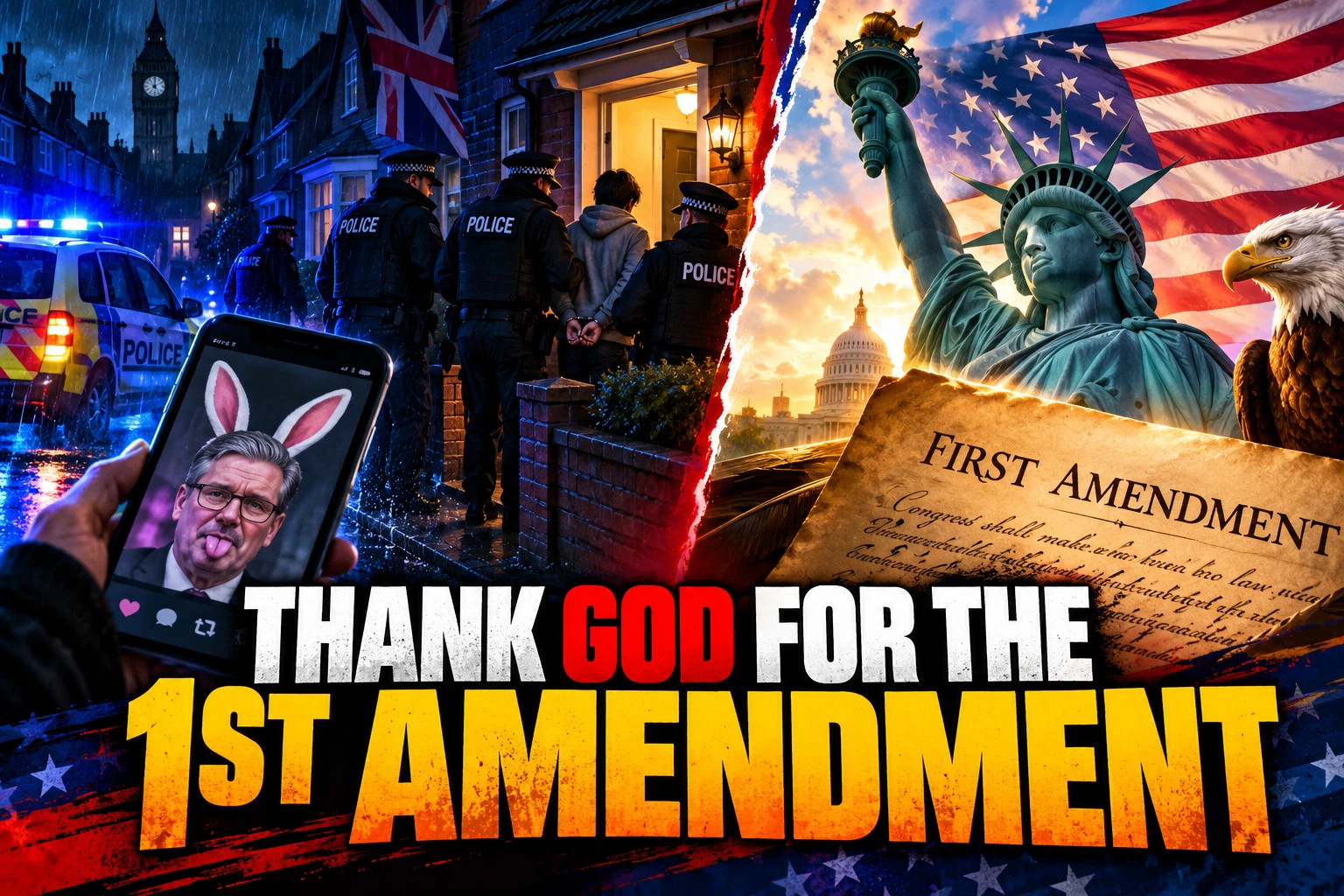
Say you’re 15 years old and sound asleep in your bed when four police officers turn up at your house, two police cars, uniforms, the whole production. They arrest you, search you in front of your neighbors and haul you off to a police station, where you’re fingerprinted, photographed, swabbed for DNA and tossed into a cell.
And the horrible crime you committed? You made fun of a politician on Facebook.
Welcome to the United Kingdom, where hurting a politician’s feelings can apparently earn you the full criminal justice experience, and where people wonder why I love the First Amendment.
Four cops, one kid, and a Facebook post
The kid’s name is Fraser. In August 2026 the 15-year-old, a Reform UK supporter, was arrested after posting criticism of Conservative councillor Simon Bennett, whom he’d gone after for dressing unprofessionally at council meetings. Fraser joked that Bennett looked like a “rent boy.” He even posted an AI-generated image of the man with rabbit ears.
Rabbit ears, people. That’s it. Honestly, that’s about as anodyne as mocking someone could get, and yet somewhere in the United Kingdom an elected official looked at a picture of himself as a bunny rabbit and decided this was a matter for law enforcement. Bennett complained to police, arguing that the repeated posts amounted to harassment and calling the remark homophobic (gay rabbits? I’m confused…). The police then looked into potential harassment, malicious communications, and even a possible hate crime.
Now, I’ll concede something. Politicians shouldn’t have to tolerate credible threats, stalking, or genuine harassment, and neither should anyone else. The full circumstances of a harassment investigation matter. If something is life-threatening, by all means take action.
But rabbit ears? Insulting a politician is not the same thing as threatening one, and when a teenager mocks an elected official and gets four police officers, a DNA swab, confiscated electronics and restrictions on attending public council meetings in return, I think it’s fair to ask whether anyone involved understands the concept of proportionality. At the time of the October reporting, Fraser was still waiting to find out whether he’d be charged, all over some political Facebook posts.
It’s not one ridiculous incident
According to a 2026 investigation by the British civil liberties group Big Brother Watch, 62,199 people were arrested for communications offenses in the UK between 2021 and 2025, and more than 12,000 were convicted.
To be fair, those numbers include communications involving potentially serious offenses, so they aren’t 62,000 people arrested exclusively for telling jokes or criticizing politicians. What they do show is worth looking at: Britain has laws broad enough to criminalize communications judged “grossly offensive.” What the hell does that even mean? Offensive to whom, by whose standards, and who gets to decide when an insulting comment turns into a crime? Can it literally be offensive to anyone?
Yes, Britain has legal protections for freedom of expression, and its own prosecution guidelines say outright that rude, satirical, and unpopular opinions deserve protection. That’s exactly the problem. You can have freedom of expression written into your laws and still have police treating citizens like criminals for using it, and a right you can only exercise after surviving an arrest, hiring a lawyer and maybe fighting the government isn’t nearly as comforting as the government would like you to believe.
America already settled this argument
Back in 1988 the United States Supreme Court decided Hustler Magazine v. Falwell. The magazine had published an absolutely outrageous parody of televangelist Jerry Falwell implying he’d engaged in drunken incest with his mother in an outhouse (seriously, that was the joke). Falwell sued, the case made it all the way up, and the Court protected the parody under the First Amendment, because public figures don’t get to use the legal system to punish satire just for being offensive or humiliating.
Think about that comparison for a second. Here, a publication could make that kind of disgusting joke about a prominent public figure and get constitutional protection for it, while over there a teenager puts rabbit ears on a local politician and suddenly we’re collecting DNA. That’s an extraordinary difference in how two democracies treat political expression.
American free speech isn’t unlimited, obviously; credible threats, certain kinds of harassment and defamation can all carry legal consequences. Merely offending someone, though, especially a government official, isn’t supposed to be a crime.
The First Amendment is not a courtesy policy
What bothers me most is that somewhere along the way people started acting as if freedom of speech only exists to protect speech that’s polite, respectful, compassionate, and approved by whatever social standards happen to be fashionable this week.
Bullshit. Nobody needs constitutional protection to compliment a politician or praise the government or repeat an opinion everybody already agrees with. You need it when you’re angry or unpopular, when you’re mocking someone powerful, when your opinion makes other people uncomfortable, and most of all when the person you’re criticizing has the power to send the police to your door.
I’m not arguing America is perfect. We’ve got plenty of politicians, bureaucrats and self-appointed guardians of acceptable thought who would love to decide what the rest of us are allowed to say. The difference is that there’s a constitutional protection standing in their way, and every time I read another story like Fraser’s I’m reminded how precious that is.
The First Amendment was written to protect the people from the government, not the other way around. Once the government gets to decide which criticism is acceptable and which is criminal, free speech stops being a right and becomes a privilege, and privileges can be revoked. So thank God for the First Amendment, and God help us if we ever forget why we needed it.

Letters to the Editor
Agree, disagree, or set me straight. The comments are open.