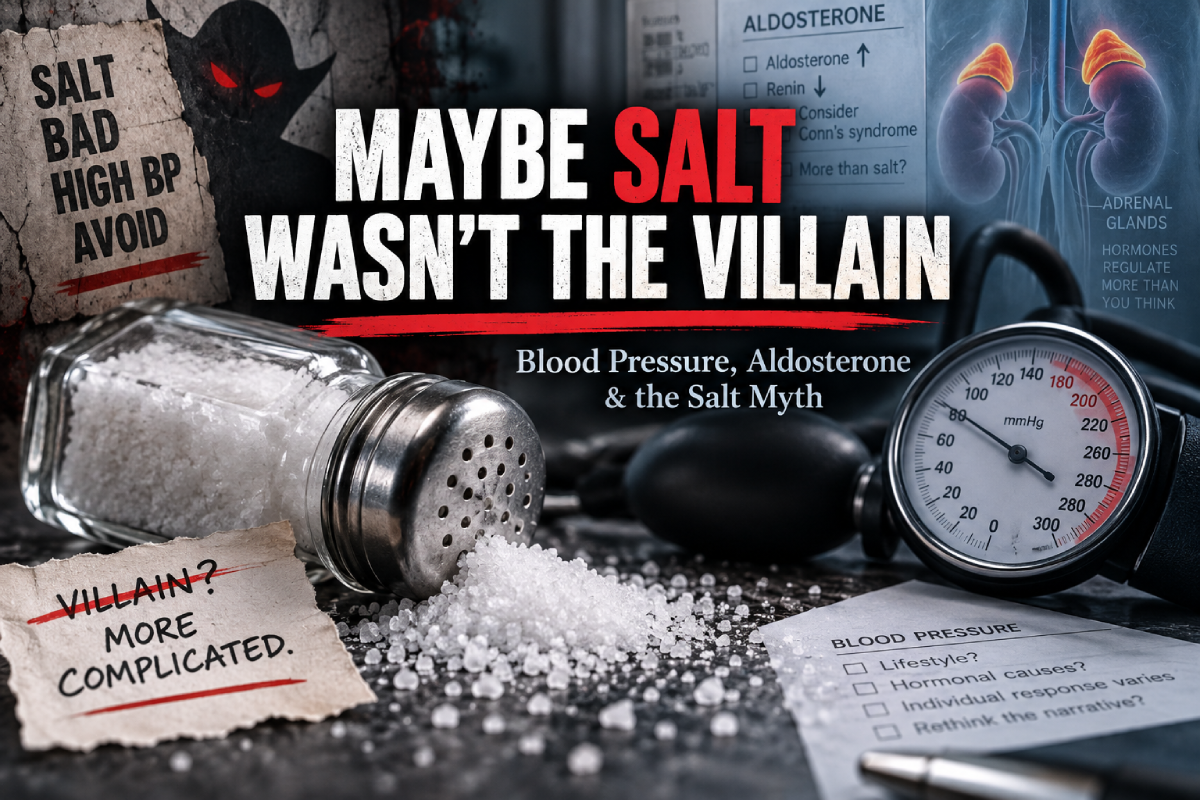
This whole thing started because of something completely unrelated to writing an article about salt.
I have primary hyperaldosteronism — Conn’s syndrome.
In very simplified terms, my body produces too much aldosterone, a hormone that tells the kidneys to hang onto sodium and water while getting rid of potassium. One of the predictable results is high blood pressure.
So naturally, I started digging into the relationship between aldosterone, sodium, potassium and hypertension.
And somewhere along the way I found myself asking a much bigger question:
Wait a minute. How bad is salt actually?
Because for most of my life, salt has occupied roughly the same nutritional category as cigarettes.
High blood pressure? Cut the salt.
Heart problems? Cut the salt.
Getting older? Cut the salt.
Somebody at the next table even looks hypertensive? For the love of God, hide the salt shaker.
It has become one of those pieces of medical advice that is repeated so routinely that almost nobody bothers asking the next question anymore:
How strong is the evidence, exactly?
And the more I started digging into this — initially just trying to understand my own weird endocrine plumbing — the more I discovered that the actual science is considerably more complicated than the little morality play we have constructed around sodium.
And before somebody gets angry and starts furiously typing that sodium affects blood pressure, yes.
It does.
That’s not really in dispute.
Eat a bunch of sodium and your body retains additional water to maintain the proper concentration of sodium in the blood. More fluid circulating through the vascular system can raise blood pressure. Reduce sodium and, on average, blood pressure falls.
Fine.
But here’s where things start getting interesting.
A large 2020 meta-analysis of 133 randomized trials found that reducing sodium lowered systolic blood pressure by about 4.3 mmHg and diastolic pressure by about 2.1 mmHg on average. The effect was larger in older people, people who started with higher blood pressure, and some other populations.
That’s real.
But it also isn’t exactly the nutritional equivalent of discovering penicillin.
An earlier systematic review found about a 1.4 mmHg systolic reduction in people without hypertension, versus about 4 mmHg in people with hypertension. A 2020 Cochrane review likewise found that, in white participants with normal blood pressure, reducing sodium from roughly 203 mmol to 65 mmol per day lowered systolic pressure by only about 1.1 mmHg, while the effect was considerably larger in people who actually had hypertension.
And that distinction seems pretty damn important.
Because somehow we went from:
Excessive sodium can meaningfully raise blood pressure in some people.
to:
Salt is bad for humans.
Those are not the same statement.
Your body actually needs this stuff
Salt isn’t some weird industrial contaminant humans started eating because Big Salt developed an especially persuasive marketing department.
Sodium and chloride are essential nutrients.
Sodium is involved in nerve impulses, muscle contraction, fluid regulation and maintaining blood volume. Chloride is equally important, including in the production of hydrochloric acid in the stomach. At the cellular level, gastric acid production literally depends on chloride transport through the parietal cells of the stomach.
Dr. Joel Wallach makes this point rather dramatically, arguing that we’ve spent decades treating an essential nutrient almost like a poison.
Now, Wallach goes considerably further than I’m willing to go. I can’t find convincing evidence that ordinary salt restriction is causing celiac disease, for example, and some of his other claims are dramatically overstated.
But the basic physiological point is completely legitimate:
Your body isn’t trying to get rid of sodium because sodium is toxic. Your body is carefully regulating sodium because sodium is necessary.
And when you significantly reduce it, the body notices.
Here’s the part nobody tells you about
When sodium intake falls dramatically, your body doesn’t simply shrug and say, “Fantastic. My cardiologist will be thrilled.”
It responds.
Renin goes up.
Aldosterone goes up.
Noradrenaline goes up.
Adrenaline can go up.
And this was particularly fascinating to me because aldosterone is the entire reason I started looking into this in the first place.
With Conn’s syndrome, my aldosterone system is already misbehaving. So suddenly I wasn’t just thinking about sodium as something that makes blood pressure go up. I was looking at the entire regulatory system surrounding it — sodium, potassium, renin, aldosterone, blood volume and vascular resistance — and realizing that the relationship is a hell of a lot more complicated than salt goes in, blood pressure goes up.
These hormonal responses aren’t fringe claims from somebody selling Himalayan salt lamps on YouTube. They’re measurable physiological responses that have been documented repeatedly.
The 2020 Cochrane review of 195 studies found that sodium reduction increased renin, aldosterone, noradrenaline and adrenaline. It also found small increases in cholesterol and triglycerides.
That doesn’t automatically mean reducing sodium is harmful. Biology is complicated, and you cannot look at one biomarker and declare victory.
But apparently we can look at blood pressure alone and declare victory?
That’s the part that bothers me.
We have spent decades treating the blood-pressure effect of sodium as though it exists in isolation, while the body is simultaneously activating an entire hormonal system designed specifically to compensate for the sodium reduction.
And then there’s insulin.
Now it gets really interesting
Dr. Benjamin Bikman argues that one of the overlooked consequences of aggressive salt restriction may be insulin resistance.
When I first heard that, I assumed it would turn out to be one of those internet claims where “studies show” translates into “a guy fed twelve rats something weird in 1987.”
Except there actually is human research supporting it.
Researchers from Brigham and Women’s Hospital and Harvard Medical School studied 152 healthy men and women under controlled sodium conditions. Participants spent seven days on a very low-sodium diet and seven days on a high-sodium diet.
Their insulin resistance was significantly higher during the low-sodium period.
The researchers also found substantially higher aldosterone and increased norepinephrine during sodium restriction. Their conclusion was straightforward: a low-salt diet was associated with increased insulin resistance, although they appropriately said the long-term consequences required further investigation.
Other experiments have reported similar effects. One found that even moderate salt restriction worsened measures of systemic and vascular insulin resistance.
Now, before we run off in the opposite direction and start licking salt blocks like livestock, there are also studies that didn’t find this effect. One randomized crossover study of healthy men found moderate sodium restriction did not significantly alter insulin resistance.
Perfect.
That’s science.
Conflicting findings should make us more cautious, not less.
But it certainly makes the simplistic instruction to “eat as little salt as possible” considerably harder to defend.
And then there’s the really awkward data
If less sodium is always better, cardiovascular outcomes should follow a fairly simple pattern.
High sodium: bad.
Moderate sodium: better.
Low sodium: best.
Except some very large studies haven’t found that.
One of the most famous was the international PURE study published in the New England Journal of Medicine. Researchers studied more than 100,000 people across 17 countries.
They found the lowest rates of death and major cardiovascular events among people whose estimated sodium excretion was roughly 3 to 6 grams per day.
Above that range, risk increased.
But below about 3 grams per day, risk increased too.
In other words, the graph looked like a J.
Too much appeared associated with increased risk.
But so did too little.
And yes, there is an important argument about this study. Sodium intake was estimated from morning urine samples rather than repeated 24-hour collections, and critics have argued that this methodology can misclassify people’s true sodium intake.
Those criticisms are legitimate.
So PURE doesn’t “prove” low sodium kills people.
But it does raise a question we should probably be willing to ask:
What if the relationship isn’t linear?
What if sodium behaves like countless other things in human biology, where deficiency is bad, excess is bad, and there is some broad middle range where the body functions reasonably well?
That would hardly be shocking.
Water works that way.
Potassium works that way.
Blood glucose works that way.
Body temperature works that way.
Oxygen works that way.
Yet somehow with sodium we arrived at this bizarre cultural assumption that the ideal amount must always be less.
Salt sensitivity also changes the entire conversation
There’s another problem with universal advice: people don’t respond to sodium equally.
Salt sensitivity is a real and reproducible phenomenon. Older adults, people with hypertension and people with certain metabolic, endocrine or kidney conditions can respond much more dramatically to sodium than others.
I am a particularly good example of why this matters.
If you have Conn’s syndrome, the entire hormonal system regulating sodium is abnormal to begin with. It would be ridiculous for me to assume that my response to salt necessarily tells you anything about the response of a healthy 25-year-old with completely normal aldosterone regulation.
And the opposite is equally true.
Two people can eat the same amount of sodium and have substantially different blood-pressure responses.
That alone should make us suspicious of one-size-fits-all advice.
If your blood pressure falls dramatically when you reduce sodium, congratulations — we have learned something useful about you.
That does not automatically mean everyone else should live on unsalted chicken breasts.
And yes, DASH really did show a sodium effect
There’s one part of Bikman’s argument I don’t think holds up completely.
He suggests that the famous DASH diet may have lowered blood pressure mostly because people improved the rest of their diets rather than because they ate less sodium.
That would be a plausible criticism of the original DASH experiment.
But researchers later did the DASH-Sodium trial, and this one controlled sodium independently.
More than 400 participants were assigned either a typical American-style diet or DASH and then given high, intermediate and low sodium levels in randomized sequence.
Blood pressure fell as sodium was reduced even when the underlying diet stayed the same.
So yes: sodium itself really does affect blood pressure.
I’m not interested in replacing one nutritional fairy tale with another.
Salt isn’t magic.
Eating enormous quantities of it isn’t healthy simply because decades of anti-salt messaging may have been overly simplistic.
The interesting question is whether we’ve confused “excess sodium can be harmful” with “sodium is harmful.”
And those are profoundly different ideas.
Yet the recommendation remains remarkably aggressive
The American Heart Association recommends no more than 2,300 mg of sodium per day and describes 1,500 mg per day as an optimal goal for most adults.
Compare that with PURE, where the lowest observed cardiovascular risk occurred around 3,000 to 6,000 mg of sodium per day.
Again, PURE is observational. It cannot establish causation, and its sodium-measurement methodology has legitimate critics.
But that’s a hell of a discrepancy.
And it isn’t some obscure disagreement over whether people should eat 2.1 grams or 2.2 grams.
One body of observational research is essentially saying the range associated with the lowest risk begins above the amount major organizations recommend as a maximum.
At a minimum, that deserves considerably more public discussion than it gets.
Maybe the real lesson isn’t about salt at all
This keeps happening in nutrition.
Fat was evil.
Then carbohydrates were evil.
Cholesterol was evil.
Eggs were evil.
Salt was evil.
We find an association, identify a mechanism that sounds plausible, simplify it into a public-health slogan and then repeat that slogan for thirty years until everybody forgets where it came from.
And biology stubbornly refuses to be that simple.
Ironically, I only stumbled into this argument because I was trying to understand a disease where sodium regulation genuinely is part of the problem.
I started out researching why my body hangs onto sodium.
I ended up wondering why we’ve spent decades telling everyone else’s body to get rid of as much of it as possible.
Maybe some people genuinely need to restrict sodium aggressively.
Maybe someone with salt-sensitive hypertension sees a substantial improvement by doing exactly that.
Maybe another otherwise healthy person cuts sodium dramatically, gets almost no meaningful blood-pressure reduction, while renin, aldosterone and sympathetic activity go climbing in the other direction.
Those can both be true.
That’s what gets lost when medicine becomes a bumper sticker.
So no, I’m not suggesting everyone throw away their blood-pressure medication, dump half a Morton container over dinner and announce that Facebook has defeated cardiology.
I’m suggesting something far less exciting:
Maybe salt isn’t the villain. Maybe excess is.
And perhaps the scientifically interesting question was never:
“How little sodium can we convince everyone to eat?”
Maybe it should have been:
“How much sodium does this particular human actually need?”
Because after decades of hearing cut the salt as though it were one of the Ten Commandments, the science increasingly looks like what biology usually looks like:
Messy.
Individual.
Context dependent.
And considerably more complicated than the slogan.