Building 7: Totally Normal, Nothing Weird to See Here
There are certain subjects you can bring up at a dinner party if you’d like it end early. Religion works. Politics works even better. You can ask whether “Die Hard” is a Christmas movie, if you’re looking for something lighter.
Or you can mention World Trade Center Building 7.
Somewhere around the phrase “the third skyscraper”, somebody at the table will usually lean forward, lower their voice, and say, “You know no airplane hit that one, right?”
At that point dessert is effectively canceled, somebody’s spouse is staring at the ceiling, and at least one person is already regretting agreeing to come over.
Building 7 occupies a strange little corner of September 11th history because it is simultaneously one of the most studied structural failures in modern history and one of the most persistent pieces of conspiracy theory catnip ever created. It has all the necessary ingredients: a dramatic collapse, government tenants, odd statements, premature news reports, competing engineering analyses and, most importantly, video footage that looks suspicious enough to keep people arguing for decades.
So before we begin, let me establish the rules.
I am not telling you Building 7 was secretly demolished. I am not telling you explosives were planted inside it. I am not suggesting Larry Silverstein was crouched behind a dumpster holding an Acme plunger while waiting for somebody to give him the signal.
What I am saying is that if Building 7 wanted people to stop wondering whether something strange happened to it, the building did an absolutely spectacular job of making that impossible.
Cue the late-night bumper music, somewhere over the high desert where the night is dark and the questions are still unanswered.
The Third Building Nobody Remembers
Everybody remembers the Twin Towers because those images are permanently burned into the collective memory of anyone old enough to have watched September 11th unfold in real time. American Airlines Flight 11 struck the North Tower at 8:46 that morning. United Airlines Flight 175 struck the South Tower at 9:03. The South Tower collapsed at 9:59, and the North Tower followed at 10:28.
Those events did far more than become the visual shorthand for a terrorist attack. They became one of those rare dividing lines in history where people who lived through it can remember the world before and the world after. A generation watched human beings leap from impossible heights rather than burn alive, watched two symbols of American power collapse into the streets of lower Manhattan, and understood in real time that something fundamental had changed. The images would become permanent fixtures in the collective memory of millions, replayed for decades not because anyone needed reminding of what happened, but because for those who witnessed it, September 11th was not merely an event in history. It was one of those moments that became part of the architecture of memory itself.
But, what far fewer people remember is that several hours later, at approximately 5:20 that afternoon, another skyscraper came down.
World Trade Center Building 7 was a 47-story office tower located just north of the main World Trade Center complex. No airplane struck it. It had not suffered anything remotely comparable to the direct impacts experienced by the Twin Towers, and yet by the end of the day the entire building was gone.
That single fact has probably launched more awkward Thanksgiving conversations than anything else associated with 9/11.
Now, this is where the more breathless versions of the conspiracy immediately start cheating. Building 7 was not sitting peacefully across the street enjoying an afternoon latte when gravity suddenly developed a personal grudge against it. When the North Tower collapsed, enormous amounts of debris struck the building, causing substantial damage and igniting fires on multiple floors. Water supplies were compromised, firefighting resources were stretched catastrophically thin, and emergency crews eventually established a safety perimeter because officials believed the structure was becoming unstable.
So when someone says, “Nothing happened to Building 7 and then it just randomly collapsed,” that simply isn’t accurate.
Plenty of things happened to Building 7.
The interesting question is whether what happened was enough to explain what came next.
Because what came next looked very, very weird.
Behold, the Extremely Normal-Looking Collapse
If you have never watched the collapse footage, do yourself a favor and watch it without commentary first. Don’t listen to conspiracy theorists. Don’t listen to debunkers. Don’t read anything from the National Institute of Standards and Technology (NIST). Don’t listen to me. Just watch the building.
The rooftop penthouse begins to sink into the structure. A few seconds later, the roofline starts dropping. Then the exterior facade descends remarkably uniformly, disappearing downward in a way that, to the untrained eye, looks extraordinarily similar to the controlled demolitions most of us have seen dozens of times on television.
That observation does not prove explosives were used, but pretending the resemblance is imaginary is ridiculous. If you showed the footage to someone with no knowledge of September 11th and told them they were watching the scheduled demolition of an old hotel in Las Vegas, I doubt many people would interrupt you and say, “Actually, that appears to be a fire-induced progressive structural collapse originating around an interior column.”
They would probably just say, “Cool demolition.”
And that visual similarity has likely done more to fuel the Building 7 conspiracy theory than every internet forum, documentary and guy named TruthPatriotDude1776 combined.
Then we arrive at one of the most notorious details in the entire debate: during part of the visible descent, the north face of Building 7 entered what NIST itself acknowledged was essentially free fall.
For roughly two and a quarter seconds, the building descended at gravitational acceleration.
Naturally, conspiracy theorists heard that and immediately began levitating six inches above their chairs.
Because free fall has an intuitive implication. If an object is accelerating downward at the same rate it would in open air, whatever had previously been holding it up is no longer offering meaningful resistance. To someone already suspicious of the collapse, that sounds enormously significant.
The disagreement isn’t over whether that period of free fall occurred. It did.
The disagreement is over why.
The demolition argument says the supporting columns must have been deliberately severed in a coordinated fashion. NIST argues that by the time the exterior began that phase of descent, the internal supporting structure had already undergone a cascading failure, leaving the visible outer shell without sufficient support.
Which brings us to one of the most important pieces of evidence in the entire story, and ironically one that actually strengthens the official explanation.
Before the exterior comes down, something very dramatic happens inside the building.
The Penthouse Has Left the Chat
Watch the roof carefully and you’ll see the penthouse suddenly drop downward and disappear into the structure several seconds before the exterior facade begins its major descent.
That matters because it strongly suggests that the collapse did not begin with the building’s exterior uniformly giving way all at once. Something was failing internally first.
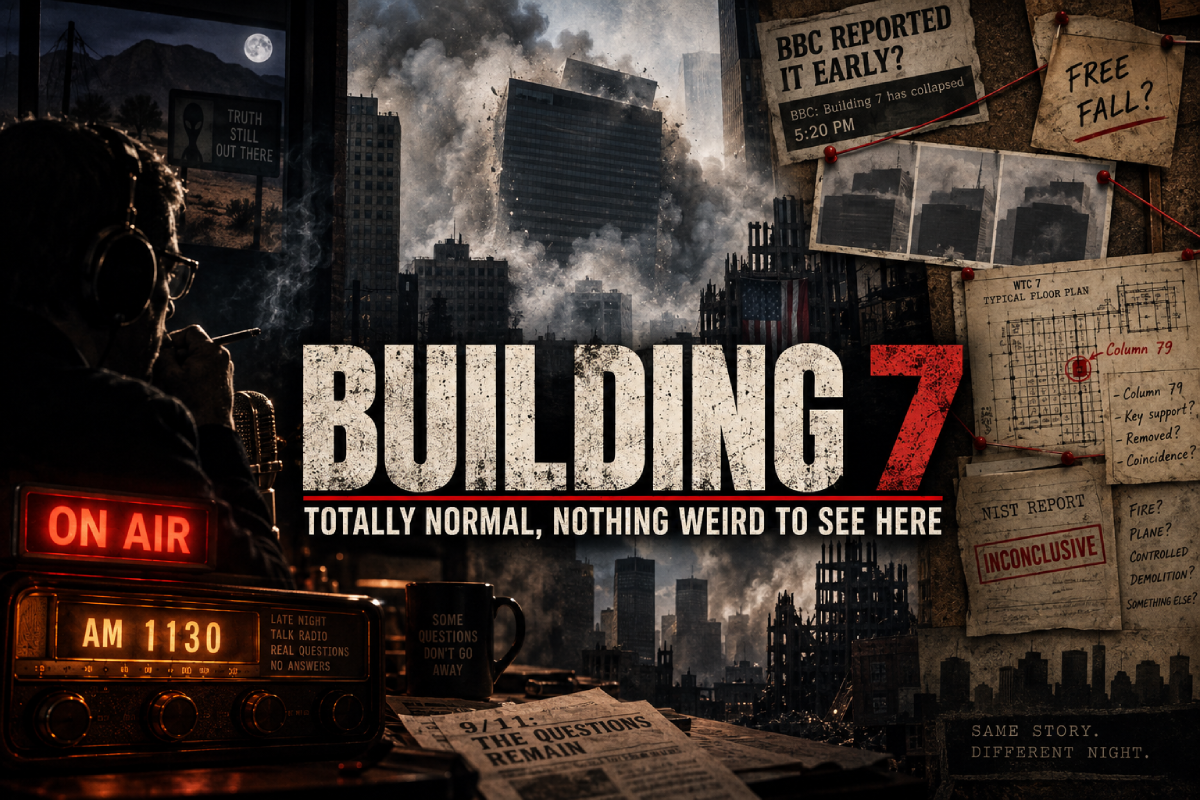
NIST’s explanation centers heavily around a critical structural element known as Column 79. According to their analysis, long-span floor beams heated and expanded during hours of uncontrolled fires. That thermal expansion placed unusual stresses on floor connections, contributing to the failure of a girder and nearby floor systems. As floors around Column 79 failed, the column lost lateral support and eventually buckled. Once that happened, failures propagated vertically and then horizontally through the interior structure.
The rooftop penthouse was supported by that internal framing, so its sudden disappearance is consistent with the idea that the building’s interior had already begun collapsing before the exterior shell visibly descended.
In plain English, the outside of Building 7 may still have looked approximately like a building while its insides were busy becoming significantly less building-like.
That’s a perfectly plausible structural mechanism, and it also helps explain why the exterior eventually appeared to drop with such eerie uniformity. If enough internal structure disappears first, the exterior frame can lose its lateral support over a broad area and then descend in a much more coordinated-looking way than most people intuitively expect.
Which is important, because the controlled-demolition appearance is one of the strongest emotional arguments for the conspiracy.
The engineering answer is essentially: yes, it looked like that because the visible exterior wasn’t where the collapse began.
Fair enough.
But before we allow structural engineering to ruin our fun completely, we need to take a brief trip to London, where the BBC apparently received a temporary subscription to tomorrow’s newspaper.
BBC News: Reporting the Future, Apparently
During the afternoon of September 11th, BBC News reported that Building 7 had collapsed.
There was one minor problem with this report.
Building 7 hadn’t yet collapsed.
Even better, during at least one broadcast, the building could still be seen standing in the background while the reporter discussed its destruction.
This is the sort of evidence conspiracy theorists usually have to fabricate using red circles, grainy screenshots and seventeen-minute YouTube videos narrated by someone whispering ominously into a gaming microphone. In this case, reality simply handed it to them.
The BBC effectively told viewers that Building 7 had fallen while the building itself remained stubbornly visible behind the reporter, apparently unaware that it was supposed to be dead.
Then, roughly twenty minutes later, it actually collapsed.
Now, before we summon the Illuminati, the mundane explanation is extremely plausible. September 11th was an incomprehensible communications disaster. News organizations were dealing with rapidly changing information, contradictory reports, rumors and legitimate warnings about damaged buildings throughout lower Manhattan. Reuters apparently distributed an erroneous report that Building 7 had collapsed, and the BBC repeated it. Officials already believed the building might come down, so a mistaken report of its collapse was hardly unimaginable.
Newsrooms screw things up during ordinary Tuesdays, I think we can all agree that September 11th was not ordinary.
Still, if you are attempting to persuade conspiracy-minded people that nobody had advance knowledge of the building’s destruction, accidentally announcing the destruction of the building before it happens is what public-relations professionals might classify as suboptimal.
From the conspiratorial perspective, it looks like somebody accidentally read page 83 of the script while everyone else was still acting out page 79.
Probably an innocent reporting mistake.
Probably.
But again, Building 7 was doing absolutely nothing to help itself.
Then Larry Silverstein Said the Worst Possible Thing
The Building 7 story might have remained merely strange if Larry Silverstein had never uttered two particular words.
Unfortunately, he did.
Silverstein, who held the lease on the World Trade Center complex, later discussed Building 7 in a PBS documentary. Recalling a conversation surrounding the dangerous conditions at the building, he said something to the effect of, “Maybe the smartest thing to do is pull it,” before adding that the decision was made to “pull” and they subsequently watched the building collapse.
If your objective is to prevent conspiracy theories, saying “pull it” about a skyscraper that later collapses straight downward is roughly equivalent to standing over a dead body holding a smoking pistol and announcing, “Well, that’s taken care of.”
The conspiracy community seized on the phrase immediately, interpreting “pull it” as industry shorthand for bringing the building down intentionally.
Silverstein’s representatives have consistently maintained that he was referring to pulling the firefighting operation and withdrawing emergency personnel from the area because the building had become too dangerous to approach.
Contextually, that interpretation makes considerable sense. Firefighters had already moved away from the structure, and officials were concerned enough about the possibility of collapse that a perimeter had been established. Saying “pull” in the context of emergency operations does not automatically mean “initiate our secret demolition sequence.”
There is also a much larger logistical problem with the dramatic interpretation.
Controlled demolition is not Uber Eats.
You do not generally decide at 2:30 in the afternoon that a 47-story skyscraper is inconvenient and have a demolition crew arrive, prepare the structural columns, install explosives, wire everything, test the circuits and finish in time for the evening news.
Large controlled demolitions typically require considerable planning, engineering work and physical access to major structural components.
So if Building 7 was intentionally demolished with preplaced explosives, the conspiracy necessarily becomes much larger. The explosives would almost certainly have needed to be installed before September 11th.
At that point, we are no longer discussing an emergency decision made during the chaos of the attack. We are discussing premeditation.
And now our pleasant little rabbit hole has acquired carpeting and a mortgage.
Oh, and Look Who Worked There
Building 7 would perhaps seem less interesting if its tenant directory consisted entirely of regional insurance firms, accounting offices and a particularly large Mattress Firm.
Instead, the building housed offices belonging to several federal agencies, including the Secret Service, Securities and Exchange Commission and Internal Revenue Service. It also contained offices associated with intelligence and defense functions, along with New York City’s emergency-management operation.
This, naturally, causes conspiracy theorists to begin rubbing their hands together like cartoon villains.
Now, government agencies having offices in New York City is not remarkable by itself. The federal government occupies office space all over Manhattan. The presence of the SEC does not transform a commercial skyscraper into NORAD, and a Secret Service office is not evidence that somebody was secretly managing “Operation Knock Down The Building.”
But again, we are judging Building 7 here by its ability to avoid looking suspicious.
And on that particular score, the building continues to fail spectacularly.
If you were writing a fictional political thriller about a mysterious skyscraper that inexplicably collapsed, would you put a dental-insurance call center in it? Of course not.
You’d put the Secret Service, SEC, IRS and intelligence offices inside.
Reality apparently hired the same screenwriter.
The Official Explanation Is More Interesting Than People Admit
One of the biggest problems with the Building 7 discussion is that people routinely caricature the official explanation into something absurd.
You’ll hear it summarized as, “A few office fires burned and then the entire skyscraper just magically collapsed.”
That is not what NIST concluded.
The actual explanation describes a specific chain of structural failures involving thermal expansion, long floor spans, connection failures, loss of lateral support and progressive collapse.
According to NIST, uncontrolled fires heated structural members for hours. Certain long-span beams expanded as temperatures increased. That expansion created stresses at connections around a girder associated with Column 79. Floor systems failed, reducing the lateral support provided to the column. Eventually Column 79 buckled, triggering failures that propagated through the interior of the building.
Once enough internal structure failed, the exterior frame no longer had the bracing necessary to remain upright, and the visible facade descended.
That explanation matters because it addresses one of the biggest intuitive objections people have when watching the footage: the apparent coordination of the collapse.
The building didn’t necessarily experience simultaneous failure of every visible exterior column. According to the NIST model, the interior structure failed first, and the exterior descent occurred only after those supporting systems had already been compromised.
There is also a genuinely remarkable historical detail involved.
NIST described Building 7 as the first known tall building to experience a complete collapse primarily as a result of uncontrolled fire.
Now, scientifically, there is nothing inherently suspicious about being the first example of something. Every event that has ever happened had a first time.
But psychologically, that phrase is absolute jet fuel for conspiracy theories. (Pardon the pun.)
When someone says, “So you’re telling me this was basically unprecedented?” and the answer is “Yes,” that doesn’t necessarily mean the explanation is wrong.
It does, however, ensure the conversation will continue for another three hours.
Then Another Group of Engineers Entered the Chat
Years later, researchers at the University of Alaska Fairbanks conducted their own structural modeling of Building 7. The project was led by structural engineering professor J. Leroy Hulsey, and its conclusions differed significantly from those reached by NIST.
The researchers argued that fire-induced failure alone did not adequately reproduce the observed collapse and that the building’s descent would have required the near-simultaneous failure of multiple columns.
On the surface, that sounds devastating.
“University engineering study disputes government explanation” is an extraordinarily marketable sentence if your business model involves selling documentaries to people who already own an Investigate 9/11 bumper sticker.
But there’s an important caveat, and ignoring it would be dishonest.
The project was funded by Architects & Engineers for 9/11 Truth, an organization specifically created to challenge the accepted explanations for the World Trade Center collapses.
That doesn’t mean the analysis is automatically wrong. Research doesn’t become mathematically invalid because somebody with an opinion paid for it.
But funding sources matter, especially when evaluating claims of independence.
If Marlboro commissions a study concluding that cigarettes improve cardiovascular health, I’m going to pay unusually close attention to the methodology.
The Alaska study therefore deserves to be evaluated on its engineering assumptions, modeling choices and results rather than treated as either holy scripture or radioactive waste.
Still, its existence adds another layer to the story. And Building 7 really didn’t need another layer.
The Explosives Problem
NIST also considered the possibility of intentional demolition and rejected it.
One major problem with conventional explosives is sound.
Severing the sort of structural columns required to initiate a controlled collapse would require substantial explosive energy. Such blasts should produce extremely loud reports and corresponding pressure effects. Lower Manhattan that day was saturated with cameras, microphones, journalists, emergency personnel and civilians.
There is no persuasive evidence of the distinctive explosive sequence normally associated with conventional controlled demolition.
That is a serious weakness in the demolition theory.
When explosives become inconvenient, some conspiracy theories pivot toward thermite or thermate, which can produce extreme temperatures without necessarily creating the same sort of blast signature.
That solves one problem while producing several new ones.
You would still need enormous amounts of preparation and access to structural steel. You would need to place materials precisely where they could sever or weaken major supports. You would need personnel who understood the building’s structure. You would need to perform that work inside an occupied Manhattan skyscraper without drawing attention.
And then everybody involved would have to remain quiet.
Which leads us to the eternal enemy of massive conspiracies: some guy named Bob. (Looking at you, Bob Lazar … but that’s a story for another night.)
Large conspiracies require people, and people are catastrophically unreliable. Somebody gets angry. Somebody gets divorced. Somebody develops a conscience. Somebody becomes religious. Somebody wants money. Somebody writes a memoir. Somebody drinks twelve beers and tells his brother-in-law. Somebody decides he wants to be on television.
Yet decades later, there has never emerged a credible insider account accompanied by physical evidence demonstrating that Building 7 was secretly prepared for demolition before September 11th.
That absence does not logically prove that demolition was impossible, but it creates a very large evidentiary hole.
Unfortunately, There Is Still That Damn Video
And this is where the entire argument circles back to the beginning.
You can explain Column 79.
You can explain thermal expansion.
You can explain the fires.
You can explain the penthouse dropping.
You can explain the BBC’s premature report.
You can explain Silverstein saying “pull it.”
You can explain the federal tenants.
You can explain why the free-fall interval occurred after internal support had already failed.
Every individual element has a plausible conventional explanation.
Then somebody plays the footage again.
The penthouse drops into the building. The roofline moves. The facade suddenly begins descending with remarkable uniformity.
And some primitive little pattern-recognition system buried deep inside your skull says:
That looks like they blew the damn thing up.
That reaction isn’t structural engineering. It isn’t evidence. But it is extraordinarily powerful.
And I suspect that is the real reason Building 7 has survived for decades as one of the most durable September 11th conspiracy theories while countless other claims have slowly disappeared into the darker corners of the internet.
Building 7 doesn’t require fake photographs. It doesn’t require holographic airplanes, space lasers, secret missile pods or actors wearing rubber masks.
It requires somebody to press play on a video and ask one simple question:
“Does that look weird to you?”
Yes. Yes, It does.
So Did Somebody Blow Up Building 7?
I don’t know.
More importantly, I have never seen evidence strong enough to convince me that they did.
The official explanation is physically plausible and supported by an enormous investigation involving structural analysis, fire modeling and examination of the building’s design. The intentional-demolition hypothesis faces substantial evidentiary and logistical obstacles.
There is no demolition plan.
There is no verified explosives trail.
There is no credible insider confession supported by documentation.
There is no recording of shadowy officials sitting around a conference table saying, “Okay, boys, remember Building 7 at 5:20.”
And yet Building 7 remains one of those stories where almost every fact seems individually determined to make the whole thing look more suspicious than necessary.
No airplane hit it.
It became the first known tall building to suffer a complete collapse primarily because of uncontrolled fires.
Its visible descent included a period of free fall.
The collapse looked remarkably similar to controlled demolition.
A major news organization reported that it had fallen before it actually did.
The building housed offices belonging to several powerful government agencies.
Its leaseholder used the immortal phrase “pull it.”
And another team of engineers eventually challenged important parts of the government’s structural explanation.
If you submitted that sequence of events as the plot of a political thriller, an editor would probably send it back with a note saying:
Too obvious. Tone it down. Nobody will believe this.
Maybe that’s ultimately the most interesting thing about Building 7.
History does not have a screenwriter.
Real catastrophes produce coincidences, mistakes, strange statements and unprecedented events without worrying whether the resulting narrative looks believable. Sometimes official explanations genuinely are boring explanations for events that look spectacularly suspicious.
Sometimes reporters get things wrong.
Sometimes buildings fail in ways engineers have never seen before.
Sometimes a guy says “pull it” when there are approximately seventeen thousand better combinations of words available to him.
And sometimes all of those things happen to the same building on the same day.
So no, I’m not telling you they blew up Building 7.
I’m simply saying that if they didn’t blow up Building 7, then Building 7 could have made considerably more effort not to look like they did.
Good night, America. Keep watching the skies.
Audio note: The narration accompanying this piece is an AI-generated tribute to the style and atmosphere of Art Bell’s late-night radio broadcasts. It is not an authentic recording of Art Bell and is not affiliated with, endorsed by, or authorized by his estate, Coast to Coast AM, or any associated rights holders.