Why the Hell Are We Taxing People for Earning Money?
Every so often I see the flat-tax argument come around again: simplify everything, pick a number … 10 percent, 15 percent, whatever and everybody pays the same percentage.
I understand the appeal. Compared with the incomprehensible Rube Goldberg machine we call the American tax code, “everybody pays X percent” sounds beautiful. Almost peaceful in its own way.
But I think we’re arguing about the wrong damn thing.
The question shouldn’t be, “What percentage of your income should the government take?”
The question should be: Why the hell are we taxing income in the first place?
Think about what we’re doing; You go to work. You build something. You write software. You weld pipe. You start a company. You work overtime. You invent a product. You take a financial risk. You hire people. You invest your money and manage not to blow it.
You create value. And somewhere along the way we’ve collectively decided that creating more value should cause the government to show up with a larger bucket.
I think that’s a bizarre place to start. I’d rather have the argument over consumption.
Not some bullshit new national sales tax slapped on top of income taxes, property taxes, payroll taxes and everything else we already pay. If that’s the proposal, throw it directly into the ocean.
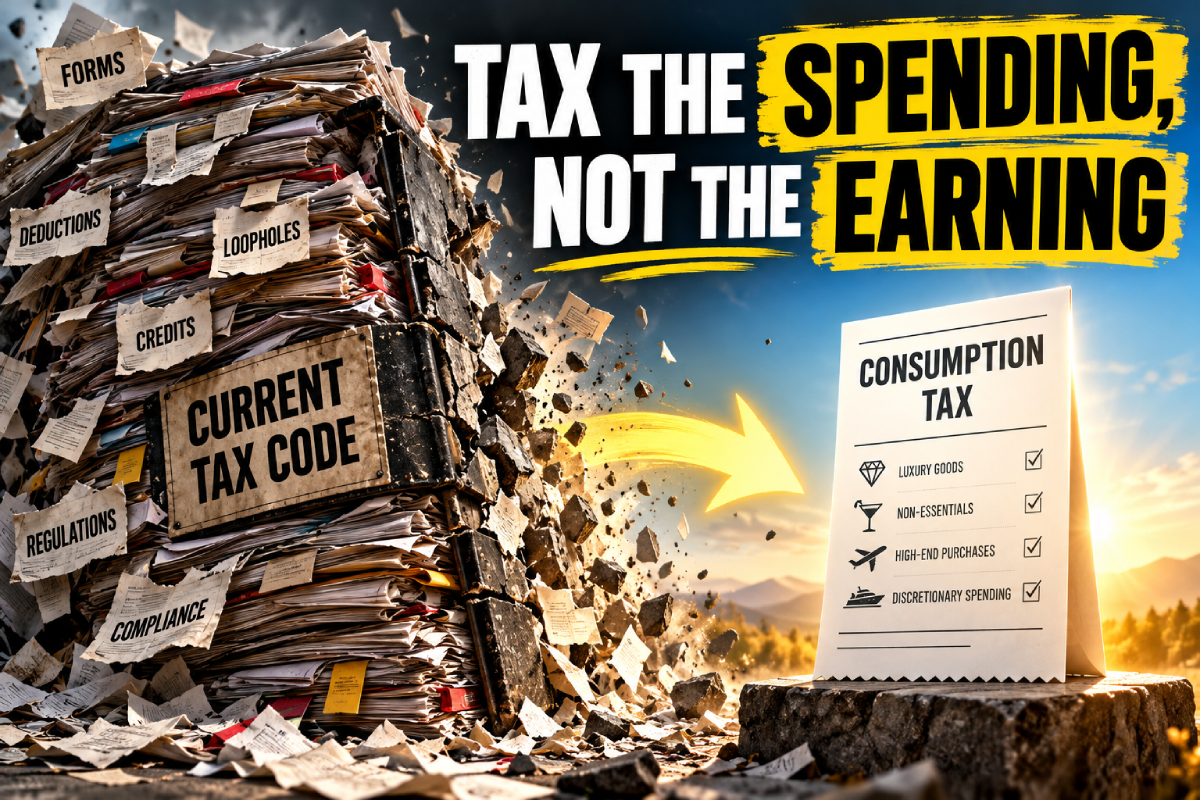
I’m talking about replacing the system. The ENTIRE system.
You earn the money? Keep it. You save it? Keep it. You invest it? Keep it. You put it back into your company? Keep it.
You buy something for ordinary day-to-day life? Under the version I’m talking about, necessities would be exempt or treated extremely lightly. Food, medicine, basic clothing, ordinary household goods … the stuff you need to exist shouldn’t become the government’s favorite revenue stream.
But when consumption starts moving from “I need this to live” toward “I would like my third Ferrari delivered in a color matched to my yacht,” now we’re having a different conversation.
You want the $200,000 sports car? There’s a tax.
You want the $30,000 watch? There’s a tax.
You want the Gulfstream, the yacht, the fifth house, the $6,000 handbag, or the wine cellar that costs more than most people’s homes? There again, is a tax.
Not because being wealthy is evil, and not because successful people need to be punished. Exactly the opposite.
I want you to get as rich as you possibly can.
Build companies. Invest. Save. Create. Accumulate capital. Become absurdly, cartoonishly wealthy if you can pull it off.
Why should the government give a shit how many zeroes are sitting in your brokerage account?
The fight over unrealized wealth becomes a hell of a lot less interesting if the government isn’t standing around staring at everyone’s assets wondering how much of them it can grab.
Did your stock increase in value? Great.
Did your company become worth ten times as much? Congratulations.
Oh, did you buy something? Ah. Now we have a taxable event.
And this is where I part company with the flat-tax idea.
A flat tax solves one problem: complexity. It does not solve the underlying question of why the government should have an automatic claim on someone’s earnings merely because those earnings occurred.
And there’s another problem with pretending that equal percentages necessarily mean equal economic burdens.
Ten percent is mathematically ten percent whether you make $40,000 a year or $40 million. Obviously. But pretending those two households experience the loss the same way is silly.
Ten percent of a modest income can represent groceries, rent, a car repair, childcare, or the little bit of savings somebody was finally managing to put away. Ten percent at the extreme upper end of the income distribution leaves an entirely different set of choices.
That isn’t an argument for soaking wealthy people. It’s an argument for asking whether income is even the right tax base.
Maybe the cleaner question is not how much you made. Maybe it’s how much you chose to consume.
And before somebody in government gets sexually excited by the phrase “new tax,” there is one gigantic condition attached to this idea:
THE OTHER TAXES HAVE TO DIE.
Not reduced. Not “reformed.” Not temporarily lowered until Congress quietly raises them again six years later.
Gone. 100%. Completely, Gone! Otherwise this entire conversation is pointless.
A consumption tax layered on top of income tax would simply be another government hand reaching into the same pocket.
The radical version of the proposal is that the consumption tax replaces all existing taxes rather than supplementing them.
Federal income tax? Gone.
Payroll taxes? Replaced.
Capital-gains taxation? Gone as part of the replacement.
Estate taxation? Gone.
And if states and municipalities adopted equivalent structures, traditional property taxes should go too. (More on property tax in another article, it pisses me off.)
You do not get to keep all the old taxes and then introduce a shiny new consumption tax on top of them. That’s not tax reform. That’s just finding another hole in my pants to shove your hand into.
The whole damn point is that the system changes.
Now, does all of this fit on a bumper sticker?
No.
There are some legitimately nasty implementation questions.
What counts as a necessity? Is a $30,000 car exempt while a $100,000 car isn’t? Do you use brackets? Do you tax the whole purchase price at a luxury rate or only the amount above some threshold? How do you handle housing, healthcare, education, imported goods, or somebody disguising personal consumption as business spending?
And perhaps most importantly, how do you raise enough revenue without hammering ordinary consumption?
Those are not little details. They are the entire engineering problem.
Business purchases would have to be handled carefully too, because the last thing I want is a system that taxes the same product six times while it’s being made.
If somebody buys raw steel, then somebody buys a component made from that steel, then a manufacturer buys the component, then a distributor buys the finished product, and finally you buy it at the store, taxing every one of those transactions just buries the tax inside the price.
The cleaner idea is to focus the tax on final personal consumption, not every transaction that happens on the way there.
So no, I’m not pretending I can scribble “TAX YACHTS” on a cocktail napkin and replace the entire American tax system by Tuesday afternoon.
But I do think the underlying question deserves a hell of a lot more attention than it gets.
Why do we keep designing tax systems around how much people produce rather than how much they consume?
I’d much rather have an economy asking how much you can build, how much you can save, how much you can invest, and how much wealth you can create than one constantly asking:
How much did you make, and how much of it can we take?
That’s the part of the flat-tax debate I think misses the bigger opportunity.
Maybe the goal shouldn’t be a fairer way of taxing the paycheck.
Maybe the interesting argument is whether we should stop taxing the damn paycheck at all.