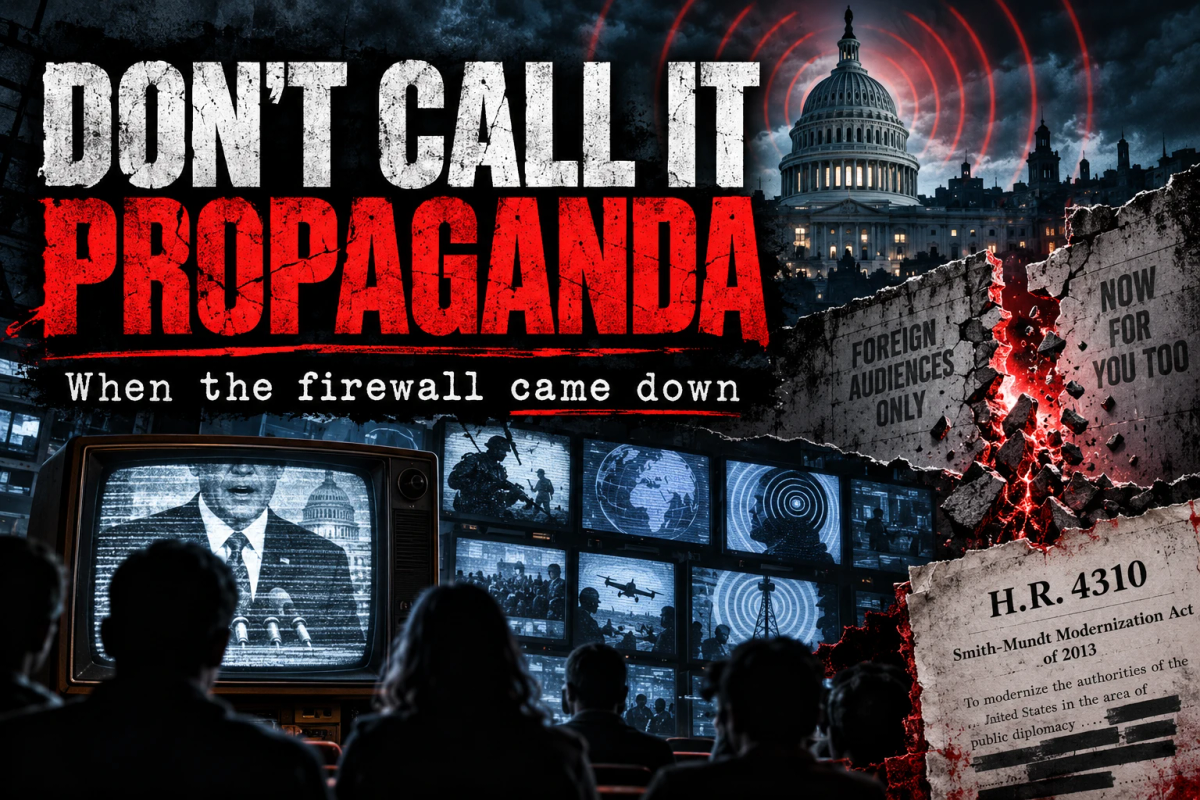
There are certain sentences that should make you stop reading, lean back in your chair, and say, “Wait… they changed WHAT?” Here’s one.
For decades, federal law put restrictions on material the United States government created specifically to influence and inform foreign audiences being distributed here at home. Congress changed those rules in the National Defense Authorization Act for Fiscal Year 2013, H.R. 4310, a gigantic bill with the change buried somewhere inside it, and President Obama signed it on January 2, 2013.
This is usually the point where the Internet loses its damn mind.
I’ve seen plenty of memes lately pointing to this bill as proof that Obama was some kind of traitor who personally legalized propaganda against Americans. Other people treat the whole controversy like there was never anything worth questioning in the first place. I wasn’t an Obama fan, but if we’re going to criticize government, we should at least criticize it for things it actually did, so spare me the rush to your preferred political corner. Nobody hatched this in a smoke-filled room underneath the White House as part of some grand Democratic conspiracy. The Smith-Mundt modernization legislation was bipartisan (Democratic Congressman Adam Smith and Republican Congressman Mac Thornberry sponsored it), and honestly that makes the story more interesting, not less.
The original Smith-Mundt Act goes back to 1948. It established the government’s authority to run information and public-diplomacy programs aimed at audiences overseas, and Voice of America is probably the example most people would recognize. Under it the government could produce radio, films, publications and other material explaining America, American policy and American interests to people in other countries. Fine. We’ve done that forever, and so does every other country. What also existed, though, was a firewall between that apparatus and the American public, and in 2013 part of it came down.
Section 1078 of H.R. 4310 amended Smith-Mundt so that material the State Department and the Broadcasting Board of Governors created and disseminated overseas could also be made available inside the United States. The U.S. Agency for Global Media, which is the government’s own agency, describes the change as one that “eases Smith-Mundt restrictions” and lets its content be made available domestically.
Cue the world’s most exhausting game of legal-semantic Twister. “No, no, no. It didn’t legalize propaganda against Americans.”
Technically correct. The amended statute says outright that funds authorized for these programs may not be used “to influence public opinion in the United States,” and it says the programs are still intended for foreign audiences. USAGM says it isn’t authorized to start creating programming specifically for Americans. Okay. The same legislation, however, also says the State Department and Broadcasting Board of Governors can’t be prohibited from communicating merely because an American audience “is or may be thereby exposed” to the material, and it expressly allows that material to be made available in the United States.
So can we at least describe what happened without wrapping it in fifteen layers of government-approved bubble wrap? Federal foreign-audience programming used to face substantial restrictions on domestic dissemination. After the change, Americans could receive it. I’m not peddling a conspiracy theory there; that’s just what the amendment did.
You can call the material propaganda, public diplomacy, international broadcasting, strategic communication, or Bob’s Totally Neutral Government Information Hour, and the underlying structure won’t care. The government creates information meant to further American foreign-policy objectives. It distributes that information overseas. And since Smith-Mundt modernization, the same material can circulate domestically under whatever circumstances the amended law authorizes, which is the part I think is worth talking about.
Supporters had an entirely reasonable explanation for changing the law, and I’ll give them that. The Internet had made the old geographic distinction pretty ridiculous; you can’t publish something online for a guy sitting in Prague and then put up an invisible force field so someone in Pittsburgh can’t click on it. The government also argued that letting Americans see the material made things more transparent, since taxpayers could finally look at more of what they were paying for it to broadcast overseas. That’s a legitimate argument.
There’s another legitimate question sitting right next to it, though, which is why America had that firewall at all. Governments have power. They have money, intelligence agencies, communications departments and professional media operations, with resources that absolutely dwarf anything ordinary citizens have, and governments of every ideology throughout history have found out just how useful it is to control the narrative.
I’m not saying every Voice of America story is propaganda, or that somebody at the State Department is down in a basement inventing Facebook memes to trick Grandma. USAGM explicitly requires its journalists to produce accurate and objective journalism, and it maintains its material isn’t propaganda. But that’s exactly why the wording matters. The historical principle was never just “government information is bad.” It was that machinery built to influence foreign populations shouldn’t casually get pointed at the domestic population, and interestingly enough, Congress apparently still thought that mattered after modernization, because it left the prohibition on influencing American public opinion sitting right there in the statute. If the distinction doesn’t matter, why keep the prohibition? And if it does matter, Americans are probably entitled to pay very close attention whenever the boundaries around it get loosened.
Here’s where I come down. I won’t tell you Obama signed a law saying, Congratulations, federal government, you may now propagandize the American people, because he didn’t. I also won’t pretend nothing meaningful happened just because the legislation has language saying domestic influence is still prohibited. A longstanding restriction on domestic access to and dissemination of foreign-targeted government media was deliberately relaxed, and the government itself says it was relaxed.
Call that modernization. Call it transparency, or adapting an obsolete 1948 law to the Internet age; I’d accept any of those as defensible. But when we’re talking about a government information apparatus and its own citizens, I’m perfectly comfortable being the obnoxious bastard standing in the corner asking why the firewall needed another door in it.
History has handed us remarkably few cases of a government getting more ability to communicate, surveil, influence or control information and then deciding, “You know what? We could technically use this power more aggressively… but we probably shouldn’t.”
I’m sure it’ll be fine. Governments are famously restrained like that.


Letters to the Editor
Agree, disagree, or set me straight. The comments are open.