The Meltdown Was the Point
You’ve probably seen the video by now.
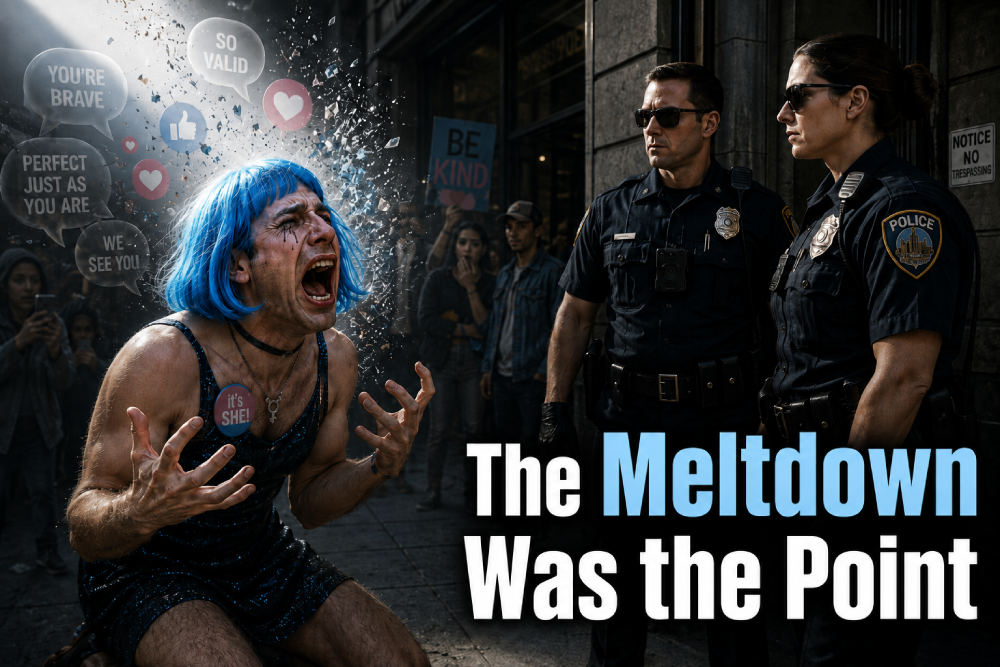
A grown adult in a blue wig, being arrested, screaming and crying, demanding to be called “she,” and genuinely baffled that the officers won’t stop everything to validate the performance.
The easy response is to laugh. I get it. The whole scene is absurd — a grown person throwing a toddler-level tantrum while the cops calmly keep doing their job is practically engineered to become internet comedy.
But the longer I watched, the less funny it got.
Because he didn’t invent this behavior on the spot. He learned it.
And I’m not going to pretend otherwise by swapping pronouns, because what I’m looking at doesn’t feel like an identity to affirm. It feels like a mental health crisis we’ve collectively decided to indulge instead of treat. In almost any other situation, when someone’s grip on reality slips this far, the response is care, boundaries, and help — not applause. I don’t say that to be cruel. I say it because people in this state don’t need validation for the behavior that’s hurting them. They need someone honest enough to say something is wrong and that they deserve real help, not just agreement.
He Was Taught That Distress Is Power
He has spent years inside a culture that taught him being upset is a form of authority. That the moment he starts crying, everyone else is supposed to lower their voice, affirm his identity, apologize for his discomfort, and rearrange reality around his feelings.
In his world, distress isn’t just an emotion.
It’s leverage.
The louder the crying, the bigger the obligation on everyone else. The more offended he looks, the guiltier everyone around him is presumed to be. The more unstable the reaction, the more urgently the rest of us are expected to accommodate it.
And for a long time, that probably worked. Teachers indulged it. HR departments rewarded it. Social media celebrated it. Activists assured him that discomfort was proof of oppression, that disagreement was violence, that the wrong pronoun was an attack — and that his feelings weren’t just valid, they were binding on everyone else.
Then he met the police.
The Police Had a Problem to Solve
The cops weren’t there to participate in an identity ritual. They weren’t there to explore his feelings, congratulate his bravery, or reassure him that he was stunning and valid.
They had a problem to solve. There was a disturbance. Somebody needed to calm down, information needed to be gathered, the situation needed to be under control so everyone could get on with their day.
And here comes this guy, shrieking and flailing and making himself the single most disruptive person in the area.
He thought he was demonstrating victimhood. The police saw a problem.
He thought his emotional state gave him power. The police saw someone getting harder to manage by the second.
He thought crying louder would make them surrender. Instead it convinced them he was the one who needed to be restrained.
That’s the tragedy hiding under the comedy. He was running a social strategy that had been rewarded his entire adult life, and for maybe the first time he ran into people completely unmoved by it.
The officers weren’t interested in debating gender theory. They didn’t need to decide whether he was a man, a woman, nonbinary, gender-fluid, or the reincarnated empress of Jupiter. They needed him to stop causing a scene. When he refused, they handled him like any other adult refusing lawful instructions and escalating a public disturbance.
And he could not understand it.
Fragility Was the Product
You can see the confusion, and it is not subtle. He’s melting down, screaming at the top of his lungs that he should be called “she,” as if sheer volume will bend the situation around him. He seems to think his tears are commands — that the officers’ failure to emotionally validate him is proof they’re doing something wrong.
That’s not confidence. It’s not courage. It’s not liberation.
It’s a person who was catastrophically unprepared for reality.
He was taught the world splits neatly into victims and oppressors, and that the safest place to stand is always at the top of the victim pile. He was taught that weakness is influence, that fragility is status, that emotional instability is evidence of moral importance.
So he became fragile. Not necessarily because he started that way — because everything around him rewarded it at every step. It taught him to turn discomfort into trauma, disagreement into abuse, embarrassment into persecution. It taught him that self-control was optional, because controlling his emotions was supposed to be everyone else’s job.
Then the real world showed up wearing a badge and carrying handcuffs.
The Real World Doesn’t Always Care How You Identify
Sometimes it cares how you behave.
That’s the part his handlers never prepared him for. They taught him to demand validation, not to survive rejection. They taught him to announce his own boundaries, not to respect anyone else’s. They taught him to read every unpleasant moment as oppression, never to ask whether his own behavior was the problem.
Most of all, they taught him that his internal identity was the most important fact in every room.
It isn’t.
Sometimes the most important fact is that traffic needs to move. That customers are trying to eat. That employees are trying to work. That the officers are trying to resolve a disturbance, and the guy screaming loudest just volunteered to be the center of it.
The meltdown didn’t strengthen his case.
It destroyed it.
Nobody watched that video and thought, “What a compelling demonstration of womanhood.” They saw an adult who had completely lost control of himself while demanding control over everyone else.
He’s the One in the Back of the Car
And honestly, I pity him.
Not because his demands were reasonable — they weren’t. Not because the police owed him compliance — they didn’t. I pity him because an entire ideological machine convinced him this would work. It convinced him that reality was negotiable, that strangers were obligated to affirm him, that emotional collapse was a fine substitute for dignity, persuasion, and self-restraint.
Then the fantasy hit reality, and he’s the one who paid for it.
The activists will move on to the next viral outrage. The online supporters will post slogans for a few days. The institutions that taught him to behave this way will accept exactly zero responsibility.
But he’s the one sitting in the back of the police car.
That’s what makes the whole thing so ugly. This wasn’t just one unstable person having a bad day. It was the finished product of a culture that rewards people for becoming less resilient, less rational, and less capable of functioning around anyone who won’t play along.
He was told that crying louder would make him powerful.
All it did was make the handcuffs arrive faster.