The Communist Manifesto Is Not About Community
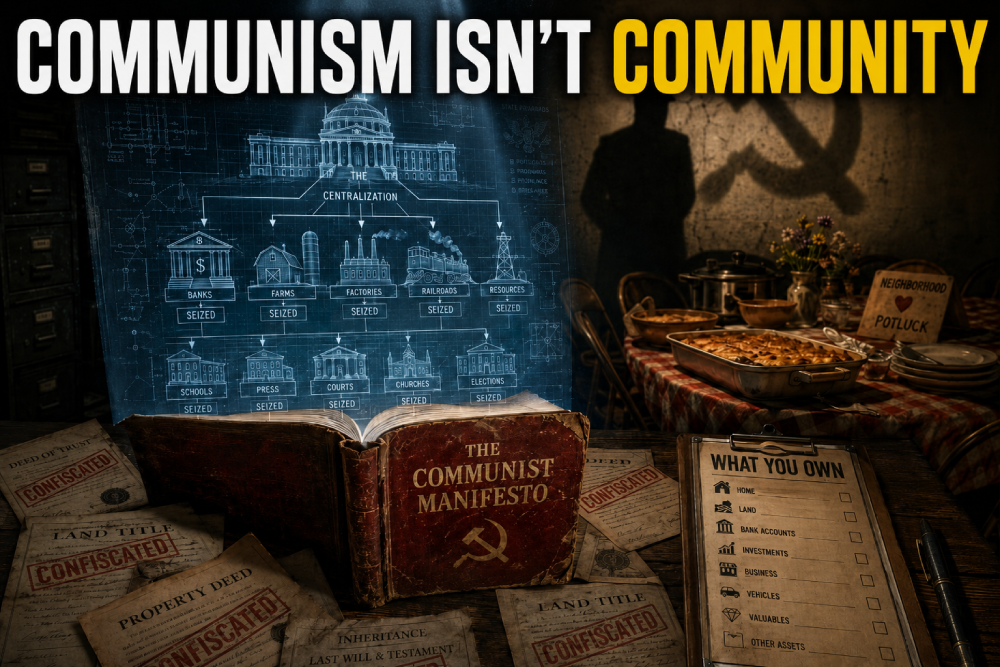
Communism is not about community.
I know they sound alike. That’s sort of the point. But the resemblance stops at the first four letters.
It’s not about neighbors helping neighbors and it’s not about feeding the hungry, caring for the sick, or pooling your money with people you trust for something you all want.
Those things already have names … charity, cooperation, mutual aid, family, church, friendship, etc… They’ve existed in basically every civilization, under every economic system, since people started living near each other. They don’t need a revolution. They just need people.
Communism is something else entirely.
It’s a political program built on class warfare, the seizure of power, the confiscation of property, and the concentration of economic life in the hands of the state. And you don’t have to take that from a Cold War Republican, a think tank, or some guy yelling on Facebook to realize it… You can read it in the manifesto itself.
Marx and Engels aren’t shy about it. The immediate goal is to overthrow the existing political order and hand power to the proletariat. Their entire economic theory boils down to four words: “Abolition of private property.”
That’s not a neighborhood potluck. That’s a revolution.
The Manifesto Is a Blueprint for Power
People talk about the Communist Manifesto like it’s a vague mood board about sharing. It isn’t. It comes with an actual to-do list. Here’s what’s on it:
- Abolish private ownership of land.
- A heavy, progressive income tax.
- Abolish inheritance.
- Confiscate the property of emigrants and “rebels.”
- State monopoly on credit and banking.
- State control of communication and transportation.
- State-owned factories and production.
- Compulsory labor and “industrial armies.”
- Shuffle populations around between city and country as needed.
- Centralized public education tied to industrial production.
Read that again and point to the love.
Where’s the voluntary cooperation? Where’s the compassion? Where’s the part where anyone gets asked?
The manifesto doesn’t ask property owners to be more generous. It doesn’t ask workers and bosses to cut a better deal. It doesn’t suggest building voluntary co-ops next to private businesses and letting the better model win.
It proposes taking power, taking property, and putting the commanding institutions of society under one authority.
Marx and Engels admit … out loud … that this takes “despotic inroads” on existing property rights. The proletariat becomes the ruling class and sweeps the old order away by force.
That’s not kindness. That’s coercion wearing work clothes.
“Private Property” Never Means Only Billionaires
Every time you point this out, the defenders retreat to the same line:
They didn’t mean your house or your toothbrush. They meant the means of production.
That distinction exists in the theory. But it doesn’t save the argument. The manifesto flatly calls for abolishing land ownership and inheritance and confiscating property from vaguely defined “rebels.” That’s not just yachts, that’s everything.
And who decides what counts as “means of production”? Because the line moves the second it’s inconvenient:
Your truck is personal property … until you make deliveries with it.
Your garage is personal property … until you fix cars in it.
Your laptop is personal property … until you start a company on it.
Your spare bedroom is personal property … until you rent it out.
Your family farm is personal property … until somebody decides you own too much land, grow too much food, or hire too many people.
That boundary between “harmless stuff you own” and “forbidden productive property” is not a law of nature. It’s a political decision, made by whoever runs the state. And once the state owns the banks, the land, the credit, the factories, the trains, and the airwaves, it isn’t regulating the economy anymore.
It owns the terms on which you’re allowed to live.
A Job Is Not Automatically a Crime
The manifesto treats wage labor as theft by definition … the worker gets just enough to survive, and the capitalist pockets the rest.
There’s a real observation buried in there, wrapped around a false conclusion. Yes, employers can exploit people. Yes, corporations abuse their power. Yes, early industrial capitalism gave us dangerous factories, child labor, and brutal hours. All true. But “sometimes bosses are bad” does not get you to “every job is exploitation and every dollar of profit is stolen.” That’s a wild leap.
And here’s what the theory leaves out; The worker gets paid whether the product sells or not. He doesn’t eat the risk. The owner puts up money before anyone knows if it’ll work. Somebody has to organize the labor, the equipment, the suppliers, the insurance, the sales, the shipping. And then customers, not Marx, decide whether any of it was worth making.
Sometimes the owner gets rich. Sometimes the whole thing folds and he loses everything.
Value doesn’t come from sweat alone. Dig a hole and fill it back in, that’s plenty of labor and zero value. Labor pays off when you combine it with skill, tools, timing, organization, capital, and actual demand. Marxist economics takes all of that and mashes it into a morality play with one noble victim and one parasite.
Real life doesn’t cast that cleanly.
Central Planning Is a Fantasy About Information
The manifesto imagines all the big productive stuff gathered under one plan and run for everybody’s benefit.
Sounds efficient. Until you remember an economy is billions of little decisions changing every single day.
How much steel? What grade? Shipped where? Should this copper go into power lines, motors, medical devices, or phones? How many size-eleven work boots does North Carolina need this winter? Which crop goes in this field after a wet spring?
No committee on earth knows all that.
That was Hayek’s whole point, and it wasn’t that planners are stupid or evil. It’s that the knowledge doesn’t sit in one place … it’s scattered across millions of people who each know their own little corner. Prices carry that information around automatically, without anyone at the top having to understand it. Central planning tries to replace the whole system with reports, quotas, and orders.
When the reports are wrong, the plan is wrong. When people get punished for missing quotas, they lie about the numbers. When the targets go political, factories crank out warehouses of junk nobody wanted, just to hit the number. And when you can’t take your business elsewhere, a shortage doesn’t get fixed … it gets a press release.
The problem was never that communism kept hiring the wrong planner, it’s that believing the right planner could ever exist.
The State Was Supposed to Just… Leave
This is the single biggest load of bullshit in the whole pitch.
First the state gets enormously power .. enough to abolish private ownership, erase the classes, run production, control all the credit, and rearrange society from the top down. Then, once it’s done all that, it’s supposed to gently fade away. Marx figured that once the classes were gone, political power would just lose its purpose and dissolve.
Sure. Right.
The people running every bank, farm, factory, railroad, school, and newspaper are going to finish redesigning civilization, dust off their hands, hand all that power back, and go home.
This asks you to believe the folks who grabbed nearly unlimited control will be the first ruling class in history that never developed an interest in staying on top. And that nobody will ever disagree about production, housing, food, wages, or who’s in charge, because anyone who does disagree can just be relabeled a reactionary, a wrecker, a counterrevolutionary, an enemy of the people.
And since the revolution can’t let the enemy win, the words start sliding:
- Dissent becomes sabotage.
- Opposition becomes treason.
- Confiscation becomes justice.
- Forced labor becomes participation.
- Censorship becomes protection.
The prison is still a prison. They’ve just told the guard he represents the workers.
History Already Ran the Experiment
None of this is hypothetical. We tried it. More than once.
Stalin’s forced collectivization seized the farmland, gutted rural life, and helped produce famine and mass death across the Soviet Union… Deaths counted in the millions.
Mao’s Great Leap Forward did the same thing on a bigger scale: communal farms, central industrial targets, officials faking the numbers to survive, critics silenced. Somewhere around 30 million people starved.
That wasn’t a shortage of community spirit. It was central power sealed off from reality. The state made the plan, controlled the information, punished the critics, and took the harvest… And the people underneath it paid for the mistakes with their lives.
And here’s the part that really buries the argument: China’s turnaround. Starting around 1978, they let prices float, allowed private business, and opened up to outside investment. The World Bank credits that era with pulling something like 800 million people out of extreme poverty. They didn’t escape mass poverty by moving toward the manifesto. They did it by backing away from it.
People Are More Than a Class
The manifesto starts from the idea that all of history is basically class struggle.
Class conflict is real. Money shapes politics. Fine. But shrinking all of human civilization down to class is just intellectual vandalism.
People are moved by family, faith, country, love, ambition, envy, loyalty, revenge, pride, boredom, and a thousand other things. A factory owner and his employee might share a religion, a hometown, a favorite team, or the same enemy. Two guys pulling identical paychecks might hate each other over politics or culture.
Marxism has to treat all of that as background noise, because the theory only works if class is your one true identity.
It isn’t. People aren’t economic units waiting to be told their historical role. They’re individuals with different talents, different appetites, and different ideas about a good life. And that’s exactly the thing communism can’t live with, because different people make different choices and end up in different places.
Forcing everyone level means somebody has to decide which differences are allowed, which rewards are earned, and which ambitions have become antisocial. And that somebody is never “the community.” It’s the government.
You Don’t Need Communism to Care About People
You can want safe working conditions without abolishing private business.
You can support unions without handing the state a monopoly on jobs.
You can feed poor families without seizing every farm.
You can fund public schools without bolting children to a production line.
You can regulate corporations without abolishing ownership.
You can build a safety net without pretending politicians can run an entire economy from a desk.
You can start a worker-owned business, a credit union, a charity, a co-op, a mutual-aid group, a church pantry, right now, today, without firing a shot.
That is community. Community is people choosing to cooperate. Communism is an authority deciding they don’t get a choice.
So stop selling the Communist Manifesto as a warm little story about sharing. It’s not a children’s book about everybody putting their toys in one box. It’s a revolutionary program that openly calls for overthrow, confiscation, centralization, and rebuilding society by force.
The promise is equality. The method is power. The sales pitch is compassion. And the enforcement is always, always the state.
The state doesn’t show up with a casserole. It shows up with a list of what you own.