I Read Books with My Ears
"Oh. So you didn't read it. You listened to it." I own hundreds of audiobooks, and how the words got into my skull doesn't decide whether I read the book.
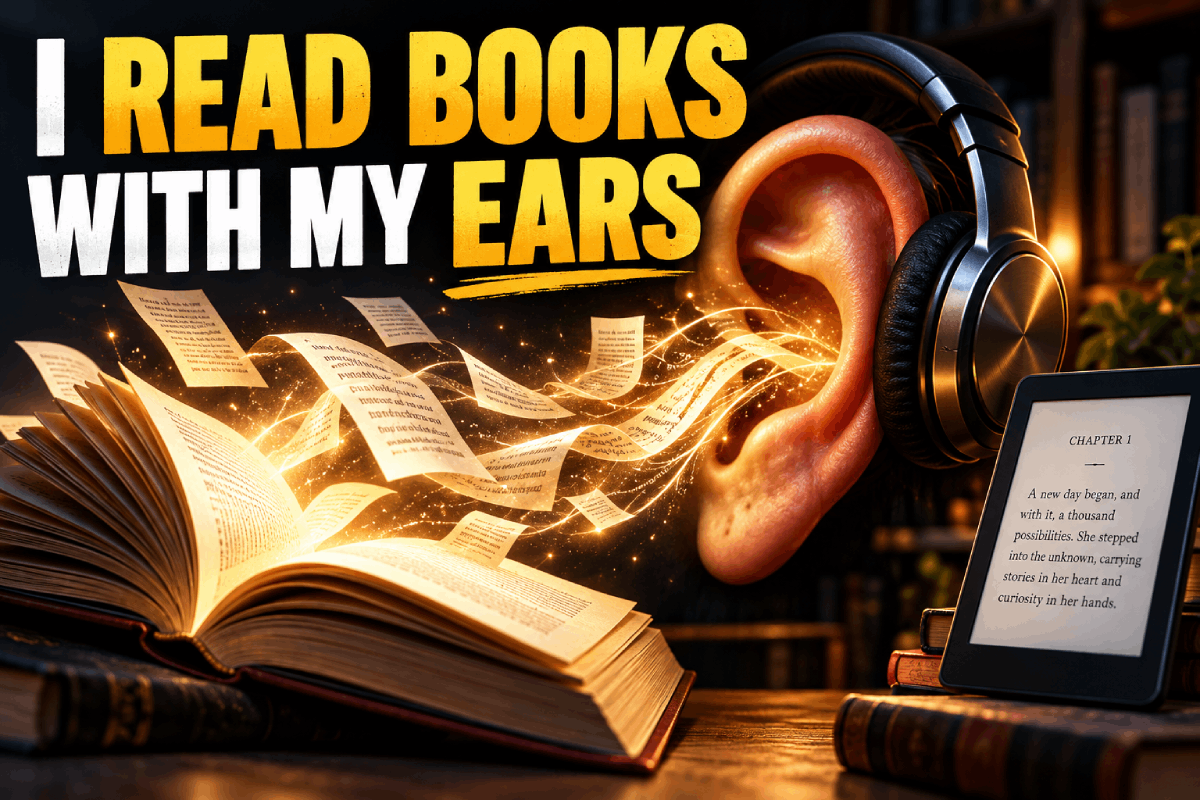
Not long ago I had one of those stupid little exchanges that stuck with me longer than it probably should have. We were talking about books, I mentioned I’d read something, and at some point it came out that what I’d actually done was listen to the audiobook, which is when I got that little look.
“Oh. So you didn’t read it. You listened to it.”
It wasn’t said the way somebody innocently clarifies which version you bought. It came with that tiny dollop of smugness people save for correcting your grammar or informing you that Frankenstein was actually the doctor. Yes, thank you, I’m aware that my ears and my eyeballs are different pieces of equipment.
Apparently I had wandered into one of the stranger forms of intellectual gatekeeping: people who believe an audiobook somehow doesn’t count as having read the book. I have questions about that, and the main one is: why the hell not?
I love books. I have hundreds of audiobooks and I’ve spent literally thousands of hours listening to them, and I also read constantly on an e-reader. Usually I have two books going at once, one I’m physically reading and another I’m listening to. The e-reader gets the times when I can actually sit down and stare at a screen, and the audiobook gets the rest of my life: driving, walking, working around the house, working in the shop, all those hours when my hands and eyes need to be doing one thing but my brain is perfectly capable of doing something else.
So I’m not anti-reading. I read books with my eyes and I read books with my ears, and for some reason that second part drives some people completely fucking insane.
Congratulations, You Used Your Eyes
Let’s get the technical objection out of the way first: “Yes, but listening isn’t technically reading.”
Okay, technically, fine. Reading involves looking at written symbols and extracting meaning, while listening involves sound entering your ears and your brain interpreting spoken language. Congratulations, we have successfully completed third-grade anatomy.
But that isn’t what people normally mean when they ask, “Have you read that book?” Nobody’s auditing your retinal activity. They’re asking whether you know the book. If you read The Martian visually and I listen to the unabridged audiobook, we both know Mark Watney, the plot, the jokes, the science, and the potato situation. The difference is that you manually decoded the little black symbols yourself, so here’s your fucking merit badge.
If the point is to take in the story, why are we handing out bonus points for how much unnecessary labor went into it? Some people treat reading as if suffering were part of the qualification. Sit quietly in a chair for six hours with a novel and that’s intellectual activity, but listen to the exact same novel while driving, walking, or working on something and apparently I cheated. I got through the same book and got shit done at the same time, so… sorry?
Humans Listened to Stories Before We Read Them
The whole attitude gets sillier when you remember that humans have been listening to stories for a hell of a lot longer than we’ve been silently reading novels. Storytelling is ancient. Before mass literacy, cheap books, and printing presses, stories were spoken: people gathered around and somebody told the story, and history, myth, religion, and entertainment all traveled through human voices.
So the idea that hearing a story is some inferior modern shortcut is kind of backwards. An audiobook is really just a high-tech version of one of the oldest things humans have ever done, which is somebody telling you a story.
And sometimes the audiobook is better. Yeah, I said it. A great narrator can add timing, character voices, accents, emotion, tension, and sarcasm, all kinds of little things that otherwise exist only in your imagination when you read. A bad narrator can absolutely wreck a book, but a great one can lift it. Sometimes the author narrates the book themselves, and then what? Am I still doing literature wrong while the person who actually wrote the damn thing is reading it to me?
Yes, There Are Things Reading Does Better
Of course there are differences, and there are plenty of things I’d rather read visually: technical books, programming, charts, tables, equations, legal language, anything where I want to jump around, compare paragraphs, highlight something, or just stare at a page for a while. That’s what my e-reader is for.
I like reading. Sometimes I’d rather sit down and read and other times I’d rather listen, and there doesn’t need to be a winner, which is part of what makes the argument so stupid. I’ve usually got one book on my e-reader and an audiobook going at the same time, two books in different formats for different parts of my day, running through the same brain.
Audiobooks Create Reading Time That Otherwise Wouldn’t Exist
This is the biggest practical advantage: audiobooks make book time out of time that could not possibly have been book time otherwise.
I cannot safely read my Kindle while driving, a sentence I feel shouldn’t need much explanation. But I can listen, so an hour-long drive becomes an hour of a book, a long walk becomes another chapter, and mowing the lawn or working on something repetitive turns into a story.
That matters because I’ve spent thousands of hours listening to audiobooks, and there’s no universe where I would have spent all those hours physically reading instead. That’s the false comparison. People imagine the choice was between (A) listening to the audiobook and (B) sitting quietly in a comfortable chair with the printed book. A lot of the time, though, the choice was really between (A) the audiobook and (B) Interstate 40.
Without the audiobook there was no book at all. It didn’t replace reading time, it turned non-reading time into book time, and that seems like a win to me.
“But You Don’t Retain as Much”
This one comes up too: “You don’t retain as much when you listen.”
Really? Maybe you don’t, and fine, people absorb information differently. But I can also read ten pages visually while my brain is off thinking about something completely unrelated, then suddenly realize I have absolutely no idea what happened. My eyeballs technically completed the assignment while my brain went out for lunch, so I go back and reread it. Likewise, if I’m listening and my attention wanders, I hit rewind.
What matters is whether you were paying attention. Did you understand it, do you remember it, can you discuss it? Those are more useful measurements than whether the information entered your nervous system through the officially approved prestige hole.
What Is the Point of a Book?
This is where I think the whole argument falls apart. What is a book for? Is it to move your eyes across printed language, or is it to transfer something from one human mind into another: a story, an idea, an argument, a world, a character, an emotion?
The author encodes something into language, and I take in that language and rebuild it in my head. That’s the important part, and the rest is plumbing. Paper, an e-reader, and an audiobook are all delivery mechanisms, each with its own strengths and weaknesses. If I know the characters, followed the story, understood the argument, remember the ending, and can discuss the book with you, then the book got where it was supposed to go. Mission accomplished.
So yes, I read books with my ears, and I also read them with my eyes, depending on which one suits the book or the moment better, and there doesn’t need to be a winner.
And if your response is still, “Well, technically you didn’t read it,” then okay, you win. I listened to the book, and I understood it, enjoyed it, and remember it. While you were carefully moving your eyes across every page to make sure your literary passport got stamped properly, I listened to the same damned thing while driving three hundred miles and getting where I needed to go.
But sure, you used your eyes. Congratulations on doing it the hard way.


Letters to the Editor
Agree, disagree, or set me straight. The comments are open.