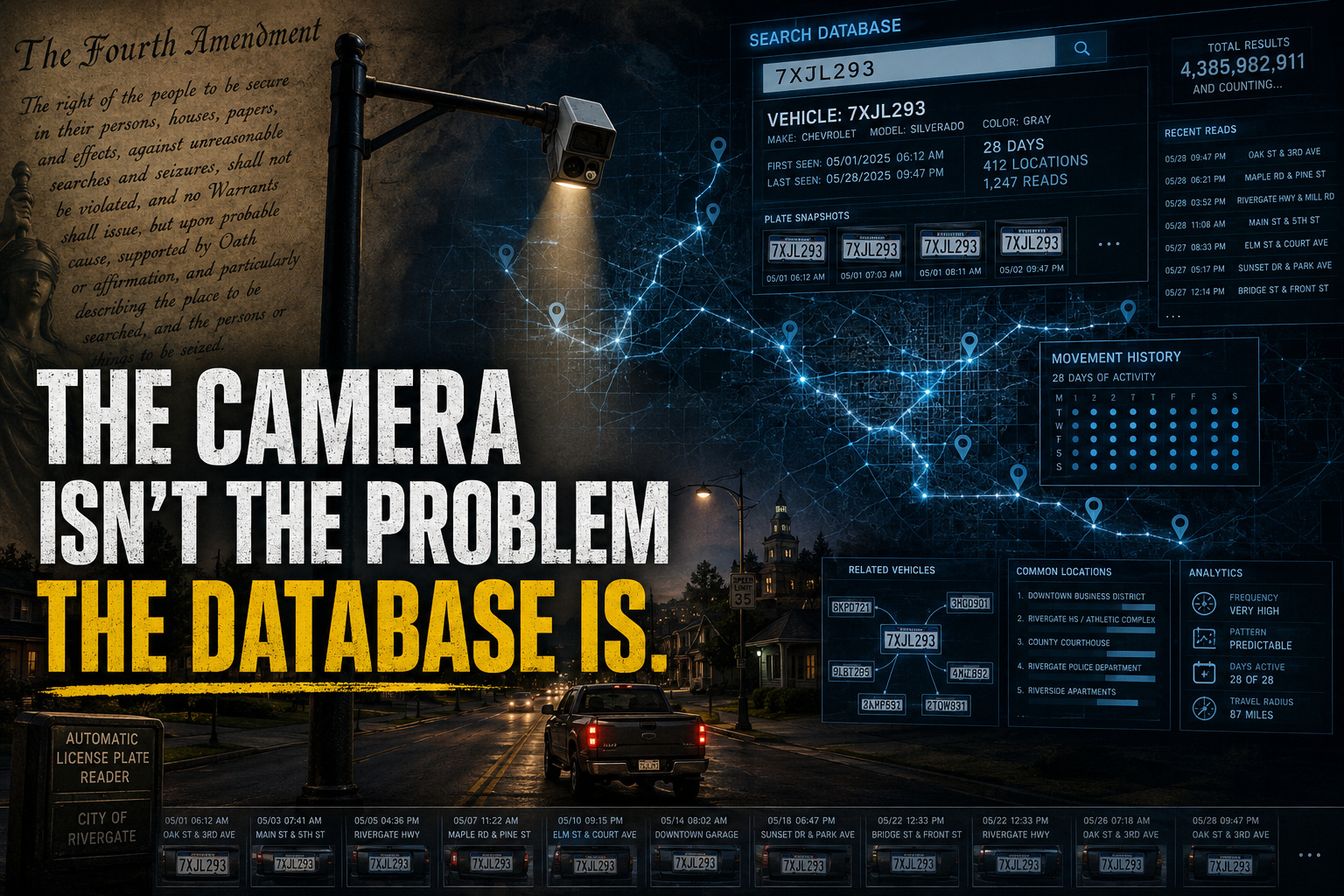
The Camera Isn't the Problem. The Database Is.
I’ve been thinking about Flock cameras and the Fourth Amendment, and the deeper I dig into it, the less comfortable I am with them. Before somebody starts with, “Your license plate is visible in public, therefore you have no expectation of privacy,” yes, I know. That’s true. It’s also completely missing the fucking point.
If a police officer is sitting beside the road and sees my truck drive past at 2:15 in the afternoon, I have absolutely no reasonable expectation that he didn’t see me. I’m in public, and my license plate is hanging right there on the back of the vehicle specifically so it can be identified. If a camera at an intersection takes a picture of that same plate, I don’t really have a problem with that either.
The camera isn’t what bothers me. The database is.
Flock isn’t simply replacing the cop sitting beside the road. It’s creating a gigantic, searchable historical record of where millions of people have been, the overwhelming majority of whom are suspected of absolutely nothing. That is a very different thing from a cop happening to see my vehicle drive past.
Imagine a detective in 1990 deciding he wanted to know everywhere you had been for the previous three months. He’d need surveillance teams, cars, officers working shifts, fuel, overtime, supervisors, and a frankly ridiculous amount of manpower. Even then, he couldn’t go backward in time. If nobody followed you Tuesday, Tuesday was gone.
Today, the government can potentially type in your license plate, click search, and discover that your vehicle passed one camera Monday morning, another Monday afternoon, another Tuesday night, and another outside some other town Wednesday. String enough of those observations together and we’re no longer talking about seeing a car on a public road. We’re talking about reconstructing somebody’s life.
Where do you sleep? Where do you work? What church do you attend? Who do you visit? Which doctor do you see? What political meetings do you attend? Where does your girlfriend live? Where does your ex-wife live? Which bar do you stop at every Thursday? You can learn an awful lot about somebody without ever looking through their bedroom window.
And that’s precisely where the Fourth Amendment problem starts.
The Supreme Court already recognized this problem with cellphone location data in Carpenter v. United States. There is a difference between seeing somebody at one particular place and giving the government a detailed historical picture of that person’s physical movements.
Then, just this year, the Supreme Court went even further in Chatrie v. United States. Police obtained Google’s historical location data during a robbery investigation, and the government argued, among other things, that it was only a relatively short amount of location history. The Supreme Court said that acquisition was a Fourth Amendment search and specifically rejected the idea that the Constitution somehow gives the government a free surveillance period just because the tracking doesn’t last very long.
More importantly to me, the Court talked about retrospective surveillance, and that’s the part people really need to understand. Police no longer necessarily have to decide to follow you before you do something. They can become interested in you today and ask a computer where you were yesterday, last week, or last month. That is an enormous change in government power, and Flock fits uncomfortably close to that model.
Now, to be fair, Flock and cellphone tracking aren’t identical. Your cellphone follows you into buildings; a license plate camera doesn’t. Flock cameras are fixed at particular roads and intersections, so they don’t necessarily know every single place you’ve been. That distinction matters legally, and a federal district court recently upheld Norfolk, Virginia’s Flock system partly because its camera network wasn’t comprehensive enough to reconstruct the whole of someone’s movements.
So no, I’m not going to pretend the Supreme Court has already declared Flock unconstitutional. It hasn’t. But that Norfolk case is now being appealed to the Fourth Circuit, which happens to be the federal appeals court governing North Carolina, and that’s where this gets particularly interesting.
The Fourth Circuit has already dealt with something very similar. Baltimore once operated an aerial surveillance system that photographed huge portions of the city and allowed police to work backward through the images to reconstruct where people had traveled. Every individual movement was outdoors, and every individual movement could theoretically have been observed by a police officer. Yet the Fourth Circuit concluded that accessing this accumulated record could reveal the whole of someone’s movements and therefore constituted a Fourth Amendment search.
And that is exactly the problem I have with the simplistic “But you’re in public!” argument.
Of course I’m in public. The Fourth Amendment was written in 1791. There weren’t satellites, databases, artificial intelligence, cellphone towers, or license plate cameras sitting every few miles recording millions of observations. Technology changes the scale of government power, and scale matters.
One cop watching you drive down Main Street isn’t the same thing as every cop in the country being able to ask a database everywhere you’ve driven for the last three months. Those aren’t remotely equivalent capabilities.
North Carolina law currently allows ALPR data to be retained for up to 90 days under its law-enforcement framework, with longer preservation possible under certain circumstances. Think about how much of your life happens in ninety days, and how detailed a picture could potentially emerge if enough cameras happen to catch your vehicle along the way.
And understand something else: I am not anti-police. I’m a former cop, and I completely understand why law enforcement loves this technology. A stolen vehicle drives past a camera? Fantastic. Amber Alert? Absolutely. Murder suspect’s vehicle gets detected heading toward another county? Hell yes, go get him. Flock can be an extraordinarily useful law-enforcement tool.
Useful does not mean constitutionally unlimited.
That’s the entire reason we have the Fourth Amendment. Warrants are inconvenient. Probable cause is inconvenient. Judges are inconvenient. Having to explain why you want to search somebody is inconvenient. That inconvenience is a feature because the founders intentionally put friction between the government and the citizen.
The easier surveillance becomes, the more likely surveillance becomes. Eventually the argument stops being, “We need this technology to find dangerous criminals,” and quietly becomes, “Why shouldn’t we look? The information is already there.”
That’s the line-crossing moment that bothers me.
I don’t believe the government should maintain a searchable historical record of everyone’s movements just in case one of us becomes interesting later. That’s backwards. Investigate crimes, develop suspects, establish probable cause, get a warrant, and then search the historical location database. That seems like an extremely reasonable constitutional line.
Frankly, I don’t care whether the surveillance device is attached to my bumper, carried in my pocket, hanging from a telephone pole, or flying ten thousand feet over the city. If the government can sit at a computer, type my name or license plate into a box, and reconstruct a meaningful portion of my life without ever establishing that I’ve done anything wrong, I have a Fourth Amendment problem with that. It also feels like it makes it far easier to invent a crime to fit a set of circumstances after the fact.
The constitutional question isn’t simply, “Could a police officer have seen your car?” Of course he could. The real question is whether the government should be able to follow every citizen indirectly, store those observations, search them instantly, share them across jurisdictions, and travel backward through months of somebody’s life without first convincing a judge that there is a legitimate reason to do so.
The government of 1791 couldn’t do that.
And if it could have, I strongly suspect the Fourth Amendment would have been considerably more specific.
Addendum:
One last thought, because I know somebody is going to make this argument: modern technology does not shrink your constitutional rights.
We hear this all the time with the Second Amendment. “The founders only had muskets. They couldn’t have imagined machine guns, AR-15s, drones, aircraft carriers, or modern weaponry.” Maybe not. It doesn’t matter. The Second Amendment protects a principle, not a catalog of weapons available in 1791.
The exact same logic applies to the Fourth Amendment.
The founders couldn’t imagine nationwide license-plate databases, cell-site tracking, facial recognition, artificial intelligence, or a computer capable of reconstructing months of your movements in seconds. That does not mean those technologies somehow fall outside the constitutional boundary simply because they are new.
The Constitution doesn’t freeze technology in 1791. It freezes the government’s boundaries.
If “arms” still means arms even when technology makes them exponentially more capable, then “searches” still means searches when technology makes government surveillance exponentially more capable.
You don’t get to argue that technological advancement expands the government’s power while simultaneously narrowing the citizen’s protections.
So yes, I believe the Second Amendment means what it says. If you can afford the machine gun (or hell, an aircraft carrier) I don’t believe the government should arbitrarily infringe your right to own it.
And by the same principle, I don’t believe the government gets to use twenty-first-century technology to quietly erase the protections of the Fourth Amendment.
Your rights don’t become obsolete because the tools got better.