We’ve all heard it a thousand times: trust the science, listen to the experts, the science is settled. And if you question any of it, congratulations, you’re apparently a science-denying idiot who probably thinks the Earth is flat.
What I’ve always found interesting about that argument is what happens when an actual scientist disagrees with the approved narrative. I mean someone with decades of experience, nearly 200 peer-reviewed scientific papers, and credentials coming out of her ears. Apparently we just stop listening to that particular scientist.
Meet Dr. Judith Curry. She’s a climatologist with a Ph.D. from the University of Chicago. She spent decades researching climate science, served as chair of the School of Earth and Atmospheric Sciences at Georgia Tech, and has authored or coauthored 192 peer-reviewed scientific papers. In other words, she isn’t some guy sitting in his basement in a tinfoil hat explaining how the government controls hurricanes.
If anybody qualifies as one of the experts we keep getting told to trust, it’s her. Only she doesn’t agree with everything we’re being told about climate change, which has made her inconvenient.
The problem isn’t climate change, it’s certainty
For the record, Curry has never said climate change is a hoax. She accepts that the planet is warming and that humans are part of the reason. Where she parts ways with the official line is on the details: how the warming splits between human activity and natural variability, how far long-term climate projections can be trusted, whether some of the consequences are being exaggerated, and whether the proposed solutions actually make economic sense.
And this is where it gets interesting, because there’s an enormous difference between saying the Earth is warming and claiming we know precisely how catastrophic it will become, exactly when disaster will strike, and that the only fix is to fundamentally restructure the global economy.
The mainstream scientific evidence strongly supports human activity as the dominant cause of modern warming. Fine, that’s what the evidence indicates. But even the Intergovernmental Panel on Climate Change acknowledges uncertainty in its projections, so why does the public conversation so often sound as if uncertainty no longer exists?
When skepticism becomes heresy
In 2017 Curry retired from her tenured position at Georgia Tech, and she said publicly that the environment surrounding climate science had become toxic and politically charged. That’s a respected scientist, decades into her career, deciding the culture around her own field had turned so hostile that she wanted out.
None of which proves she’s right. Other scientists have pushed back on her conclusions, sometimes with substantial evidence, and I have no problem with that, since pushback is the whole process. Somebody proposes a theory and somebody else challenges it, everyone looks at the evidence, and the better explanation wins. What isn’t part of the process is declaring the discussion finished and handing out ideological demerits to anyone asking uncomfortable questions, which looks a lot more like a church with a peer-review department than like the scientific method.
Somehow we’ve reached the point where questioning the severity of climate projections, or whether climate policy actually works, can get treated as denying climate change altogether. Imagine an engineer tells you your house has a foundation problem, and a second engineer agrees there’s a problem but thinks you can fix it for $15,000 instead of demolishing the entire house. You wouldn’t accuse the second engineer of denying the existence of foundations. You’d probably thank him for saving your damn house.
Then there’s the media
There’s a popular meme comparing Greta Thunberg, who became famous as a teenage climate activist, with Judith Curry, the accomplished climate scientist, claiming that Greta gets endless media attention while Curry gets none. That’s an exaggeration. Curry has appeared in major media and testified before Congress, and she participated in a 2025 Department of Energy climate report.
The meme is still getting at something real, though. Emotional appeals about impending catastrophe tend to pull in far more attention than technical talk about uncertainty and competing risks, or about what climate policy will do to the economy, and I’d like someone to explain why. Greta is an activist, and that’s fine, since activism has its place. It just isn’t scientific expertise.
Put a frightened teenager warning that our future is being stolen up against a climatologist spending 45 minutes explaining uncertainty in climate models, and we all know which one makes better television. Fear sells, and so do outrage and catastrophe. As for a thoughtful discussion about probabilities and economic tradeoffs, good luck squeezing that into a 30-second segment between commercials.
To be fair, journalists shouldn’t pretend one dissenting scientist represents half the scientific community. That would mislead people too. But reporting a consensus accurately is a different thing from treating every challenge to its conclusions as forbidden territory.
And Then the AI Proved My Point. Sort Of.
Here’s something almost too ridiculous to make up.
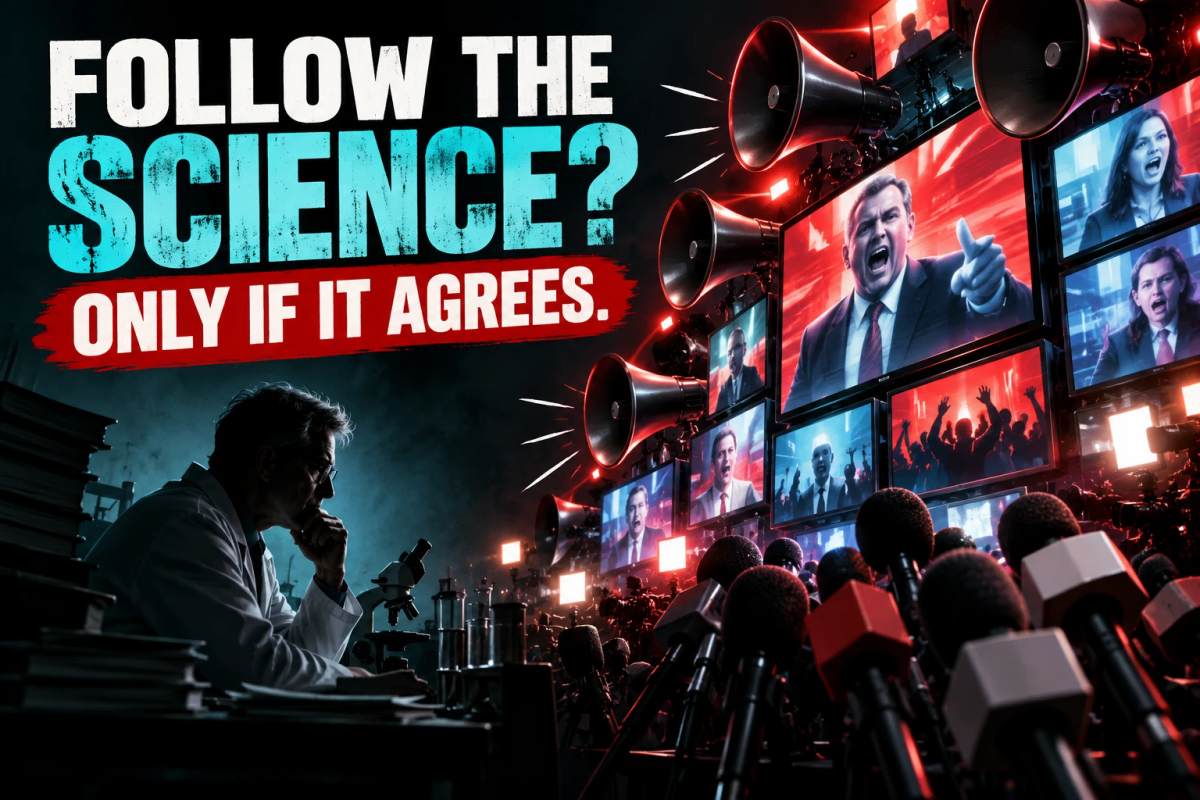
While writing this very article, I asked ChatGPT to generate a thumbnail for it. Nothing particularly outrageous. Just an image representing the idea that scientists who challenge the prevailing narrative don’t always get a fair hearing.
The AI refused to generate it.
So we tried again.
Rejected. Again.
One rejection suggested the image might resemble copyrighted or third-party content. The other vaguely cited content policies.
Now, was the system deliberately censoring climate skepticism? I can’t prove that. It could just be an overzealous automated filter that doesn’t understand context.
But isn’t that interesting?
I’m writing about the danger of allowing institutions to decide which viewpoints are acceptable, and an AI system won’t even let me illustrate the article. Worse, it can’t tell me exactly why.
And that’s the larger concern. When algorithms become the gatekeepers of public expression, they don’t have to intentionally censor an idea to effectively suppress it. They just have to keep rejecting it without explanation.
Apparently, even questioning whether we’re allowed to question the narrative can be a problem.
You really can’t make this shit up.
Follow the money, and the policy
This is where it stops being an academic debate. Climate policy means trillions of dollars, enormous government regulations, and energy infrastructure, and it shapes how ordinary people live, right down to how electricity gets generated, what vehicles we’re allowed to buy, how we heat our homes and which industries survive. You’d hope decisions on that scale would get more than slogans.
Some aggressive climate policies may well be justified, while others could turn out to be expensive, ineffective, or counterproductive. You can’t sort out which is which by announcing that scientists agree carbon dioxide warms the planet. A scientific finding isn’t a political mandate, or at least not automatically.
What science does well is explain the risks, estimate future outcomes and weigh the evidence. How much society should spend, who should pay, and which tradeoffs we’re willing to live with are public policy questions, not scientific commandments, and the public deserves to hear competing arguments before politicians start spending trillions of dollars supposedly on our behalf.
I don’t need climate change to be a hoax
The part that seems completely lost in this ridiculous debate is that I don’t need climate change to be a hoax in order to question climate policy. I don’t need Judith Curry to be right about everything to believe her arguments deserve serious consideration, and I certainly don’t need to believe every climate scientist is participating in some enormous conspiracy.
Scientists can be sincere and still be wrong. An institution can do valuable work and pick up biases along the way, and a journalist can report a legitimate finding while leaning hardest on its most frightening interpretation. None of that takes a secret meeting of villains plotting to control the weather. Ordinary human incentives will get you there, with some help from politics and institutional pressure and a media industry that knows fear attracts attention.
We can acknowledge human-caused warming and demand rigorous science, protect the environment and insist on affordable energy, and question government policy while we’re at it, without any of those positions canceling out the others. Science doesn’t become more trustworthy by shielding its conclusions from scrutiny. It earns trust by surviving it.
The climate may be changing, but the scientific method shouldn’t have to change along with the political narrative.



Letters to the Editor
Agree, disagree, or set me straight. The comments are open.