The Electoral College Isn't Broken. You Just Don't Understand What It's For.
Every election, this meme comes back around:
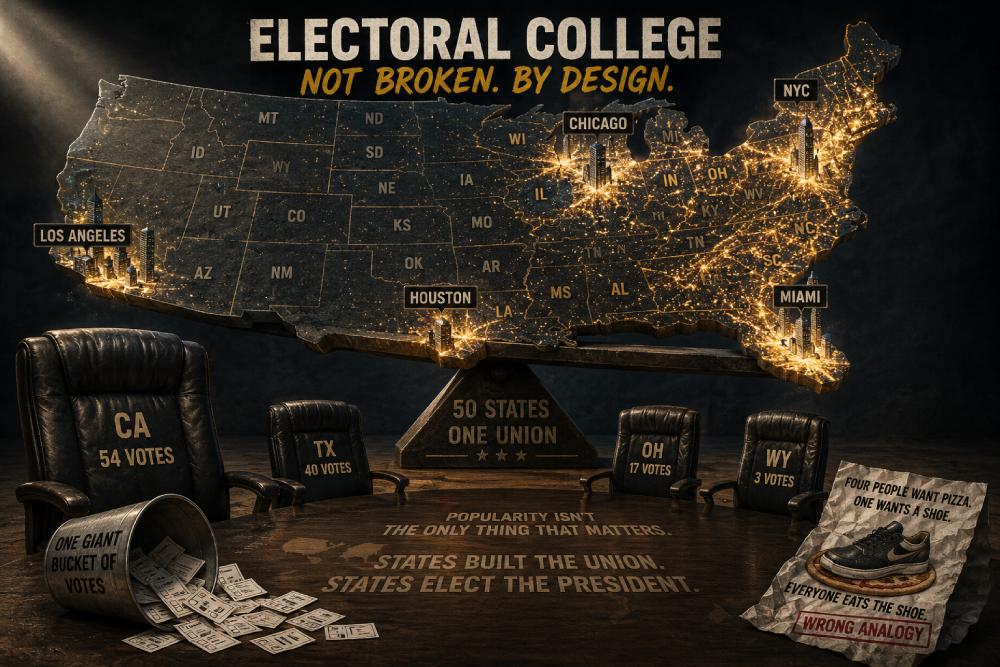
“Four people want pizza. One person wants an old shoe. Because she’s from Wyoming, everyone eats the shoe.”
It’s clever.
It’s also built on a complete misunderstanding of what the Electoral College actually is.
The meme assumes America is one giant democracy where 340 million people pile their votes into a single national bucket and whoever grabs the most wins.
That’s not the country we built.
We Are a Union of States. It’s Right There in the Name.
The United States is exactly what the name says it is: a union of states.
California isn’t a county. Texas isn’t a county. Wyoming isn’t a county. They’re sovereign states that agreed to form a federal republic. The President doesn’t get elected by one giant national headcount. He gets elected by the states, through a system that balances raw population against state representation.
That wasn’t an accident. It was one of the compromises that made the Constitution possible in the first place. The delegates fought over how to pick a president all summer of 1787. Some wanted a straight national vote. Some wanted Congress to choose. The Southern states weren’t going to accept a national popular vote, and the small states wanted a guarantee they wouldn’t get rolled over. The Electoral College was the deal that got everybody to sign.
Without it, the biggest states could permanently steamroll the smallest ones — and the smallest ones would’ve had no reason to join the Union at all. Why sign up for a club where you’re outvoted forever on day one?
A Better Analogy Than Pizza
The pizza thing falls apart because it imagines five people picking a restaurant.
Try five companies forming a partnership instead.
One company is huge. The other four are much smaller.
Should the biggest one get to pick the CEO forever, just because it has the most employees?
Of course not. The smaller companies would never sign that deal. So they negotiate something else — the big partner gets more influence, but not total control. Everybody has a seat. Nobody gets absolute rule.
That’s the Electoral College.
And No, Wyoming Doesn’t Outweigh California
This is the part the meme quietly skips.
California currently has 54 electoral votes. Wyoming has 3.
California has eighteen times the influence.
Now, to be fair to the meme, there’s a real point buried in it. Per person, a Wyoming vote does count for more. Wyoming gets one electoral vote for roughly every 195,000 residents. California gets one for roughly every 730,000. That makes a Wyoming voter worth about 3.7 Californians.
That’s not a glitch. Every state gets two electoral votes for its two senators, no matter how small it is: the same deal that gives Wyoming two seats in the Senate. It’s a bump, not a veto.
Wyoming doesn’t outweigh anybody. The Electoral College just keeps Wyoming from getting rounded down to zero.
Now Actually Abolish It. Then What?
This isn’t just a meme fight, either. Under the National Popular Vote Interstate Compact, states agree to hand all of their electoral votes to whoever wins the national popular vote, no matter how their own state voted. It kicks in once the states that have signed on hold 270 electoral votes. Virginia joined in April 2026, which brought it to 222. That’s 48 electoral votes away from turning the Electoral College into a national popular vote without ever amending the Constitution.
So say we scrap it. Where do presidential candidates campaign?
Wherever votes are cheapest to get, and votes are cheapest where people are packed together. The money and the rallies would tilt toward Los Angeles, New York, Chicago, Houston, Dallas, Phoenix, Atlanta, Miami, and Philadelphia, because one stop there reaches more voters than a week of driving across Montana.
To be fair, that alone wouldn’t win it. Those nine metros hold about 82 million people, roughly a quarter of the country, and nobody wins with a quarter. But that’s where the center of gravity would move, and the farther you live from it, the less a campaign would care what you think.
Rural America wouldn’t lose its vote.
It would lose its relevance.
And yes, I know the comeback, because it’s a real one: the Electoral College doesn’t exactly have candidates touring Wyoming either. In 2024, 246 of the 262 general-election campaign events happened in just seven swing states. Wyoming, Montana, the Dakotas, Idaho, and Mississippi got basically nothing.
That’s a fair hit. Winner-take-all turns the safe states, red and blue, into spectators. But look at who those seven states are: Pennsylvania, Wisconsin, Michigan, Georgia, Arizona, Nevada, and North Carolina. Rust Belt factory towns, Sun Belt suburbs, farm country, desert, small cities and big ones. To win them, a candidate still has to build a coalition that’s geographically broad instead of just densely packed. And the list changes. Ask Ohio or Florida how long swing-state status lasts.
The Part That’s Actually Ironic
The people who hate the Electoral College usually say they want everyone’s voice to matter.
The Electoral College exists precisely because it makes every state matter.
You can absolutely argue there are better ways to elect a president. That’s a real debate, and it’s worth having.
But if your argument is a meme about eating an old shoe, you’re not criticizing the Electoral College.
You’re criticizing a system that has never existed.