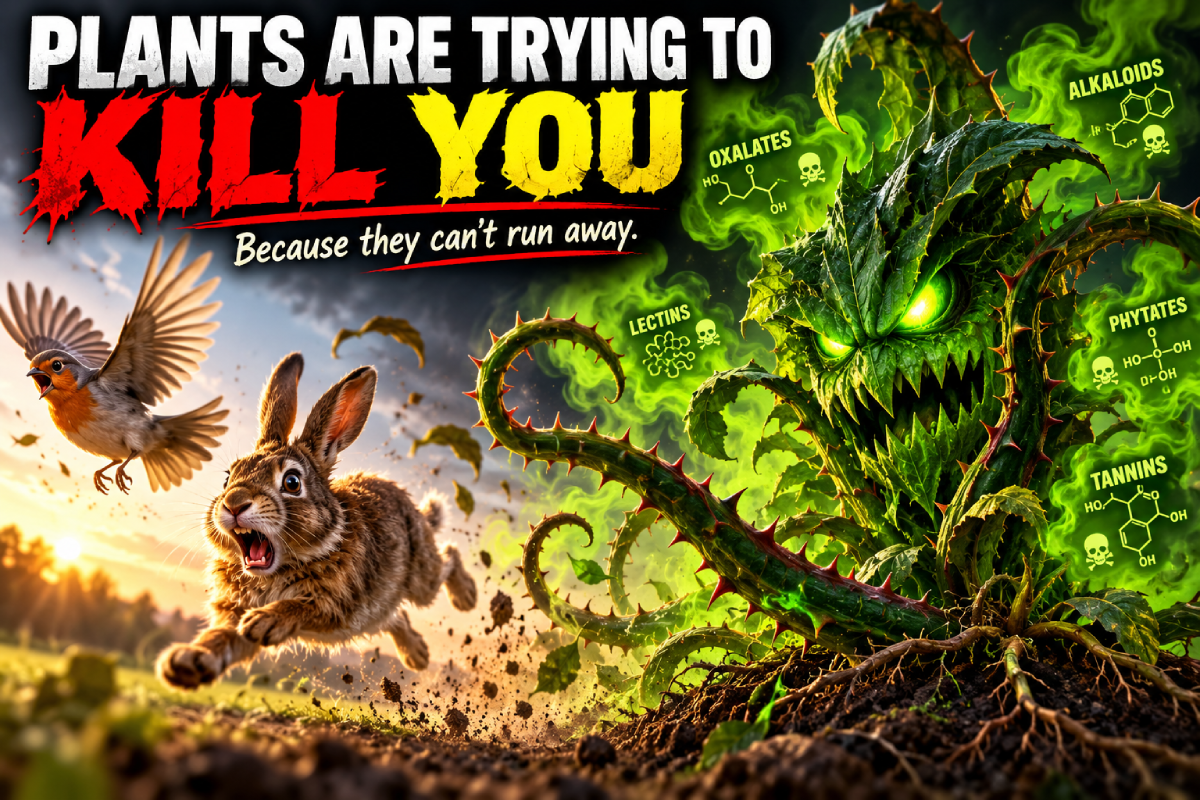
For my entire life, I’ve been told to eat my vegetables.
Vegetables are good. Plants are healthy. Kale apparently possesses supernatural healing powers, spinach will make you strong, whole grains will save your heart, and if you can somehow choke down enough Brussels sprouts you may eventually ascend beyond the mortal plane.
Except there’s one small problem nobody seems particularly interested in mentioning.
The plant doesn’t want you to fucking eat it.
That sounds like some carnivore-diet bumper sticker, but there’s actual biology underneath it.
Plants are living organisms whose entire evolutionary mission is basically the same as yours: don’t die before reproducing.
The problem for plants is that evolution really screwed them on mobility.
A rabbit sees you coming and takes off at 30 miles an hour. A deer runs. A bird flies. A cow can kick the shit out of you. A porcupine carries around its own personal collection of roofing nails.
A lettuce plant? It’s fucked.
It lives exactly where it was born. It can’t run. It can’t hide. It can’t bite you. It can’t climb a tree because, inconveniently, it is the tree.
So plants did what evolution does best. They improvised.
And many of them went with chemical warfare.
That isn’t fringe nutrition theory. Plant defense chemistry is an entire field of biology. Plants produce an enormous variety of compounds that discourage insects, animals, fungi, bacteria and other organisms from eating them. Some taste terrible. Some interfere with digestion. Some impair nutrient absorption. Some disrupt cellular processes. And some, in sufficient quantities, will flat-out poison you.
Researchers studying plant-herbivore interactions describe an enormous arsenal of compounds that can be toxic, repellent or antinutritive to the organism trying to eat the plant.
Plants can even recognize that they’re being eaten and change their chemistry in response.
Think about how wonderfully fucked-up that is.
An insect starts chewing on a plant, and the plant essentially says, Oh, we’re doing this? Fine, and starts activating chemical defenses. Some plants can increase defensive compounds. Some release volatile chemicals that attract predators of the insect eating them.
That’s right; the damn salad just called for backup.
Welcome to the Plant Chemical Weapons Convention
This is where we get into words like oxalates, lectins, phytates, tannins, alkaloids, glucosinolates and cyanogenic glycosides.
The video that originally sent me down this particular rabbit hole described many of these as plant-defense compounds and “antinutrients”, substances capable of interfering with digestion or binding minerals.
And yes, these things actually exist.
Phytates, common in grains, legumes, nuts and seeds, can bind minerals including iron and zinc and reduce their bioavailability.
Oxalates, found at particularly high levels in foods such as spinach, rhubarb and beet greens, can bind calcium and are relevant to calcium-oxalate kidney stones in susceptible people.
Tannins can bind proteins and interfere with iron absorption. They’re part of what gives things like tea and wine that dry, astringent sensation.
Lectins are carbohydrate-binding proteins found throughout the plant kingdom. Most of the lectins we encounter in properly prepared foods aren’t going to send us to the emergency room, but some absolutely can make us sick if the food is eaten improperly prepared.
And then there are alkaloids, which is a gigantic family of compounds that includes some wonderfully interesting characters.
Like nicotine. Nicotine wasn’t invented by Marlboro. The tobacco plant makes it.
Why, you ask? I’m so glad you asked.
Because nicotine is a remarkably effective natural insecticide. Experiments in wild tobacco have shown that plants prevented from making normal amounts of nicotine get eaten substantially more than normal plants.
And caffeine?
Yep. Also an alkaloid involved in plant chemical defense.
Apparently the coffee plant developed caffeine in part to deal with pests, and humanity responded by grinding the plant up, pouring boiling water through it and using the resulting pesticide to survive Monday morning meetings.
(We really are an extraordinary species.)
But Surely Our “Natural Foods” Aren’t Poisonous
Oh, vegetables are mankind’s natural food? Cool.
Now soak them overnight, throw away the water, boil the shit out of them, ferment some of them, grind others into powder, remove the poisonous parts, and whatever you do, don’t eat those beans raw or you’ll spend the evening communicating directly with God through your toilet.
That sounds like exaggeration. It isn’t.
The FDA specifically warns about phytohaemagglutinin, a lectin naturally present in raw and undercooked beans, particularly red kidney beans. Eat enough improperly cooked kidney beans and you can get nausea, severe vomiting and diarrhea.
Cooking destroys most of it.
So humanity discovered kidney beans and apparently the process went something like:
“Can we eat these?”
“No. They poison us.”
“What if we soak them?”
“Still poison.”
“What if we soak them, dump the water, replace it, and then boil the ever-loving shit out of them?”
“…Okay, now we can eat them.”
“Excellent. Put them in chili.”
This is how fucking determined humans are.
And kidney beans aren’t even the most dramatic example.
Cassava is a staple food for hundreds of millions of people, yet some varieties naturally contain cyanogenic glycosides that can release cyanide when the plant tissue is broken down. Proper processing dramatically reduces the danger. Improper processing can cause serious poisoning and, at sufficiently high exposure, death. The FDA explicitly discusses this problem along with naturally occurring toxins in other plant foods.
Again, I am not making the argument that cassava is evil.
Cassava does not have intentions.
It isn’t sitting underground stroking a tiny mustache waiting for a hungry Peruvian.
The point is that nature did not create every plant as a perfectly packaged Whole Foods product designed around human nutritional requirements.
We figured out how to eat them.
There’s a difference.
And Then There’s Fruit
Now here’s where we have to stop before this becomes stupid. Because some plants absolutely do want animals to eat part of them.
Fruit.
Fruit is the friendly neighborhood drug dealer of the plant kingdom.
“Hey buddy. Want some sugar?”
Why? Because the fruit itself often isn’t the important part.
The seed is.
For a huge number of plants, producing a delicious, brightly colored, sweet package around the seed is an evolutionary strategy specifically designed to attract animals. The animal eats the fruit, wanders away and later deposits the seed somewhere else frequently wrapped in its own convenient little pile of fertilizer.
Biologists call this seed dispersal.
I call it:
“Hey buddy, eat this package and shit my children somewhere else.”
And it works spectacularly well. A substantial share of woody plant species use animals to disperse their seeds, with fleshy fruits evolving specifically around these plant-animal relationships.
So fruit gets something of a pass here. Fruit and plant have negotiated terms.
You get calories. The plant gets transportation. Everybody wins.
The leaf? Different arrangement. The plant generally needs that.
The root? Definitely needs that.
The seed itself? That’s basically the plant’s baby.
So it shouldn’t surprise anyone that plants often concentrate protective chemistry in precisely the tissues where having some asshole eat everything would be evolutionarily inconvenient.
Does This Mean Spinach Is Trying to Murder You?
No.
And this is where both sides of the nutrition wars usually become insufferable.
Someone discovers that plants contain defensive compounds and immediately announces that broccoli is toxic and humans should live exclusively on ribeye.
Someone else hears that and responds as though the very existence of plant-defense chemistry is misinformation invented by Big Steak.
Both positions are ridiculous.
Plants contain defensive chemicals. That is simply biology.
But the existence of a defensive chemical does not automatically mean that eating normal amounts of a properly prepared food is harmful.
Dosage is important. How you prepare it is kind of important, your physiology also comes into play, and the specific compound kind of matters.
Some of these so-called “antinutrients” also appear to have potentially beneficial biological effects. Phytates, tannins and other plant compounds may interfere with nutrient absorption under some circumstances while acting as antioxidants or producing other potentially useful effects under others. Modern reviews increasingly describe this as a context-dependent continuum rather than a neat little box marked GOOD or POISON.
Welcome to biology. It’s messy. Wear a helmet because apparently nature neglected to read Twitter.
But That’s the Part I Find Interesting
For decades, we’ve talked about plants almost entirely in terms of what they supposedly contain for us.
Vitamin C. Fiber. Potassium. Antioxidants. Look at all these nutrients!
But that’s a very human-centered way of looking at an organism that spent hundreds of millions of years evolving without giving the slightest shit about our nutritional guidelines.
Plants aren’t vitamin factories. They’re organisms. And every organism plays defense.
The rabbit developed speed.
The turtle developed armor.
The porcupine developed a coat of roofing nails.
And the skunk apparently said, “Fuck all of you,” and weaponized its ass.
Plants developed thorns, tough fibers, bitter flavors, toxins, enzyme inhibitors, alkaloids and an absolutely astonishing chemical arsenal.
Some plants even outsource security by producing chemical signals that attract the enemies of whatever is currently chewing on them.
That’s not a vegetable. That’s a goddamn biological home-security system.
And humans? Humans showed up, poked at all of this stuff for a few hundred thousand years, occasionally poisoned ourselves, and eventually figured out:
Cook that. Soak this. Ferment those. Don’t eat that part. Peel this one. Wait until that one ripens.
And for the love of God, do not eat the green potato.
That isn’t evidence that humans cannot eat plants.
It is evidence that humans are unbelievably good at figuring out how to eat things that initially objected to the arrangement.
So What the Hell Does Any of This Mean?
It does not mean you need to empty your refrigerator and replace the vegetable drawer with bacon. (Hrmm, Although….)
It does not prove that carnivore diets are optimal.
It does not prove vegetarian diets are unhealthy.
It doesn’t even prove that a particular plant food is causing you a problem.
What it means is much simpler:
Stop pretending plants are biologically neutral.
They aren’t.
The original argument that got me interested in this claimed that because humans lack the digestive systems of true herbivores and because plants contain these compounds, humans were never really meant to depend heavily on plants.
I think that goes farther than the evidence can support.
Humans clearly can eat plants. We have been doing it for a very long time.
But our ability to eat something doesn’t magically mean that thing evolved for our benefit.
There’s an important distinction between:
“Humans can eat this.”
and
“This organism exists to nourish humans.”
The first statement is biology.
The second is basically Disney.
Maybe spinach works fantastically for you. Eat spinach.
Maybe beans agree with you. Eat beans.
Maybe eating a giant salad makes you feel like someone inflated your intestines with a bicycle pump. Perhaps stop eating giant salads.
Nutrition has somehow become this bizarre ideological battlefield where people feel obligated to defend entire kingdoms of life.
You don’t owe plants loyalty.
They certainly don’t owe it to you.
Eat the foods that work for you, prepare them correctly, understand what they contain, and stop pretending nature is a benevolent grandmother standing in a garden asking whether you’ve had enough vegetables.
Nature is brutal.
Everything alive is trying to survive.
Plants just had the unfortunate evolutionary luck of being bolted to the fucking ground.
So they learned chemistry.
The rabbit runs away. The deer runs away. The bird flies away.
The plant stays right where it is and quietly invents poison.