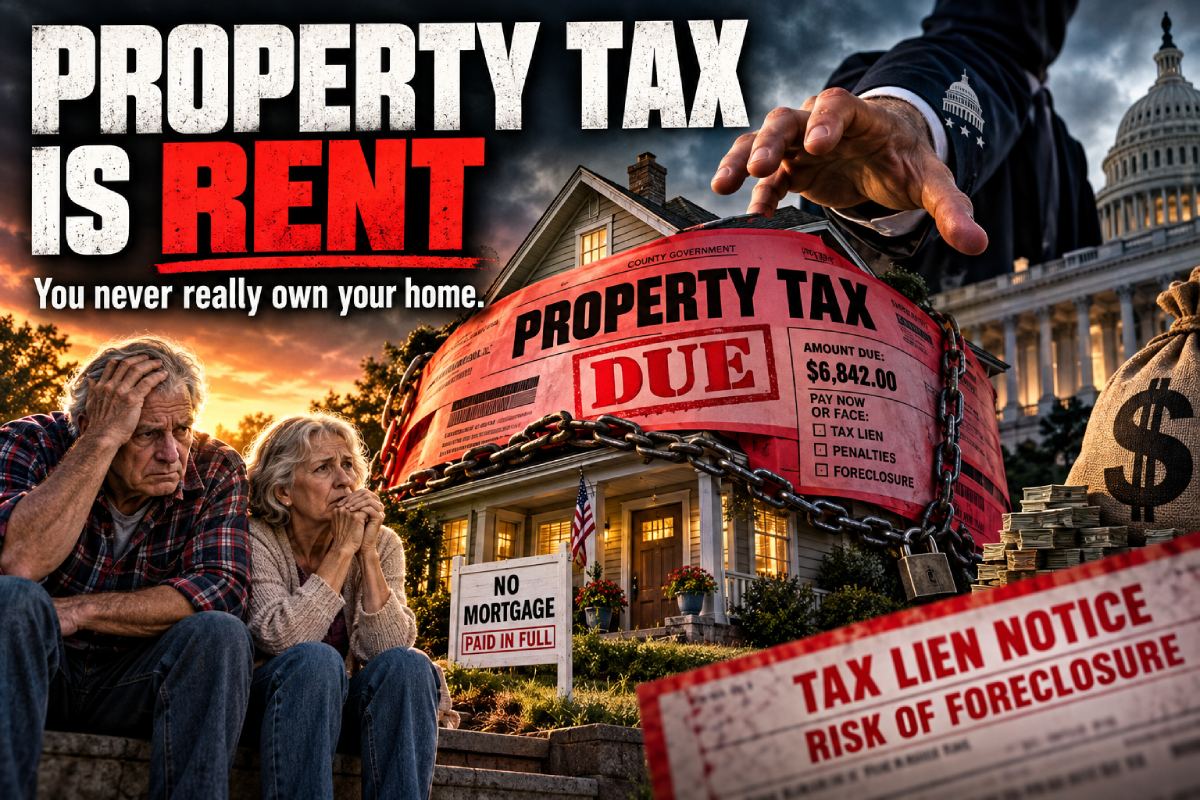
There are a lot of taxes I don’t like.
- Income tax annoys the hell out of me because apparently the government deserves a percentage of my labor simply because I had the audacity to earn money.
- Sales tax means I get taxed again when I spend the money they already taxed when I earned it.
- Capital gains tax means if I invest what’s left and manage to make more money with it, somebody is standing there with their hand out again.
But property tax might be the most fundamentally fucked-up tax of them all, because it attacks the very concept of ownership.
Think about what we’re told our entire lives: work hard, save money, buy a house, spend thirty years paying off a mortgage, build equity, and eventually you’ll own your home outright and have someplace secure to live when you’re old.
Except you don’t.
You can pay the bank every penny you owe. You can burn the mortgage paperwork in the backyard, frame the satisfaction letter, and dance naked around the kitchen celebrating the fact that after thirty years the house finally belongs completely to you.
Then stop paying the government its annual fee for allowing you to continue possessing it and see what happens.
In Florida, for example, unpaid real-estate taxes can result in a tax certificate being sold against the property. After the statutory waiting period, the certificate holder can apply for a tax deed, beginning a process that can ultimately result in the property being sold at public auction.
You can have no mortgage whatsoever and still lose your house because you stopped paying rent to the government.
We just don’t call it rent. We call it a “property tax,” which apparently makes the whole arrangement sound more civilized.
And the truly bizarre part is what we’re taxing. It isn’t necessarily what you paid for the house, what you’ve spent maintaining it, money you’ve earned, or money sitting in your bank account. It’s what somebody estimates the house might theoretically be worth if you sold it.
People will correctly point out that property tax isn’t technically an unrealized-capital-gains tax. Fine. Legally and mechanically, they’re different things. But from the homeowner’s perspective, the similarity is pretty fucking obvious.
Your house goes up in theoretical market value. You haven’t sold it, you haven’t received the money, you haven’t deposited a profit into your checking account, and your paycheck didn’t suddenly get bigger because Zillow thinks your neighborhood got fancy. But your tax liability can nevertheless increase because you’re supposedly wealthier now.
Congratulations on all that imaginary money.
Please remit some actual money.
The $650,000 House That Became a $4.4 Million Tax Problem
There is a fantastic example of just how absurd this can become in Florida.
Walter and Debbie Priebe bought their Pompano Beach home in 2002 for $650,000. Years later, the house needed substantial work. There were termite problems, the roof was failing, and they eventually undertook a major renovation that included adding a second story.
They weren’t flipping it, converting it into a shopping center, or selling it to a hedge fund. They were improving the house they already lived in.
After the work was completed, however, the renovation triggered a reassessment under Florida’s property-tax rules. Their home was assessed at more than $4.4 million, and their annual property-tax bill reportedly jumped from roughly $15,000 to more than $90,000.
That’s about $7,583 every month in property tax alone, with no mortgage, electricity, homeowners insurance, groceries, or repairs included. Just the annual cost of continuing to possess the property you already own.
Florida does have protections intended to prevent exactly this kind of shock. Its Save Our Homes system generally limits annual increases in the assessed value of homesteaded property to the lower of 3% or the change in the Consumer Price Index. But Florida law also says that changes, additions, or improvements can be assessed at current “just value” after they’re substantially completed.
And that’s where this gets particularly perverse: improve your property too much and you can financially punish yourself for improving your property.
Think about the incentives that creates. You’ve owned a house for decades and it needs serious work. Maybe you want to renovate it so you can stay there as you get older. Maybe you want to add a bedroom so your elderly mother can move in. Maybe you finally have enough money to build the workshop you’ve wanted your entire life.
Before you pick up a hammer, apparently you’d better ask the government how much additional annual rent they’re going to charge you for improving the thing you supposedly own.
That’s insane.
And Then There Are Retired Homeowners
This gets even uglier when we’re talking about elderly people.
Imagine buying a fairly modest house in 1985 for $90,000. You raise your children there, work for thirty or forty years, pay the mortgage off, and retire. Then the surrounding area explodes in popularity. People move in, developers show up, a couple of houses down the street sell for ridiculous amounts of money, and suddenly somebody tells you that the little house you’ve lived in for forty years is now worth $700,000.
Wonderful.
Except you’re still living in exactly the same damn house. Your Social Security check didn’t increase by $610,000. There isn’t an extra $610,000 sitting in your checking account. You haven’t realized $610,000 in profit. You have exactly what you had yesterday: a house.
Yet depending on the jurisdiction and whatever exemptions or assessment caps exist there, rising valuations can mean rising taxes. So what’s the answer when an elderly homeowner can no longer afford them?
“Well, they can sell.”
Oh, fantastic. There’s the American dream.
Spend your entire working life paying off your home so that someday, when the neighborhood becomes sufficiently valuable, the government can price you out of it and graciously explain that you’re sitting on a valuable asset you can sell.
Maybe they don’t want to fucking sell it. Maybe that’s their home. Maybe their spouse died in that house, their kids grew up there, and there’s still a pencil mark on a doorframe showing how tall their daughter was in third grade. Maybe they specifically spent thirty years paying the damn thing off because not having to leave it was the whole fucking point.
Property ownership shouldn’t become unaffordable simply because everybody else’s willingness to pay for nearby property went through the roof.
“But Property Taxes Pay for Schools and Fire Departments!”
Yes, they do. Counties, municipalities, school districts and special districts use property-tax revenue to fund public services. Police cost money. Fire departments cost money. Schools, roads, libraries, and everything else local government does cost money.
I’m not arguing that government services magically become free because I don’t like the method used to fund them. I’m arguing that “we need revenue” and “therefore this particular method of collecting revenue is sensible” are two completely different propositions.
If tomorrow we funded the fire department by randomly selecting twelve homeowners every year and taking their cars, the fact that firefighters need trucks wouldn’t suddenly make the financing mechanism reasonable.
The question isn’t whether public services cost money. Of course they do. The question is whether an annual tax on the theoretical market value of an asset someone already owns is a fair and sustainable way to collect that money.
I don’t think it is.
And before somebody says, “Well, wealthy people with expensive homes should pay more,” understand where that logic leads, because we’re constantly told how outrageous it would be to tax people on wealth they haven’t actually realized.
“Elon Musk’s stock went up! Tax the increase!”
And somebody immediately responds, “But he hasn’t sold the stock. That’s unrealized wealth.”
Fair enough.
So explain to me why Grandma’s house is different.
Her $150,000 house becomes an $800,000 house because the neighborhood changed around her, and suddenly everybody seems perfectly comfortable sending her a larger annual bill based on wealth she hasn’t realized either.
Apparently unrealized wealth is sacred when it’s sitting in a brokerage account, but if it has a roof and Grandma sleeps inside it, break out the calculator.
There Has to Be a Better Way
I’d much rather see government revenue tied primarily to actual economic transactions — money being earned, spent, transferred or consumed — than to continued possession of property somebody already bought.
I’ve written before about my preference for consumption-based taxation, particularly systems that protect necessities while putting progressively heavier taxes on luxury consumption. There are plenty of legitimate arguments to have over exactly how such a system would work, how much revenue it could realistically replace, and what unintended consequences it might create.
Fine. Let’s have those arguments.
But at least the taxable event would be an actual event. I bought something. I sold something. I consumed something. Money changed hands.
Property tax can effectively say, “We looked around your neighborhood and decided your house is worth more now.”
Okay. Am I selling it? No. Did anybody give me that money? No. Did I receive some sort of dividend? No.
Then where exactly am I supposed to get the additional cash you’re demanding?
Not their problem.
And that, more than anything, is what bothers me about property taxes: they’re disconnected from liquidity. The government can decide you became richer on paper, then demand that you somehow produce actual dollars to satisfy the resulting bill.
Ownership Should Mean Something
Maybe “you don’t really own your house” is deliberately provocative language. Fine. I’ll own that.
Legally, obviously, you own the property. But ownership with a mandatory annual payment attached to it — a payment that can change because other people decided property around you became more valuable, backed by the government’s ultimate ability to put a lien against the property and eventually force a tax-deed sale if taxes remain unpaid — is a strange kind of ownership.
At minimum, we should be willing to admit that.
Because there is something deeply fucked up about telling an elderly couple:
“Congratulations. You worked hard. You bought your home. You maintained it, improved it, paid off the mortgage, and did everything we told you responsible adults were supposed to do.
“Unfortunately, everybody around you got richer, your neighborhood got expensive, and according to our spreadsheet the property underneath your ass is now extremely valuable.
“So your bill went up.
“Pay us. Every year. Forever.”
And if someday you can’t?
Well, apparently somebody else gets to own your house.
That sounds like a lot of things.
Ownership isn’t the first word that comes to mind.