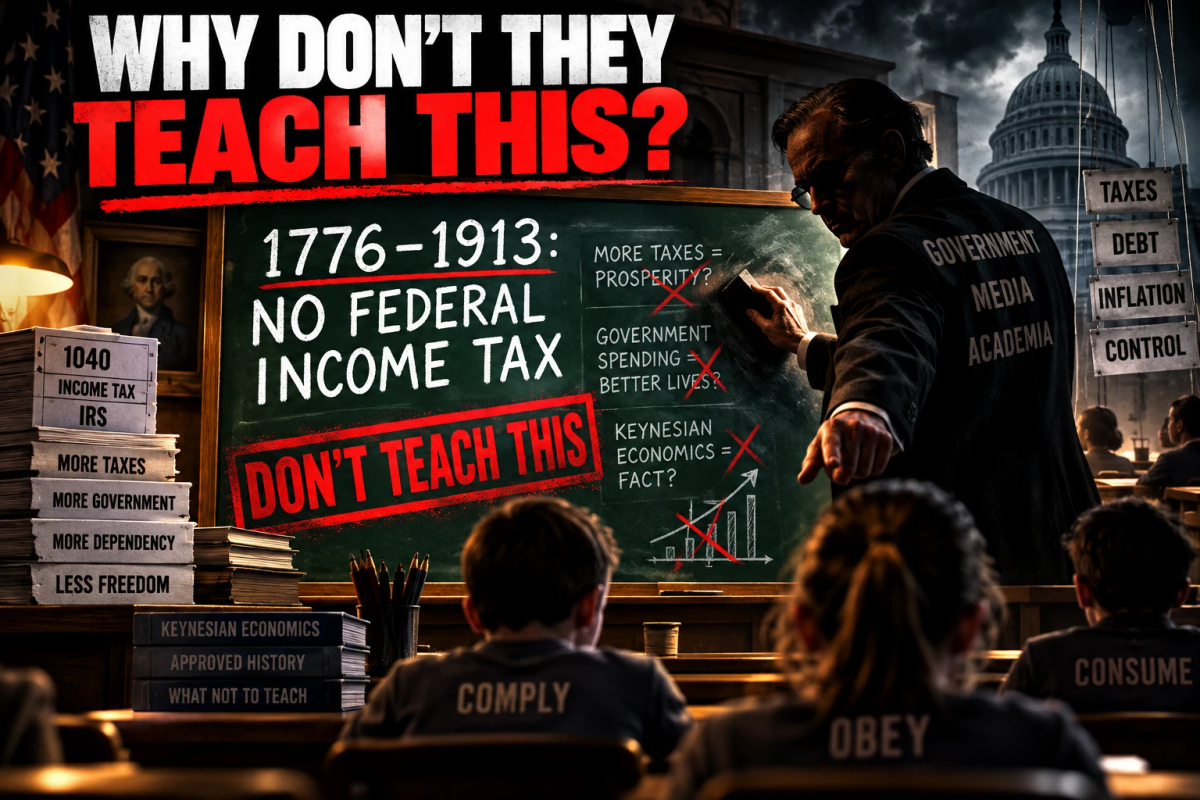
I suspect most Americans have never seriously considered this question: how the hell did the United States become one of the most powerful economies on Earth before the federal government started taking a permanent cut of everybody’s paycheck?
Seriously. Think about that for a minute.
We declared independence in 1776, set up a constitutional republic, and spread across a continent, building railroads, factories, steel mills, cities, and entire industries along the way. The country came through wars, economic disasters, and political upheaval, and by the beginning of the twentieth century it was already an industrial powerhouse. For most of that stretch, there was no permanent federal income tax.
How was that even possible? Listen to some of our politicians today and you’d think the economy would collapse by Thursday afternoon if Washington couldn’t reach into your wallet every two weeks. History tells a rather different story.
There was a temporary federal income tax during the Civil War, and it expired in 1872. Congress tried again in 1894, only to have the Supreme Court strike down important provisions of that law in Pollock v. Farmers’ Loan & Trust Co. It wasn’t until 1913, when the Sixteenth Amendment was ratified, that the constitutional path to the modern federal income tax was cleared.
Before then, the federal government mostly paid its way through tariffs and excise taxes. Those were real taxes, and tariffs could make imported goods more expensive for ordinary Americans, so I’m not pretending we lived in some magical tax-free paradise. My point is narrower. For generations, the federal government ran without treating an individual’s annual income as its main source of revenue.
What I find really interesting is how small the thing was at the start. When the modern income tax arrived in 1913, fewer than one percent of Americans paid it, and the basic rate was just one percent, with higher rates reserved for exceptionally large incomes. Imagine telling someone in 1913 what that system would grow into: that one day the federal government would collect income taxes from tens of millions of households, pull the money straight out of their paychecks, and keep an enormous bureaucracy busy administering the whole thing. They might reasonably ask what the hell happened. We could tell them it’s progress, I suppose.
Before someone starts screaming about the nineteenth century, yes, there were terrible working conditions, extreme inequality, financial panics, and plenty of other problems, and nobody is claiming everything before 1913 was wonderful. That isn’t my argument. My argument is that extraordinary economic growth happened without the enormous federal tax-and-spend apparatus we now treat as essential to modern civilization, which brings me to John Maynard Keynes.
The government’s favorite economic theory
Keynesian economics took hold during the Great Depression, especially after Keynes published The General Theory of Employment, Interest and Money in 1936. The basic idea is that when private spending collapses in a downturn, government can temporarily spend more or cut taxes to prop up demand, keep people employed, and help steady the economy. That’s a simplified version, obviously. And in a severe depression, with factories sitting idle and people desperate for work, there’s a legitimate economic case for temporary intervention.
But the philosophy has another half. When times are good, governments are supposed to show some fiscal restraint, rebuild their finances, and pay down debt.
Wouldn’t you know it, politicians seem to have a very selective memory about that part. They remember the spending and somehow forget the restraint, which makes it a wonderfully convenient economic theory for people whose careers depend on promising voters things somebody else has to pay for.
I’m not saying every Keynesian idea is nonsense. The problem is that the political version of Keynesian economics has become a nearly perfect justification for government that only ever grows. If the economy’s bad, we need more government spending, and if it’s good, well, now we can afford more government spending. Inflation hurting families calls for another program. An exploding national debt apparently proves the government needs more revenue.
At what point do we stop treating every problem as evidence that Washington deserves a bigger slice of the economy? And when are we allowed to ask whether some of these interventions might be feeding the very problems they’re supposed to solve?
The money doesn’t magically appear
Something else bothers me about all this, which is how routinely government spending gets discussed as though it creates economic activity out of thin air. Where do people think the money comes from?
Taxes, borrowing, or monetary expansion. Those work differently and have different consequences, but none of them conjures up unlimited real resources. If the government taxes a business owner $10,000 and spends it somewhere else, it hasn’t automatically created $10,000 in new wealth; it has moved purchasing power from one place to another.
Now, that spending might well buy something genuinely valuable. Roads, infrastructure, national defense, and other public services can support growth, and when resources are sitting idle in a recession, well-designed stimulus can generate real additional activity. It still isn’t a blank check. Whatever the government spends is money that can’t go to something else, and if it was borrowed in the first place, somebody is on the hook to pay it back. Printing it isn’t any better. You can create all the new dollars you like and the country won’t have any more houses or food or energy than it did the day before, never mind more skilled workers. Somehow we’ve convinced ourselves anyway that government spending and economic prosperity are the same thing.
According to the Congressional Budget Office’s October estimate, the federal government ran a deficit of roughly $2 trillion in fiscal year 2026. Two trillion dollars more spent than collected, and we’re supposed to believe that’s a sustainable model.
Try running your household that way. Every year you spend a lot more than you earn, and every time your spouse asks how you’re going to pay for it, you explain that you’re stimulating the household economy. Eventually someone’s going to take away your credit cards, but Washington, unfortunately, gets to write the rules.
Now, why aren’t we teaching kids this?
This is the part that really pisses me off. Why don’t we teach our children the actual history of taxation, the competing theories of economics, and how government spending relates to private wealth creation?
The Council for Economic Education’s 2026 survey found that only 22 states require an economics course for high school graduation. More states require personal finance, which is genuinely encouraging, but knowing how a checking account works isn’t the same as understanding national economic policy. Some schools absolutely do teach tax history and competing economic theories. Good for them. I just don’t see why a serious grounding in economics isn’t a basic requirement for every student.
As things stand, somebody can graduate high school without ever being made to wrestle with how the federal government paid for itself before the income tax, or why the Sixteenth Amendment was needed in the first place. They may never have been asked what the Federal Reserve actually does, where money comes from, what happens when the government borrows, or what inflation is and who wins or loses when purchasing power shifts. And perhaps most important of all, nobody has asked them who benefits when ordinary Americans don’t understand any of this.
I’m not suggesting every teacher is in on some grand conspiracy. Most teachers are doing their jobs, and plenty of them would probably love to teach more practical economics. What I question are the incentives in a system where the government helps set educational requirements, funds public education, and then graduates citizens who may never have seriously questioned the economic foundations of government itself. You don’t need a secret meeting in a smoke-filled room to produce institutional bias; sometimes a system that rewards certain assumptions and rarely challenges them is enough. A financially ignorant population is a hell of a lot easier to govern than one that can follow where the money goes. That isn’t proof of a coordinated plot, but it’s a pretty obvious institutional incentive, and one we ought to be willing to look at.
Teach them to think, not just comply
I don’t want schools telling children that Keynes was an idiot and every government program is evil. I want them teaching Keynes, and Hayek, and Friedman, along with the other economic theories that disagree with one another. Show students the arguments, the history, and the actual federal budget, and let them work out what happens to a dollar as it moves through taxes, government spending, debt, investment, and inflation.
Teach them that markets can fail. Governments can fail too, and it won’t hurt them to figure out for themselves that economics isn’t some magical science where a politician pulls the right lever and everybody gets rich. And for God’s sake, teach them that the government doesn’t create the wealth it taxes just by collecting it.
Most wealth starts with people producing something of value. Workers, entrepreneurs, inventors, farmers, businesses, and investors take risks, put in labor, build things, and trade goods and services with one another, and while government can help provide the conditions for that, it shouldn’t automatically get the credit for having created all of it.
The federal income tax didn’t create the American economic miracle either. It was introduced into a country that was already an economic powerhouse, and that distinction matters, because if we teach children that prosperity depends mainly on government spending, we shouldn’t be surprised when they grow into adults who think every economic problem calls for more government intervention. If we never show them how America functioned before the modern income tax, they have no reason to wonder whether the system we have now is the best one possible, or to notice that the government didn’t invent American prosperity so much as figure out how to tax it.
Those are two very different things. Getting kids to see that might be the most important economics lesson we could teach them.


Letters to the Editor
Agree, disagree, or set me straight. The comments are open.