What If Oswald Wasn't the Whole Story?
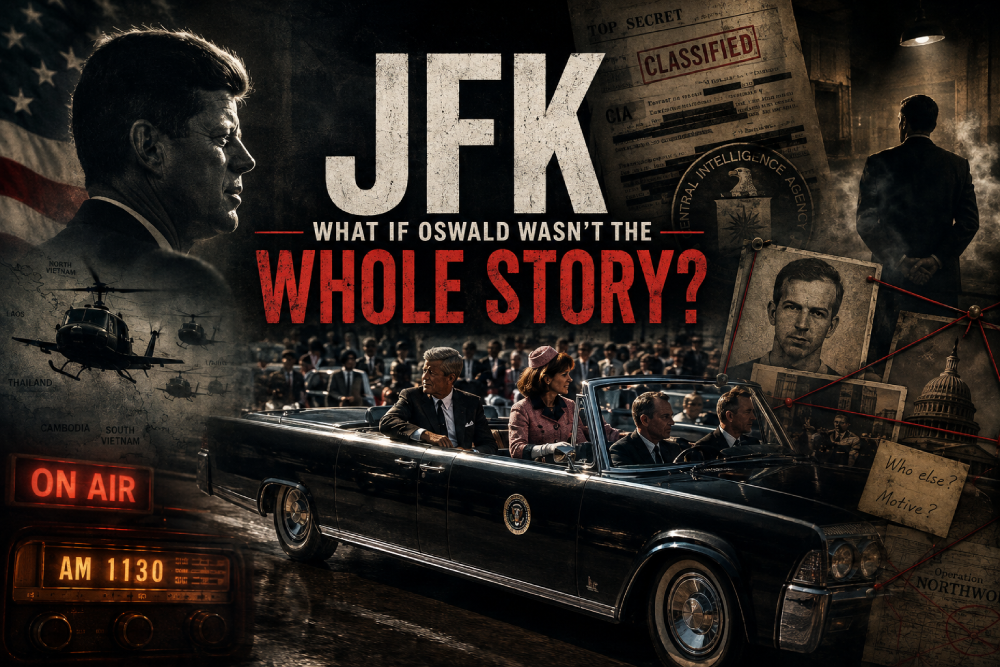
The JFK conspiracy theory you don’t have to make anything up to believe
I love a good conspiracy theory. Not necessarily because I believe it, but because every once in a while you start pulling on a loose thread and discover that the official version of history is considerably stranger than the conspiracy theory.
(Although sometimes it turns out the conspiracy theory was correct all along, and that can be mind-blowing in its own way.)
The assassination of John F. Kennedy is probably the granddaddy of them all. For more than sixty years we’ve heard every conceivable explanation for what happened in Dealey Plaza: the Mafia did it, the CIA did it, Castro did it, anti-Castro Cubans did it, Lyndon Johnson did it, the military-industrial complex did it, or some combination of all of them sat around a table smoking cigars and decided Kennedy had to go.
Most of those theories eventually wander into territory where evidence gives way to somebody drawing red string between photographs on a corkboard. That’s entertaining, but it also makes it easy to dismiss the entire subject as lunacy.
The problem is that you really don’t have to make much up.
There are enough documented facts surrounding Kennedy, the CIA, Vietnam, organized crime and the investigation of his assassination to produce one hell of a conspiracy theory using almost nothing except things the United States government itself eventually admitted.
So turn down the lights, pour yourself something strong, and imagine that somewhere in the Nevada desert an AM radio is crackling to life. (Yeah, I like Art Bell. Sue me.)
Because this gets weird.
Six Weeks Before Dallas
There’s a claim floating around social media that Kennedy signed something called the “Tonkin Act” shortly before his assassination, ordering American troops out of Vietnam. There was no such act. The Gulf of Tonkin Resolution wouldn’t exist until August 1964, nine months after Kennedy was dead.
But whoever mangled that story may have been reaching for something very real.
On October 11, 1963 — six weeks before Kennedy was assassinated — Kennedy approved National Security Action Memorandum 263. NSAM 263 adopted recommendations from Defense Secretary Robert McNamara and General Maxwell Taylor that called for withdrawing 1,000 American military personnel from South Vietnam before the end of the year. More importantly, the underlying plan called for training South Vietnamese forces to take over functions being performed by Americans so that it should be possible to withdraw “the bulk of U.S. personnel” by the end of 1965.
That doesn’t mean Kennedy had decided to abandon South Vietnam regardless of circumstances. The policy was based partly on optimistic assessments that South Vietnamese forces could increasingly handle the war themselves. Kennedy remained committed to preventing a communist victory, and nobody can know what he would have done had the military situation deteriorated in 1964 or 1965.
But it is equally misleading to pretend there was no withdrawal policy. There absolutely was, and people inside Kennedy’s administration understood its political significance. During the discussions leading up to it, McNamara argued that announcing the withdrawal was valuable because Senator J. William Fulbright and others feared America was becoming permanently bogged down in Vietnam. McNamara’s rather remarkable description was that the announcement demonstrated “we have a withdrawal plan.”
White House officials were talking openly about a future in which Vietnamese forces would finish the job without American military forces on the scene. An October 7 staff memorandum described the administration’s position as being that within two years the South Vietnamese would be able to continue without U.S. military forces present.
Then, on November 22, Kennedy went to Dallas.
You know what happened next.
Enter Lyndon Johnson
This is usually where the conspiracy version cheats. It tells you that Johnson immediately tore up Kennedy’s withdrawal order and reversed American policy the day after Kennedy died.
That isn’t what happened.
Four days after the assassination, Johnson issued NSAM 273, and it specifically stated that America’s objectives concerning withdrawal remained as previously stated. In December, the United States actually followed through and withdrew roughly 1,000 personnel.
That matters because if we’re going to play conspiracy detective, we don’t get to throw away evidence that hurts the theory.
What happened afterward, however, is difficult to ignore.
Eight months later came the Gulf of Tonkin incident. Congress passed the Gulf of Tonkin Resolution, giving Johnson extraordinarily broad authority to use American military force in Southeast Asia. By 1965, instead of approaching the point where Kennedy’s policy had envisioned withdrawing most American personnel, American combat troops were pouring into Vietnam. Eventually more than half a million Americans would be stationed there.
That isn’t proof that Kennedy was killed because of Vietnam. History is full of dramatic changes caused by circumstances rather than conspiracies. Johnson inherited a deteriorating situation, made his own decisions and ultimately chose escalation.
But as coincidence goes, it’s a hell of one.
The president who had approved a program intended to replace American personnel with Vietnamese forces dies. His successor eventually presides over one of the largest military escalations in American history.
And there was an enormous amount of money attached to that escalation.
Follow the Money
This is another place where the viral version gets sloppy. The claim is that Lady Bird Johnson owned Brown & Root, which later became associated with KBR and Halliburton, and that the company profited from the Vietnam War. Lady Bird Johnson did not own Brown & Root, KBR or Halliburton. That claim should be discarded.
But discard it carefully, because the real Brown & Root story is much more interesting.
Brown & Root was closely associated with Lyndon Johnson’s political rise. Herman and George Brown were major financial supporters of Johnson’s early career, while Johnson helped the company navigate Washington and obtain federal work.
Then came Vietnam.
In August 1965, as America’s military commitment was exploding, Brown & Root joined Raymond International, Morrison-Knudsen and J.A. Jones in the enormous RMK-BRJ construction consortium. According to the Navy’s own history, that consortium performed the lion’s share of heavy construction in Vietnam. It constructed the infrastructure an enormous American military needed: airfields, ports, logistics facilities, buildings and bases. The construction program ultimately ran into the billions of dollars.
Again, none of that tells us Brown & Root murdered Kennedy. There isn’t evidence establishing such a thing. But imagine hearing this story without knowing the ending.
A powerful Texas politician has longstanding ties to a giant engineering contractor. He unexpectedly becomes president following an assassination. Under his presidency America dramatically expands a war. The contractor becomes part of the consortium responsible for building much of the infrastructure required for that expansion.
If that were the plot of a political thriller, you’d complain that the screenwriter was laying it on a little thick.
And hanging over all of this was a warning delivered by another American president only three days before Kennedy took office. Dwight Eisenhower, a five-star general who certainly wasn’t some anti-military hippie, warned Americans about the growing power of what he famously called the military-industrial complex and specifically warned against the emergence of “misplaced power.”
Two years later, the President of the United States was dead.
Then There’s the CIA
This is the point where the story stops merely being suspicious and starts becoming genuinely bizarre.
Kennedy’s relationship with the CIA had been badly damaged by the Bay of Pigs disaster. The invasion failed spectacularly in April 1961, humiliating the new administration. Kennedy subsequently cleaned house. CIA Director Allen Dulles and senior covert-operations official Richard Bissell left the agency following the disaster.
A year later, during the Cuban Missile Crisis, Kennedy again found himself resisting military advice. The Joint Chiefs favored an air strike against Soviet missile sites followed by an invasion of Cuba. Kennedy instead imposed a naval quarantine and pursued the diplomatic path that ultimately ended the crisis without nuclear war.
Now add something Americans weren’t told at the time.
The CIA really was involved in assassination plots.
Not rumored assassination plots. Not Internet folklore. Assassination plots.
The Senate’s Church Committee later found concrete evidence of multiple CIA plots involving attempts to assassinate Fidel Castro between 1960 and 1965. Some involved poison, weapons and even organized-crime figures. The agency that features so prominently in JFK conspiracy theories actually was, during that same period, experimenting with ways of covertly killing political leaders.
That doesn’t mean the CIA killed Kennedy. There remains an enormous evidentiary gap between “the CIA plotted assassinations” and “the CIA assassinated the President of the United States.”
But it changes the question.
When somebody in 1964 suggested that intelligence officers might participate in a political assassination, the idea sounded fantastical. Decades later we learned that political assassination was literally something elements of the intelligence apparatus had been discussing and planning.
And now comes my favorite part of this entire story.
Who did Lyndon Johnson appoint to investigate Kennedy’s murder?
Allen Dulles. Yes, that Allen Dulles.
The former CIA director who had been forced out following the Bay of Pigs became one of seven members of the Warren Commission investigating the assassination of the president who removed him.
Even more remarkably, the Warren Commission didn’t maintain a massive independent investigative apparatus of its own. It relied heavily upon existing agencies … including the FBI, Secret Service and CIA … to investigate important aspects of the case.
So part of the government was effectively being asked to provide information necessary to determine whether anyone connected to the government had been involved.
What could possibly go wrong? As it turns out, quite a lot.
The Part the Government Eventually Admitted
Years later, the House Select Committee on Assassinations went back through the case. Its findings should bother anyone who has ever confidently announced that there was nothing suspicious about the Kennedy investigation.
The committee said the Warren Commission’s investigation of Lee Harvey Oswald himself was thorough, but concluded that its investigation into the possibility of conspiracy was inadequate. It specifically found that the FBI failed adequately to investigate possible conspiracy and that the CIA had been deficient in collecting and sharing relevant information. The committee concluded that the Warren Commission had acted in good faith, but that its conclusions were presented too definitively given the limitations of the investigation.
Read that distinction carefully because it’s important.
There is a tremendous difference between saying “the Warren Commission deliberately fabricated its findings” and saying “the Warren Commission didn’t have all the relevant information and didn’t adequately investigate conspiracy.”
The first remains an allegation.
The second is essentially the judgment of a later congressional investigation.
That means some of the distrust surrounding Kennedy’s assassination wasn’t created by conspiracy theorists. The government earned it.
And Then They Kept the Files Secret
Which brings us to the most recent chapter.
In March 2025, after an executive order from President Trump, the National Archives released more than 80,000 pages of previously classified JFK assassination records, followed by additional releases.
Those documents did not contain a signed confession from Lyndon Johnson. They didn’t reveal a CIA purchase order labeled THREE RIFLEMEN - DEALEY PLAZA. They did not suddenly establish that Kennedy was murdered in a military-intelligence coup.
But think about what we’re saying; John Kennedy was murdered in 1963.
The government was still releasing previously classified assassination records more than sixty years later.
There may be perfectly legitimate explanations for individual classifications: intelligence sources, foreign relationships, operational methods, privacy concerns and the bureaucratic tendency to classify something and then forget about it forever.
But institutionally, this is almost a perfect machine for manufacturing conspiracy theories. You cannot tell the public for generations that there is nothing more to see while simultaneously insisting that they aren’t permitted to see everything.
Eventually people start asking why.
So Who Killed Kennedy?
I don’t know.
Lee Harvey Oswald may very well have fired the shots that killed Kennedy. He may have acted entirely alone. The enormous historical record contains plenty of evidence pointing directly at him, and nothing I’ve written here establishes the existence of another shooter, much less identifies some secret committee that ordered the assassination.
But that’s what makes the Kennedy story fascinating. You don’t have to believe that Lyndon Johnson ordered a hit. You don’t have to believe Allen Dulles sat in a dark office plotting revenge. You don’t need the Federal Reserve, shape-shifting lizards, mysterious deathbed confessions or fabricated audio recordings.
Strip all of that away and you’re still left with something extraordinary.
A president enters office immediately after a five-star general warns America that an increasingly powerful military-industrial establishment could acquire dangerous influence. That president suffers a catastrophic break with his intelligence agency after the Bay of Pigs, removes its legendary director, resists military demands to attack Cuba during the most dangerous confrontation of the Cold War, and shortly before his death approves a policy intended to begin reducing America’s military presence in Vietnam.
He is then murdered.
The man who replaces him eventually takes America in precisely the opposite direction in Vietnam, creating an enormous war that pours billions of dollars into military contractors, including a company deeply connected to the new president’s political history. The former CIA director Kennedy removed is appointed to the commission investigating Kennedy’s death. The CIA and FBI fail to provide that commission with all of the information it needs. Decades later Congress concludes that the investigation of possible conspiracy was inadequate. Meanwhile, the American government continues withholding assassination records for more than half a century.
Does that prove there was a coup?
No.
But here’s the question that keeps this story alive for me: at what point does skepticism stop being irrational?
Maybe every one of those dots is unrelated. Maybe Oswald was exactly what the Warren Commission concluded he was and everything surrounding him is simply the astonishing background noise of Cold War America. History does occasionally produce coincidences so improbable that no novelist could get away with writing them.
But if that’s the case, the United States government has spent the last sixty years doing an absolutely spectacular impression of an organization that doesn’t want us looking too closely.
And somewhere around 2:00 in the morning, with the AM signal fading in and out somewhere over the high desert, that’s where I’d open the phone lines.
Audio note: The narration accompanying this piece is an AI-generated tribute to the style and atmosphere of Art Bell’s late-night radio broadcasts. It is not an authentic recording of Art Bell and is not affiliated with, endorsed by, or authorized by his estate, Coast to Coast AM, or any associated rights holders.