And Energy Is Too Important for Fairy Tales.
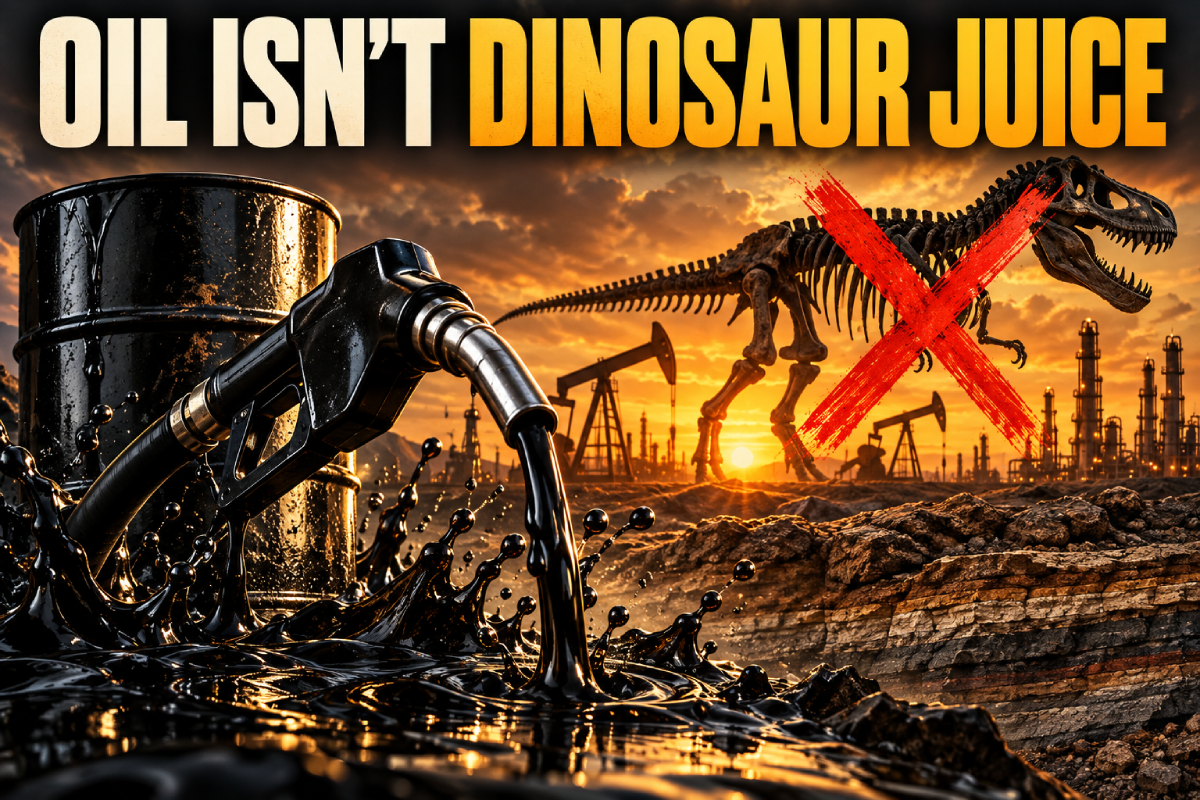
Somewhere along the way, one of the most important substances in modern civilization got reduced to a children’s-book explanation; Oil is dead dinosaurs.
In this ridiculous narrative dinosaurs died, got buried, turned into black goo, we drilled it up, and now we’re rapidly approaching the bottom of the prehistoric dinosaur milkshake.
Except that isn’t what petroleum geology actually says at all.
Your tank of gasoline is almost certainly not liquefied brontosaurus. Conventional petroleum is primarily associated with ancient organic material … algae, plankton, microorganisms and plant matter … that accumulated in sedimentary environments and was subjected to heat and pressure over geological time periods. Much of the material responsible for petroleum deposits predates the dinosaurs entirely.
So right out of the gate, the cartoon version most of us grew up hearing is wrong, bordering on absurd.
But this is where things get much more interesting, because hydrocarbons aren’t some magical substance that biology alone knows how to manufacture.
The Earth can make hydrocarbons all by itself.
Read that again. That isn’t conspiracy theory and it isn’t Facebook geology. Scientists have documented abiotic methane and other hydrocarbons generated through geological processes involving rock, water, heat, pressure and chemical reactions. Researchers have found them in ultramafic rocks, hydrothermal environments and deep geological settings, and experimental work has demonstrated hydrocarbon synthesis under mantle-like conditions.
What does that mean in plain English? It means the Earth can create hydrocarbon molecules through heat, pressure, water, and rock chemistry without anything ever having been alive. That does not mean oil fields magically refill forever, but it does mean the idea that hydrocarbons can only come from dead plants and animals is too simplistic by far.
Researchers have even reported evidence of abiotic organic compounds forming in material originating from the sub-oceanic mantle.
That should immediately make everyone stop using the phrase “dinosaur juice.”
Unfortunately, this is also where the Internet usually takes an interesting scientific fact, straps a rocket to its ass, and launches it directly into Crazytown.
Because proving that some hydrocarbons can form abiotically is not the same thing as proving that Saudi Arabia has a bottomless petroleum fountain connected to the center of the Earth.
Those are two very different claims.
Oil companies themselves have spent billions of dollars developing petroleum geochemistry precisely because different oils contain chemical fingerprints … biomarkers, isotopes and molecular signatures … that can frequently be matched to particular source rocks and depositional environments. This isn’t some theory somebody scribbled on a napkin in 1923. Petroleum exploration literally uses this science to figure out where oil came from and where more of it might be.
And research specifically examining abiotic hydrocarbons has found that, while they unquestionably exist, they do not appear to represent a globally significant source of the commercial petroleum reservoirs we presently exploit.
So no, I’m not going to replace one oversimplified story with another one just because the second story pisses off the establishment more.
But now we get to the part that actually upsets me.
Because none of that changes how spectacularly dishonest our public conversation about energy has become.
Energy isn’t some boutique political issue.
Energy is civilization.
Cheap energy means cheaper farming, cheaper transportation, cheaper manufacturing, cheaper construction, cheaper food, cheaper shipping and cheaper everything else that requires something to move, heat up, cool down, get built or arrive at your front door.
Raise the price of energy and eventually that increase works its way into practically everything you buy.
Which means energy policy doesn’t primarily punish billionaires.
The billionaire barely notices whether gasoline costs $2.50 or $5 a gallon.
The guy driving forty miles to work notices.
The single mother buying groceries, the plumber running three trucks, the farmer running diesel equipment, etc. They all notice.
The trucking company, when it notices the increase, passes the expense to Walmart. Walmart then passes it to you, and suddenly everyone is standing in the grocery aisle wondering why a cart full of ordinary food cost a small mortgage payment.
And yet we’re constantly presented with energy as though there are only two acceptable positions.
Either hydrocarbons are evil remnants of prehistoric death that humanity must escape immediately, or you apparently want children breathing refinery exhaust for breakfast.
That’s ridiculous.
We can simultaneously acknowledge that burning petroleum produces pollution and CO₂ and acknowledge that petroleum is one of the most useful, energy-dense, transportable and economically important materials humanity has ever discovered, bar none.
Both of those things can be true.
And I have the same problem with the way electric vehicles get discussed.
EVs are brilliant for some people.
They have tremendous acceleration, fewer drivetrain components, regenerative braking, excellent efficiency and the enormous convenience of starting every morning with a charged vehicle if you can plug in at home.
Great. Buy one.
But stop pretending that means they’re automatically the superior solution for every human being on Earth.
Someone towing a trailer hundreds of miles, living where charging infrastructure is sparse, traveling continuously, parking without access to overnight charging or needing extremely fast refueling has an entirely different transportation problem than somebody commuting twenty miles from a suburban garage to work every day.
Technology is supposed to solve people’s problems. People shouldn’t have to reorganize their lives to solve technology’s problems.
And meanwhile we have this absurd petroleum pricing machine that virtually nobody understands.
Right now, you see crude prices fall and naturally wonder why the giant illuminated sign at the gas station hasn’t moved down as well.
Because gasoline isn’t priced by taking today’s barrel price, dividing it by 42 and changing the Speedway sign before lunch.
Crude oil is only one component of the final price. We have to take into consideration refining capacity and margins, distribution, inventories, taxes, seasonal fuel requirements, regional supply disruptions, commodity markets, etc. These things all matter, and changes in crude prices can take time to work through wholesale and retail markets.
That’s a considerably more complicated explanation than “THEY’RE ALL FIXING THE PRICE.”
But frankly, the real system doesn’t need a smoke-filled room full of cartoon villains to deserve scrutiny.
Oil-producing nations can constrain supply.
Refiners operate within limited capacity.
Governments tax and regulate fuel.
Wars close shipping routes.
Traders speculate on future supply.
Companies understandably attempt to maximize profit.
And consumers sit at the very end of that gigantic machine with absolutely no negotiating power whatsoever, staring at a gas pump wondering why they’re paying what they’re paying.
That’s the conversation I want us having.
Not whether petroleum came from Fred Flintstone’s pet dinosaur, Dino.
Not whether hydrocarbons are magically infinite.
Not whether electric cars are salvation or Satan.
The question should be:
How do we produce the largest possible amount of reliable energy, as cheaply and cleanly as reasonably possible, while allowing technologies to compete instead of turning energy into another fucking religion?
If solar gets cheaper, build solar.
If nuclear provides enormous amounts of reliable baseload electricity, build nuclear.
If an EV works better for you, drive one.
If gasoline works better for you, drive that.
Develop better batteries, better geothermal, cleaner combustion, better synthetic fuels. Develop whatever works.
But stop demanding that everyone begin with the politically convenient conclusion and then work backward until the science supports it.
Because civilization does not run on slogans … it runs on energy.
And when politicians, corporations, activists, oil producers, environmental groups, regulators or anyone else starts fucking around with the cost and availability of energy, every single one of us eventually gets the bill.
Rich and poor alike. Although, as usual, the poor feel it first.