"No One Is Illegal on Stolen Land" Is Not an Argument
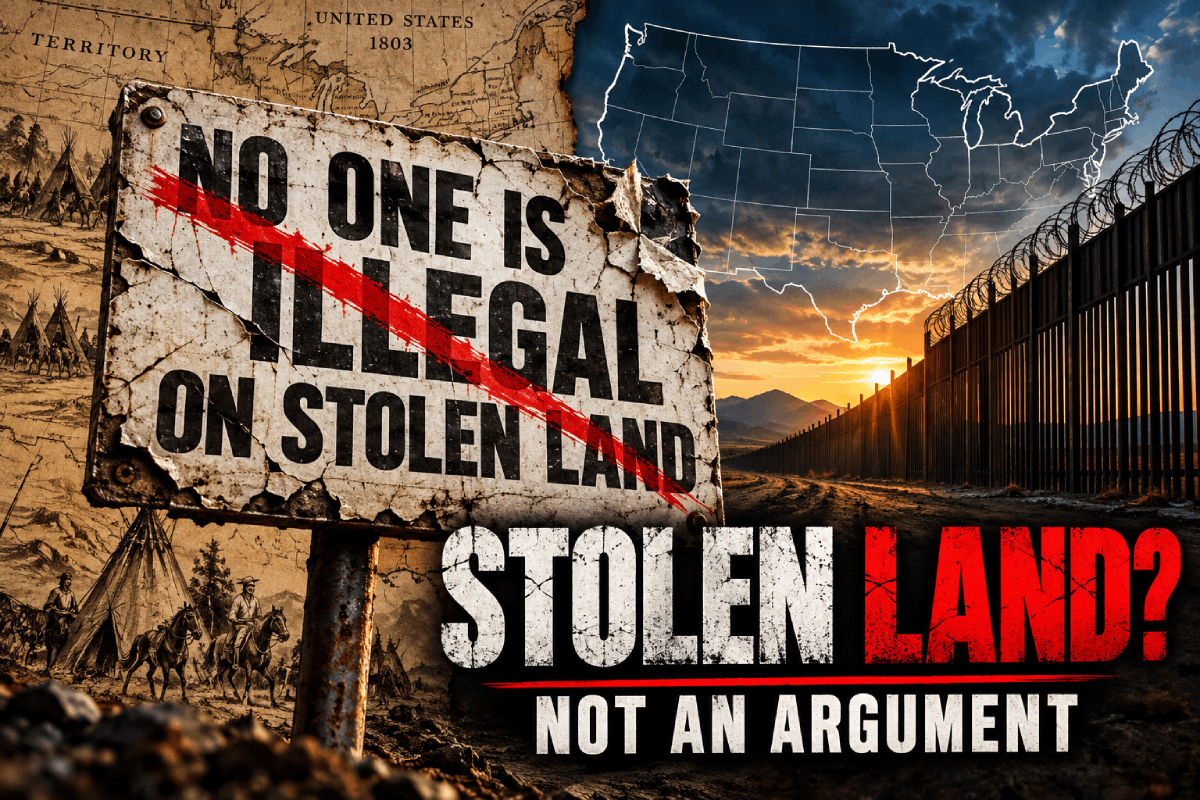
You’ve probably seen the bumper sticker: NO ONE IS ILLEGAL ON STOLEN LAND. It usually comes with a smug little sense that somebody just delivered the intellectual equivalent of checkmate, except that when you stop and think about it for more than a second, what the hell does that even mean?
At first glance I understand the argument. Native Americans were absolutely screwed over through large parts of American history, with forced removals, broken treaties, wars, and land taken through policies we would rightly consider appalling today, and the Trail of Tears actually happened. Pretending every square mile of the United States changed hands through a pleasant little real-estate closing where everybody shook hands afterward would be historically ridiculous, which ought to be obvious to anyone. It still has nothing to do with whether somebody can illegally enter the United States today, and that’s the part where this bumper-sticker philosophy drives straight through the guardrail.
As far as I can tell the argument goes something like this: some land that eventually became the United States was acquired unjustly, so the United States has no legitimate authority over its territory, so its borders aren’t legitimate, so nobody can enter illegally. I count about seventeen missing steps between the first claim and the last.
And if conquest, displacement, war, annexation, migration, or territorial disputes permanently invalidate the sovereignty of whatever country exists there today, then congratulations, you’ve just abolished most of the borders on planet Earth. Human history is basically 10,000 years of people moving somewhere and fighting somebody who was already there. Territory got lost and won, treaties got signed and broken, countries were formed and destroyed and merged and divided, and every so often someone decided they owned a place because they’d planted a flag in it. None of that is peculiar to America; it’s simply the history of everywhere. Which doesn’t mean everything that happened was morally acceptable, a distinction that seems to get lost constantly.
You can say, “The United States treated Native tribes horribly in numerous instances,” and you’d be right. Point out that “The federal government violated agreements and forcibly displaced people,” and that’s true too. You could argue that specific treaty obligations should still be honored, that tribal sovereignty should be respected, or that particular historical wrongs deserve remedies, and those would all be actual arguments. But “therefore nobody can illegally enter Arizona in 2026” doesn’t follow from any of them.
We have immigration laws. If you think those laws should be changed, or that immigration should be easier, or you genuinely believe in open borders, fine, make that argument. What you don’t get to do is hide behind some historical reset button, where saying “stolen land” makes the whole concept of national sovereignty disappear whenever it becomes politically inconvenient.
Then there’s the question nobody on the bumper-sticker side seems to ask: if the United States has no legitimate claim to territory because people once took territory from somebody else, who gets it? Which nation, which tribe, and at what point in history do we freeze the map? Native America wasn’t one enormous peaceful country called “Native America.” Long before Europeans ever arrived it held hundreds of distinct peoples and cultures, each with its own alliances and enemies, its own territories, migrations and wars, and boundaries that kept shifting.
So whose border counts: the one from 1491, or 1200, or 500, or yesterday afternoon? History doesn’t come with a magical save point we can reload where everybody was standing on the land God assigned them at the beginning of time.
Borders are human creations, and so are nations and laws, but they exist all the same. Under current American law there are lawful and unlawful ways for noncitizens to be present in the country, and calling that reality offensive doesn’t make the statute disappear.
If what you actually want is different immigration laws, argue for different immigration laws. The same goes for greater recognition of Native treaty rights, and I’m happy to talk honestly about historical atrocities with anyone who wants to. But what “No one is illegal on stolen land” amounts to is three separate arguments wearing a trench coat and pretending to be one, which is a long way from some deep dismantling of the concept of borders, and putting it on a bumper sticker doesn’t fix the logic.