Gun Control Is the Fantasy of People Who Think Criminals Obey Signs
Gun control is what happens when the people who know the least about firearms demand authority over the people who know the most.
It gets sold under the soothing label of “common sense gun control,” as if disagreeing with it proves you have no common sense. But scrape off the focus-tested slogan and you’re left with the same tired proposition:
The law-abiding citizen has to surrender more freedom because the criminal won’t obey the freedoms already taken away.
That’s not common sense.
That’s just stupid.
Criminals Don’t Shop Off the Legal Menu
Every gun-control proposal should have to answer one question before anything else:
How does this take guns away from criminals?
Not from hunters. Not from veterans. Not from competitive shooters. Not from the woman carrying because her ex told her he’d kill her. Not from the homeowner who knows the cops are several minutes away when somebody kicks in his door.
From criminals.
The Justice Department’s own survey of people locked up for crimes committed with a gun found that 90% didn’t get that gun from a store, and 99% didn’t get it at a gun show. They got them the way criminals get everything … theft, the black market, trades, a buddy who knows a guy.
So naturally the political response is another restriction on the retail buyer. The one who fills out the paperwork, shows his ID, sits through the background check, and follows every rule.
The criminal walks around and completely ignores the system.
The government responds by making the system harder for the guy who used it.
Then it pats itself on the back for “doing something.”
That’s not crime prevention. It’s theater, performed at the expense of people who had nothing to do with the crime.
A Sign Is Not a Force Field
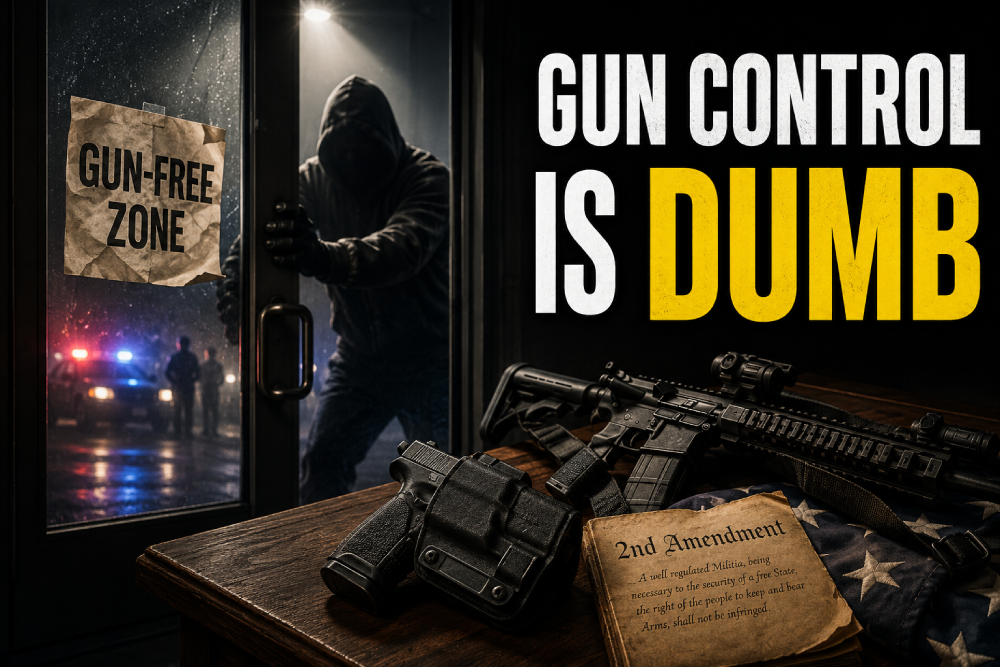
The “gun-free zone” might be the purest version of the fantasy. Somebody prints a sign, tapes it to a door, and decides the building is now protected.
Protected by what? The ink? The tape? The moral authority of the property-management committee?
A rule works on people who intend to follow rules. It does exactly nothing to physically stop someone who has already decided to commit murder.
The sign doesn’t detect a weapon. It doesn’t tackle an attacker. It doesn’t return fire. All it does is announce that the responsible people inside have probably been disarmed… Read that again.
That doesn’t mean every building should be the Wild West. It means a policy is not a security system. Declaring a place safe is not the same as making it safe.
A sign without enforcement is a wish taped to a wall.
The “Good Guy With a Gun” They Pretend Not to Believe In
Gun-control advocates love mocking the phrase “good guy with a gun.” They sneer at the idea that an armed citizen might stop a violent attacker.
Then violence starts, and what do they do?
They dial 911 and beg the government to send several good guys with guns.
Apparently the concept only becomes legitimate when the armed person is wearing a government-approved costume.
We arm the police because we already agree on the basic truth: determined violence sometimes has to be met with immediate, capable force. That question is settled. We settled it the day we handed cops guns.
The actual disagreement is whether ordinary people should be forced to stay helpless until those armed agents show up.
And they can’t always show up. Police can’t teleport into your bedroom, your business, your church, or your car. They arrive after somebody notices the danger, finds a phone, makes the call, explains the situation, and waits for dispatch.
That’s not an insult to cops. It’s time, distance, and physics. When your life can end in seconds, help is a few minutes away.
The gun exists to give an innocent person a fighting chance in the gap between the two.
Guns Are Tools, Not Demons
A firearm is a machine. It isn’t possessed. It doesn’t whisper. It doesn’t crawl out of the safe at night to go commit crimes.
It can be used to murder. It can also protect a home, stop an assault, put food on the table, drop a predator, win a match, or defend a country. Its morality comes entirely from the person holding it.
Pretending otherwise is childish. It’s the political version of blaming the hammer and ignoring the guy swinging it.
The answer to dangerous people is to identify and stop dangerous people with evidence, due process, and actual enforcement. The answer is not to declare millions of peaceful citizens presumptively dangerous because they own an object that scares politicians.
The Scary Black Rifle
Nothing exposes the ignorance faster than the obsession with black rifles.
Bolt on some black polymer, a pistol grip, an adjustable stock, and a detachable magazine, and suddenly an ordinary rifle becomes a demonic “weapon of war.” Swap the furniture for polished walnut and a lot of the same people calm right down.
That’s not firearms policy. That’s interior decorating.
The AR-15 gets attacked mostly for how it looks. Its appearance has become a substitute for understanding how it actually works. The same people who describe a .223 as some unimaginably powerful battlefield round usually have no idea how it stacks up against ordinary hunting ammo.
Here’s the perspective they skip. Winchester lists a 55-grain .223 load at about 1,282 foot-pounds of muzzle energy. Their 150-grain .308 comes in around 2,648, and the 150-grain .30-06 at roughly 2,839. Loads vary, but the supposedly apocalyptic .223 is plainly weaker than the traditional deer rifles nobody is scared of.
But the .223 rifle is black. It’s got rails. It looks mean on TV.
So politicians who couldn’t identify a bolt carrier if you set one in their palm demand the authority to decide which guns knowledgeable adults are allowed to own.
They don’t regulate by mechanics. They regulate by aesthetics, fear, and polling.
“Shall Not Be Infringed” Wasn’t a Suggestion
The Second Amendment says:
“A well regulated Militia, being necessary to the security of a free State, the right of the people to keep and bear Arms, shall not be infringed.”
That’s the text. The Supreme Court has recognized it protects an individual right to keep and bear arms for self-defense in District of Columbia v. Heller and again in New York State Rifle & Pistol Association v. Bruen.
That doesn’t mean no regulation can ever exist. Rights have legal edges, and dangerous people can be disarmed through lawful process. But it does mean the government starts from a constitutional restriction on its own power.
The citizen doesn’t have to prove a special need to exercise a right. The government has to justify taking it away.
Calling an infringement “common sense” doesn’t stop it from being an infringement. Neither does relabeling a commonly owned rifle an “assault weapon,” or pretending cosmetic features determine lethality, or demanding you explain why you “need” a particular gun.
You don’t have to prove a need for free speech. You don’t have to prove a need for a lawyer. You don’t have to prove a need to be free of unreasonable searches.
A right you have to get government permission to use isn’t a right. It’s a privilege.
Use History Honestly — Then Actually Learn From It
The lazy version of the history argument goes: Nazi Germany passed gun control, then the Holocaust happened, checkmate.
History is more complicated than a bumper sticker, and a bunch of civilian rifles wouldn’t have stopped the German army from rolling over Poland. Let’s be honest about that.
But history still teaches something.
During the Warsaw Ghetto uprising, Jewish fighters took on the SS and German police with Molotov cocktails, grenades, and a handful of small arms. The Germans had overwhelming superiority and it still took them nearly a month to put the resistance down.
The lesson isn’t that a rifle guarantees you beat tyranny. It doesn’t.
The lesson is that an unarmed population has fewer options when persuasion, the courts, and the political system have all failed.
Arms don’t guarantee liberty. But history is not exactly overflowing with examples of the state monopolizing all force and powerless minorities ending up safer for it.
The Second Amendment exists for the ugly possibilities. For the moment every civilized safeguard has broken down and the government, the mob, or the criminal no longer cares about your rights.
A fire extinguisher doesn’t guarantee your house survives a fire. That’s not an argument for throwing it out.
Look at What Other Countries Call “Freedom”
Americans get told constantly to be more like Europe.
Thirty years after clamping down on civilian gun ownership, some of those same European governments now enforce speech laws that would be constitutionally unthinkable here. In the United Kingdom, prosecutors keep official guidance for “grossly offensive” electronic communications, and people have genuinely been convicted and sentenced over social-media posts.
That doesn’t prove gun restrictions caused speech restrictions. It proves something more basic: those governments don’t share the American assumption that your rights exist above ordinary political convenience.
Rights erode. Culture shifts. Things that used to be none of the government’s business become regulated, investigated, and prosecuted.
The First Amendment protects the soapbox. The Second Amendment makes sure the government remembers who owns it.
Nearly 400 Million Reasons Confiscation Is a Fantasy
Then there’s the logistics.
The Small Arms Survey put civilian-owned firearms in the United States at roughly 393 million as of 2017. So let’s drop the euphemisms and talk about how “getting the guns off the street” would actually work.
Voluntary surrender collects guns from people willing to comply. The criminals won’t. A whole lot of ordinary owners won’t either.
Then what? Registration? Warrants? Home inspections? Informants? Cops sent door to door? Prison for the people who say no?
At some point “gun control” stops being a slogan and becomes an armed government agent physically trying to take a gun from someone who does not consent. That’s the part advocates never want to say out loud.
They talk like hundreds of millions of guns are going to quietly evaporate the second Congress passes the right combination of words. They won’t.
Confiscation requires confiscators. And sending armed agents to disarm millions of citizens creates the exact coercive confrontation the Second Amendment was written to deter.
Start Punishing the People Actually Committing the Crimes
There are things a government can genuinely do. None of them involve disarming the innocent.
Prosecute violent repeat offenders like you mean it. Punish illegal possession by people already prohibited through due process. Go after traffickers, thieves, and straw purchasers. Fix the reporting of genuinely disqualifying records. Build real crisis intervention that doesn’t treat everyone who asks for help as a future criminal. Provide actual security where credible threats exist. Teach firearm safety instead of cultivating ignorance. Hold prosecutors and judges accountable when dangerous offenders keep getting turned loose.
All of that focuses on conduct and dangerousness. And all of it is hard. It means investigating individuals, proving cases, enforcing laws already on the books, and telling dangerous people apart from peaceful ones.
Blanket restrictions are easier. They let officials avoid the criminals entirely and regulate the people who are easy to find, easy to monitor, and unlikely to shoot back.
Law-abiding gun owners make convenient targets precisely because they’re law-abiding.
Stop Treating Liberty Like a Disease
Gun-control advocates keep treating the law like a magic spell. Write another prohibition. Print another sign. Ban another feature. Cap another magazine. Build another database. Surely evil obeys this time.
But laws don’t physically protect anybody. People protect people. Tools help them do it.
The firearm is the tool that lets the old resist the young, the weak resist the strong, the woman resist the man, the lone homeowner resist the mob and the citizen stay something more than a subject.
You’re free to dislike guns. You’re free to fear them. You’re free to decide you never want one in your house.
What you’re not entitled to do is turn your fear, your discomfort, or your ignorance into helplessness imposed on everybody else.
My rights don’t depend on your comfort. My ability to protect my family doesn’t depend on your understanding of ballistics. And my gun doesn’t become illegitimate because a criminal somewhere used a different one to do something evil.
You don’t stop criminal violence by disarming the innocent.
You don’t protect liberty by banning the tools that preserve it.
And you don’t get safer just because the government promised that someone with a gun will eventually show up.
Audio note: The narration accompanying this piece is an AI-generated tribute to the style and delivery of Ryan Reynolds. It is not an authentic recording of Ryan Reynolds and is not affiliated with, endorsed by, or authorized by him, his representatives, or any associated rights holders. Love you, Ryan. Please don’t sue me.