The Dead Internet Theory Was Wrong. Then We Built It.
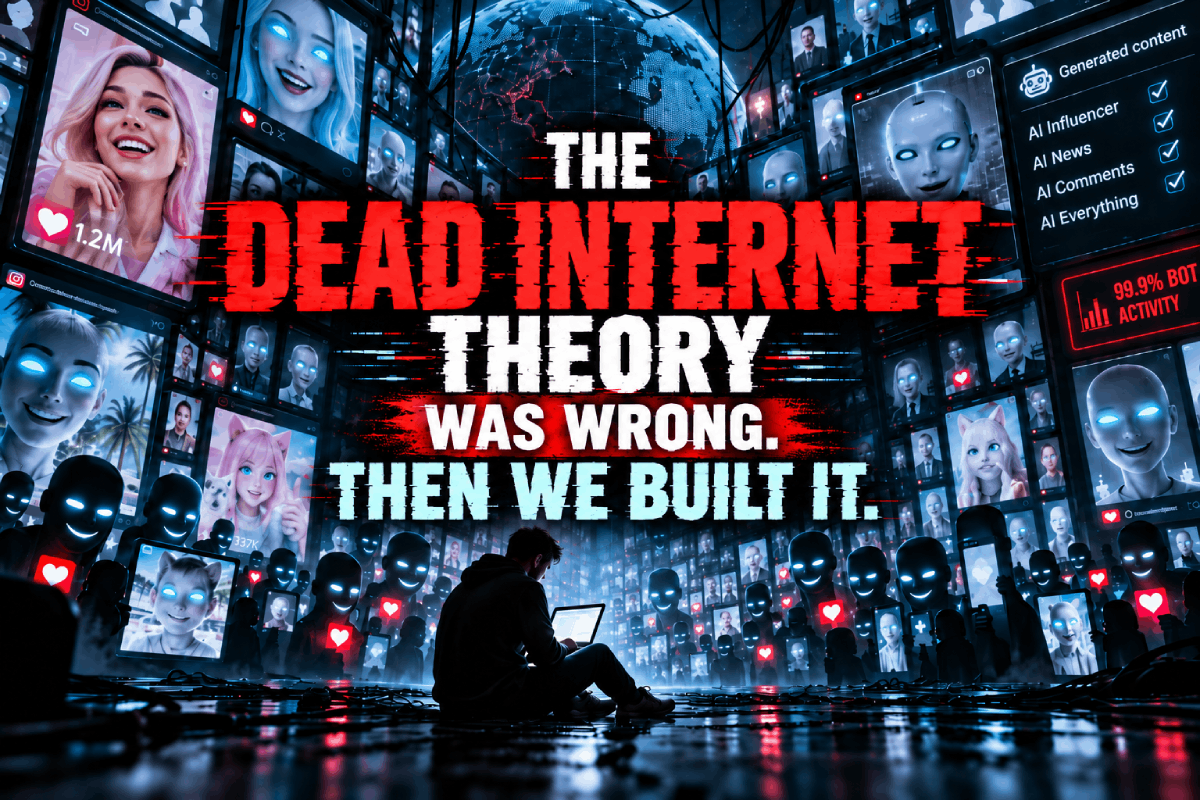
At first glance, the Dead Internet Theory sounds like the sort of thing you’d hear at 3:00 in the morning from a guy in a bathrobe who’s also trying to explain that the CIA replaced his neighbor with a chatbot.
The theory started out in the weird corners of the internet and broke into wider public view around 2021. Its claim was basically that the internet had already died. Believers put the date somewhere around 2016 or 2017, when the web supposedly stopped being mostly humans talking to humans and turned into an elaborate synthetic ecosystem of bots, fake accounts, manufactured trends, automated content and algorithms manipulating whatever actual people were left.
Some versions went a lot further and dragged governments, corporations and intelligence agencies into it, which is usually where normal people rolled their eyes and moved on. Honestly, that was probably the reasonable response.
The trouble is that the theory may have been wrong for the right reasons. There’s no evidence the internet secretly died in 2016, but in the years since, we’ve built a lot of the exact things the theory said already existed.
The Ridiculous Part Stopped Being Ridiculous
Back in 2021 the theory had an obvious hole: where was this magical artificial intelligence that was supposedly churning out believable human content at enormous scale? ChatGPT didn’t exist. Normal people weren’t sitting around using AI to generate articles, photographs, videos, music and human-sounding conversations.
Then November 2022 happened, and suddenly the ridiculous part wasn’t ridiculous anymore.
To be clear, the internet is not literally dead. Billions of actual human beings are online, and there’s no credible evidence that nearly everyone you interact with is secretly a bot. But that isn’t the interesting argument anymore.
The interesting question is whether enough of the internet has become synthetic, automated or manipulated that apparent online activity can no longer reliably be treated as evidence of actual human activity. That one is much harder to laugh off.
Most Web Traffic Isn’t Human Anymore
Imperva’s 2025 Bad Bot Report found that automated traffic accounted for 51% of all web traffic in 2024, compared with 49% generated by humans. Bad bots made up 37%, and legitimate automation like search crawlers accounted for another 14%.
No, that doesn’t mean half the people on Facebook are robots. Search engines, security scanners, monitoring software and AI crawlers all count as automated traffic, and traffic is not people.
Still, it’s worth noticing that we’ve crossed a fairly bizarre line. For most of the internet’s history, machines existed mainly to serve information to humans, and now human requests are the minority of what’s hitting the web. That doesn’t prove the Dead Internet Theory, but it does make the name feel a little less stupid.
Then AI Started Writing the Internet
Pew Research Center analyzed nearly half a million English-language webpages in 2026 and found significant signs of AI authorship or editing on about 10% of the whole sample. That sounds fairly small until you remember how much of the internet predates modern generative AI. When Pew looked only at pages published after ChatGPT launched, more than one-third showed significant signs of AI authorship.
Other analyses have come up with even bigger numbers. Ahrefs estimated that roughly three-quarters of the newly discovered pages it analyzed contained at least some AI-generated material, though only a small fraction looked entirely AI-written.
You can argue about the exact figure, because AI detection is imperfect. You can’t really argue about the direction: almost overnight, AI got involved in producing enormous amounts of web content.
And you’ve probably already seen the results. Facebook is full of impossible log cabins, 147-year-old grandmothers celebrating birthdays alone, veterans with seventeen fingers, children supposedly building magnificent sculptures out of trash and, of course, Jesus made out of shrimp. Underneath are thousands of likes and comments saying “Amen,” “Beautiful,” and “God bless.”
Are those commenters human? Some obviously are. All of them? How the hell would you know?
That’s the real issue. The entire internet doesn’t need to become fake. It only needs enough uncertainty that social proof stops being reliable.
Fake Engagement Is Already Industrial Scale
Meta says it removed more than 100 million fake Facebook Pages involved in scripted-follow abuse in 2024, along with tens of millions of impersonating profiles. Reddit said in 2026 that its automated systems were revoking nearly two million fake votes every day.
Think about what that means for Reddit, whose entire model is social voting. A post gets upvoted and rises, and everyone else reads that number as evidence that real people found it interesting, useful or correct, while Reddit is apparently throwing out roughly two million attempts a day to rig the system.
The platforms aren’t fake. But likes, shares, votes, followers and comments are becoming shakier and shakier proxies for what humans actually believe, and that matters because humans take their cues from other humans. A restaurant with a line must be good. A video with ten million views must be important. An opinion with 80,000 likes must have broad support. So what happens when “everybody” isn’t everybody?
Sometimes fake engagement isn’t trying to convince you directly at all. It only needs to convince you that everyone else has already been convinced.
AI Makes Fake People Cheap
Fake accounts aren’t new. What AI changes is the economics.
A convincing fake persona used to take work. Somebody had to create the profile, find a photograph, write the bio, make posts, respond to comments and keep the account alive. Now AI can generate the profile picture, the bio, the posts, the replies, the images and the translations, and it can vary its writing style and operate across dozens of languages.
OpenAI has already documented influence operations using AI to create fake personas, generate social-media posts and even reply to their own content so it looks like a discussion is happening. Some of those operations were surprisingly ineffective, which is genuinely good news.
It’s also darkly hilarious. We now have documented cases of artificial intelligence writing content for fake people, who then respond to their own fake content so the fake conversation looks popular. We’re building a gigantic machine that congratulates itself.
We Have Industrialized Bullshit
This may actually matter more than bots pretending to be people.
Generative AI has collapsed the cost of producing plausible content. Before AI, even shitty websites needed somebody to write the shitty articles. Now you can tell software to produce hundreds of articles about lawn mowers, tune them for search engines, create the images and write the promotional social posts, and the person running the site doesn’t need to know a single thing about lawn mowers.
So we’ve built an information economy where bullshit is dramatically cheaper to manufacture than truth. Truth has overhead: you have to research it, verify it, read documents, interview people, run experiments or actually understand the subject. Bullshit only has to sound plausible, and AI is exceptionally good at plausible.
Then AI Starts Eating AI
Modern AI systems learned largely from human-created material like books, websites, forums, code, scientific papers, documentation and conversations. Human civilization accidentally spent decades building the greatest training dataset in history, and AI learned from it.
Now AI is writing the internet. And what trains the next AI? The internet.
So AI learns from humans and creates content, which goes online, where another AI scrapes it and learns from AI-generated material. That model’s output goes back online too, and the next model eventually runs into it. It’s the information equivalent of photocopying a photocopy of a photocopy until grandma’s face looks like weather radar.
Researchers have already demonstrated something called model collapse, where repeatedly training systems on recursively generated synthetic data can gradually reduce diversity and amplify errors. That doesn’t mean synthetic data is inherently bad. The danger is in training on it indiscriminately, and the public internet is about as indiscriminate as humanity has ever managed to make anything.
What Happens to the Human Internet?
This is the part I find most depressing.
The old internet was an enormous, distributed record of human experience. You could search for some bizarre mechanical problem and find a guy named Larry on a forum in 2007 who had exactly the same problem and explains that the fucking ground wire behind cylinder six corrodes.
Larry is what made the internet magical. He wasn’t chasing engagement, building a brand, setting up a funnel or trying to become an influencer. Larry had a busted boat, Larry fixed the boat, and then Larry told you how he fixed it. That was the human internet.
Now Larry is buried under seventeen thousand AI-generated articles titled 10 Common Reasons Your Boat Won’t Start — Number Seven Will Surprise You. We aren’t simply adding more information. We’re changing the signal-to-noise ratio of civilization’s largest information system.
The Internet Doesn’t Have to Be Dead to Become Haunted
So is the Dead Internet Theory true? Not in its original maximalist form. There’s no credible evidence that nearly everybody online is fake, or that the internet secretly died in 2016.
But look at what we have now. More web traffic is automated than human. AI-generated content is rapidly filling the web. Platforms remove staggering quantities of fake accounts and manipulated engagement, and influence operations use AI to create fake personas and fake conversations. Algorithms decide which pieces of all that actual humans get to see. And AI-generated material is increasingly flowing back into the same information system future AI models may learn from.
None of it needed a secret meeting, a giant government supercomputer or a conspiracy, just economics, automation, algorithms, incentives and scale, which may actually be creepier.
Nobody sat down and deliberately built the Dead Internet. We built systems that rewarded engagement and then automated the engagement, and we did the same thing with content, and again with popularity. Then we built systems that learned from the internet and let them start writing the internet they’d eventually learn from.
Each of those decisions was perfectly reasonable when somebody made it, and yet here we are at the end of them, staring at a screen with a pile of questions we can’t answer. Was this article written by a person? Did the photograph ever happen? Maybe the reviews were bought and the comments generated, and the likes aren’t real, and the topic never actually trended. For all we know, the asshole screaming at us from the other side of an argument doesn’t even fucking exist.
That’s the part the original Dead Internet people got right: an internet full of information isn’t necessarily an internet full of people.
Maybe the internet didn’t die in 2016, and maybe it isn’t dead today. But we’re quickly building a world where artificial evidence of human activity is cheaper to manufacture than the human activity itself. If machines write the articles, generate the pictures, create the accounts, post the comments, manufacture the engagement and eventually train on the internet that results, there may still be billions of humans online. We’ll just be the weird minority wandering around wondering who the hell we’re talking to.