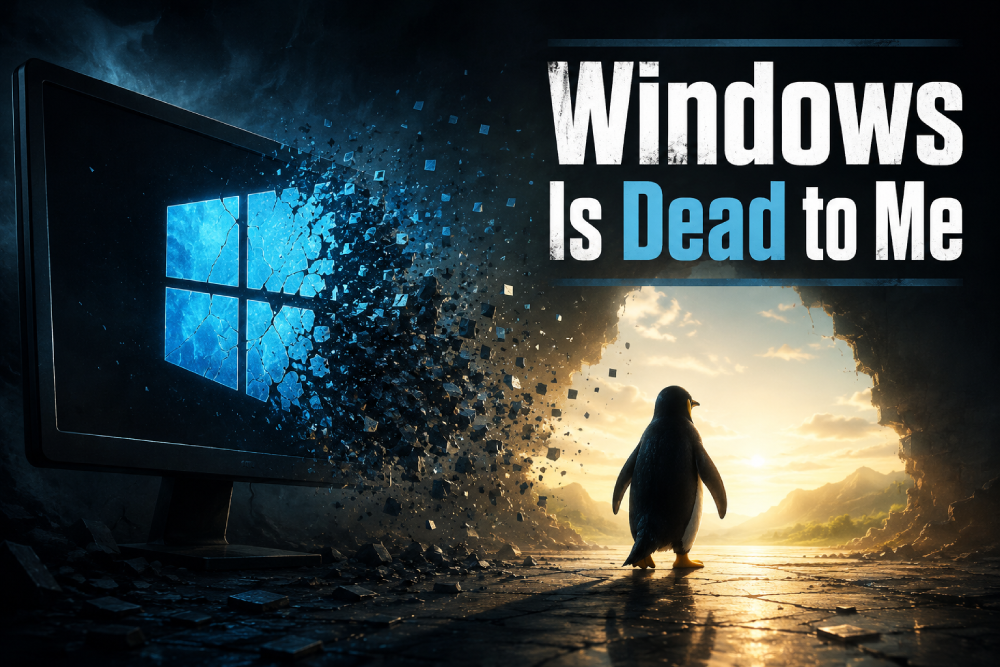
Windows Is Dead to Me
Microsoft didn’t lose me in one giant disaster. It lost me the way companies usually lose customers: one small insult at a time.
A nag here. A forced account there. A Start menu that feels less like a tool and more like a billboard. A “feature” nobody asked for. Another AI button. Another privacy concern. Another reminder that the operating system I paid for doesn’t really feel like mine anymore.
At some point, you stop arguing with it. You just leave.
The Last Excuse Is Gone
For years, Windows had one unanswerable argument: gaming.
Sure, Linux was cleaner. Sure, it was lighter. Sure, it respected the user and didn’t feel like it was constantly trying to upsell, herd, track, or monetize you. But if you wanted to play games, the answer was simple. You ran Windows. That was the deal.
Well, that deal is over.
Steam and Proton changed the math. The Steam Deck changed the expectations. Linux gaming went from “technically possible if you hate yourself” to “honestly, this just works more often than I expected.” It’s not perfect … some anti-cheat garbage is still a problem, and some games still need tinkering. But the old excuse is dead.
Windows is no longer the gatekeeper of PC gaming. And once that wall fell, I had to ask the obvious question: why am I still putting up with this?
A Master Class in Burning Goodwill
Windows 11 took an OS people already tolerated more than loved, then made the upgrade path more annoying, more restrictive, more account-dependent, more cloud-dependent, and somehow more needy.
Instead of making Windows feel fast, clean, private, and user-controlled, Microsoft decided the future was ads, nags, AI branding, and pretending every desktop needs to become a subscription-flavored assistant platform.
Copilot everywhere. Recommended apps. Microsoft account pressure. Hardware requirements that turned perfectly useful machines into “unsupported” machines. Search that forgot its job was to search your computer… The list goes on.
The whole thing feels less like an operating system now and more like a shopping mall with a kernel.
And the bloat isn’t theoretical. On my machine, Windows can sit there doing absolutely nothing and still chew through 5 or 6 GB of RAM like it’s proud of itself. Fresh boot. No real work happening. Just Windows existing, breathing heavily in the corner.
CachyOS, meanwhile, idles low and feels like it actually remembers what an operating system is supposed to be. An OS should not be the heaviest application on the computer. It should not be the first enemy you have to defeat before you launch the thing you actually wanted to use.
Windows has become the cover charge to use your own hardware.
The Hardware Lockout
Windows 11 has minimum system requirements. Not “this might run poorly on old hardware” requirements but actual gates. TPM. Secure Boot. Supported CPUs. Enough of Microsoft’s blessing to decide whether your perfectly usable computer is worthy of continuing to exist.
Linux can run on a potato. It doesn’t treat old hardware like garbage by default. Will every distro run beautifully on a museum piece? No, modern Ubuntu with a heavy desktop is not magic. But Linux gives you choices. Mint, XFCE, LXQt, Debian, Arch, antiX, Puppy, and a pile of lightweight distros can keep machines useful long after Microsoft has decided they belong in a landfill.
That’s the difference. Microsoft says, “Buy a new machine.” Linux says, “Let’s see what this thing can still do.” And that’s huge!
Doing More Around Me, Not For Me
Windows 11 doesn’t feel “modern” or “feature rich.” It feels heavy.
It’s the operating system equivalent of a suitcase packed by a committee. Every department got to throw something in. Ads. Widgets. Teams. OneDrive nagging. Edge nagging. Copilot. Cloud sync. Background services. Telemetry. Search results from the internet when I’m trying to find a file on my own machine.
It’s bloated in the most insulting way possible: not because it’s doing more for me, but because it’s doing more around me.
And now Microsoft wants AI embedded into the whole experience. Maybe that’s useful for some people. Fine. But I don’t want my operating system acting like an always-present assistant, integrated into my apps, my search, my screenshots, my workflow, my files, and my private desktop life.
Even when Microsoft swears the scary stuff is local, encrypted, opt-in, and totally not creepy, the problem is bigger than one setting. The problem is trust.
I don’t trust the company that already shoved ads into the Start menu to suddenly become a humble guardian of my private data. I don’t trust the company that keeps trying to drag me into accounts, Edge, Bing, OneDrive, and Copilot to respect the boundary between “my computer” and “their ecosystem.”
An OS Should Not Arrive With Homework
When a fresh install immediately sends people to Google searching for “things to disable after installing Windows 11,” something has gone badly wrong.
There should not be a whole cottage industry of articles explaining how to turn off the ads, the tracking, the recommendations, the telemetry, the cloud nags, the AI junk, the Start menu clutter, and the various little “helpful” features Microsoft sprinkled around like glitter on a crime scene.
I should not have to spend the first hour after installing an OS making it less annoying, less invasive, and less Microsoft. That’s not a quirk. That’s hostile by design.
And it tells you exactly what Microsoft thinks Windows is now. Not a clean tool. Not a stable platform. Not a trusted layer between you and your machine. It’s a funnel. A funnel into Microsoft services, into AI, into subscriptions, into data collection, into whatever quarterly strategy meeting decided the desktop needed more engagement metrics.
Windows used to feel like a platform. Now it feels like a negotiation.
A negotiation over my privacy. Over my hardware. Over my defaults. Over my attention. Over whether the machine in front of me is actually mine. I’m tired of negotiating with my own computer. You want a good laugh, look at how they rebranded the computer from “My Computer” to “This Computer” in the last OS. Yeah.. We noticed.
Momentum Is Not Love
Microsoft will be fine for a while. Of course it will. Windows has decades of momentum. Corporations, governments, schools, and businesses move slowly, with legacy software, support contracts, compliance rules, and employees who just need Excel to open.
Momentum is real. But momentum is not love. It’s not trust. It’s not loyalty. Momentum is just the distance something travels after it stops steering. Even icebergs eventually come to a stop.
That’s where Windows is for me now. Not dead in the market-share sense but completely dead in the personal sense. Dead as something I recommend. Dead as something I enjoy. Dead as something I trust to stay out of my way.
So I Moved to CachyOS
Not because Linux is perfect. It isn’t. I know I’m going to hit weird driver issues. I know some things will need command-line archaeology. I know there will be moments where I mutter, “This would have taken thirty seconds on Windows.”
Fine. At least when CachyOS annoys me, it’s usually because something is genuinely complicated. Windows annoys me because a trillion-dollar company made a choice.
That’s the difference. One is friction. The other is contempt.
I’d rather fight with a system that respects me than be smoothly guided through a system that sees me as a product, a target, a metric, or a captive audience.
So that’s it. Windows can keep its Copilot buttons. It can keep its ads, its nags, its artificial requirements. It can keep trying to turn a computer I own into a terminal I rent, but at this point it has failed. Because I’m done. Windows is dead to me.